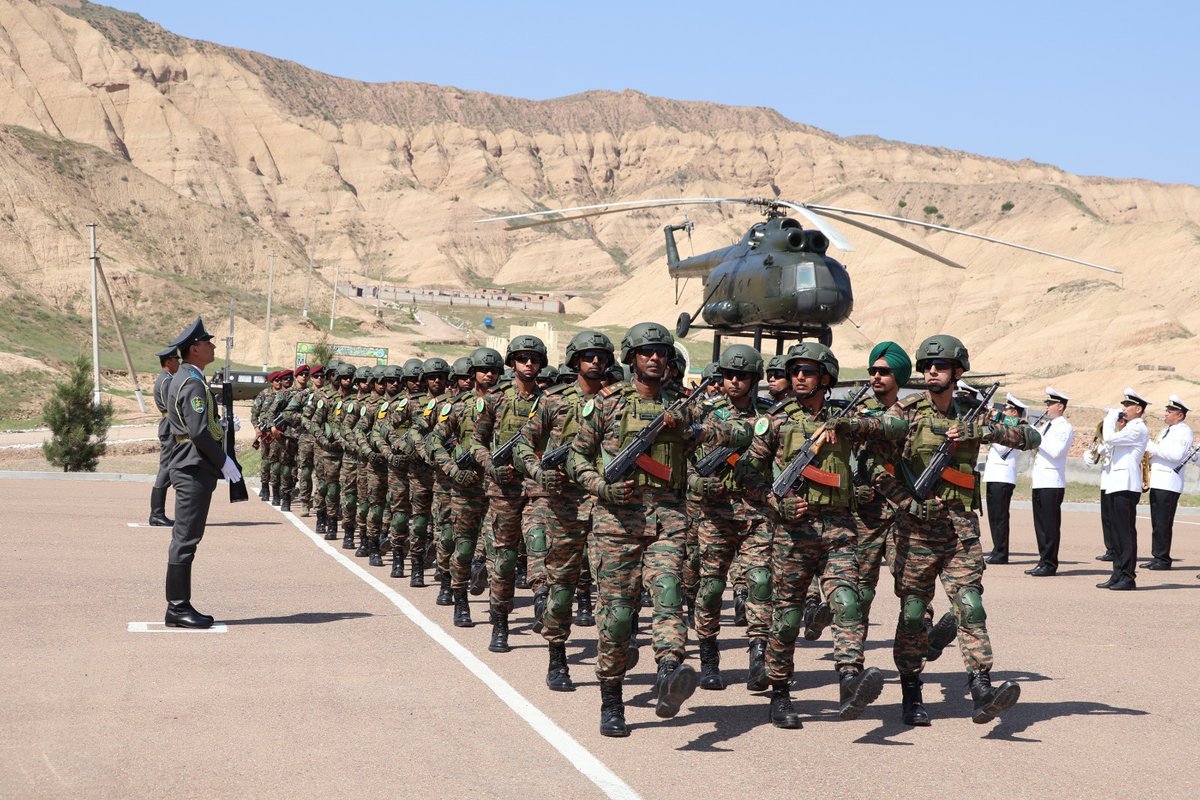
New Delhi: The seventh edition of the annual bilateral Exercise Dustlik is currently underway at the Gurumsaray Field Training Area in Namangan, Uzbekistan, underscoring the deepening defence partnership between India and Uzbekistan in an increasingly complex regional security environment.
The joint drill, which commenced on April 12 and will run until April 25, brings together contingents from the Indian Army and Uzbekistan Army to focus on joint special operations, with a particular emphasis on the neutralisation of unlawful armed groups. This year’s iteration marks another step in the maturing military-to-military ties between the two nations, alternating host countries as per established practice. The previous edition was held in April last year at the Foreign Training Node in Aundh, Pune.
According to official statements from the Indian Army, the exercise is designed to enhance operational synergy through the exchange of Tactics, Techniques, and Procedures (TTPs), seamless integration of niche technologies, and the sharing of best practices in counter-terrorism and special operations. Training activities include ambidextrous firing, reflex shooting, employment of unmanned aerial vehicles (UAVs), urban operations, combat casualty evacuation, reconnaissance, sniper drills, and basic mountaineering skills tailored to the semi-mountainous terrain of the training area.
The Indian contingent comprises approximately 60 personnel, including troops from the Mahar Regiment and elements from the Indian Air Force, training alongside an equal-sized Uzbek force. Endurance-building activities form an integral part of the schedule, testing physical and mental resilience under demanding conditions. Beyond tactical drills, the exercise incorporates cultural interactions aimed at fostering greater camaraderie, mutual trust, and long-term defence cooperation between the two armies.
Defence analysts view ‘Exercise Dustlik’ as a key pillar of India’s broader engagement with Central Asian republics. In a region marked by evolving threats from terrorism, extremism, and instability, such joint training builds critical interoperability and prepares forces for collaborative responses in real-world scenarios. The inclusion of tri-services integration elements further reflects the growing complexity of modern joint operations.
Exercise Dustlik, which began in 2019, has steadily expanded in scope with each edition. By providing a structured platform for professional military exchange, it contributes not only to bilateral readiness but also to broader regional stability and the shared commitment of both nations to global peace and security.
As the exercise progresses through its final phase, observers expect participating troops to demonstrate enhanced coordination in planning and executing complex special operations under a unified command framework. Upon conclusion on April 25, the drill is anticipated to yield valuable lessons that will further strengthen the strategic partnership between New Delhi and Tashkent.
This edition of Dustlik arrives at a time when both countries continue to prioritise robust defence diplomacy amid shifting geopolitical dynamics in Eurasia.
‘Defence Chronicle’ will provide further updates as the exercise concludes.

contact: drrajeshjauhri@gmail.com
Dr Rajesh Jauhri is a Journalist with an experience of over 25 years in Indian and foreign media, a Social Scientist, an Ac-complished Author, a Political & Strategic Analyst, a Marksman (Rifle & Pistol), an Orator, a Thinker and an Educationist. He holds a Ph.D. degree on “Impact of colonial heritage on Indian police”. He runs an NGO dedicated to the social and eco-nomic uplift of tribal communities in MP and two decades back, he established a school in a village of Indore district, providing education and moral values to children belonging to underprivileged and minority families. Has received multiple awards in various fields.