

Imphal, Manipur: In a horrifying escalation of violence that has left residents reeling, suspected militants from the United Kuki National Army (UKNA) hurled a bomb at a private residence in Bishnupur district on April 7, killing a five-year-old boy and his six-month-old sister outright while critically injuring their mother. The targeted attack on an ordinary family home has sent shockwaves through the state, transforming grief into widespread public anger and reigniting demands for decisive action against insurgent groups operating in the region.
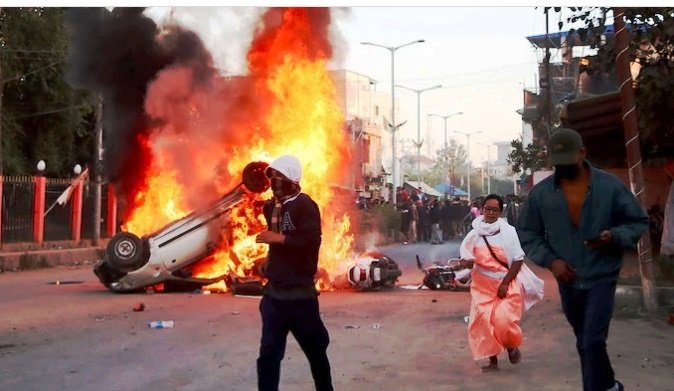
Protests erupted across the Imphal valley districts from April 9, drawing an unusually large number of children who joined sit-ins and torchlight rallies. Young participants were seen chanting slogans in solidarity with their slain peers, while adults demanded an immediate crackdown on militants and the restoration of safe passage along the state’s vital highways. The demonstrations, largely peaceful in the initial days, reflected a rare cross-generational mobilisation born of exhaustion with recurring cycles of ethnic bloodshed.
Tensions reached a boiling point on Thursday night in the Singjamei area of Imphal, where security forces used tear gas to disperse crowds after clashes broke out. Local authorities responded swiftly with a series of arrests, the imposition of curfews in sensitive pockets, and an extension of the existing internet blackout, an increasingly familiar measure aimed at preventing the rapid spread of inflammatory content. These steps, while necessary for immediate containment, have further strained civil liberties in a state already grappling with prolonged instability.
The latest tragedy unfolds against the grim backdrop of Manipur’s ethnic conflict, which erupted in May 2023 and has claimed more than 2,000 lives to date. What began as a dispute over land rights, political representation and affirmative action between the valley-dwelling Meitei community and the hill-based Kuki-Zo groups has morphed into a low-intensity civil war characterised by targeted killings, village burnings and the displacement of tens of thousands. Despite repeated appeals for dialogue and the deployment of central security forces, trust between communities remains fractured, and the rule of law continues to erode in several districts.
Defence analysts monitoring the north-eastern theatre note that the Bishnupur incident carries unmistakable strategic undertones. Manipur shares a porous 352-kilometre international border with Myanmar, a region plagued by its own civil war and a well-documented pipeline for small arms, narcotics and trained cadres. The UKNA, like several other Kuki insurgent factions, has historical links to camps across the border, raising legitimate questions about external sponsorship.
Senior officials in New Delhi have long expressed concern over the role of foreign powers in stoking unrest in India’s Northeast. Intelligence assessments have repeatedly pointed to the involvement of external actors, ranging from sympathetic diaspora networks in Europe and North America to state-level intelligence agencies seeking to exploit ethnic fault lines for geopolitical leverage. Arms smuggling routes through Myanmar’s Sagaing Region, coupled with the free movement of militants across unfenced stretches of the border, have allegedly provided both material and ideological oxygen to groups like the UKNA. While concrete evidence of direct foreign orchestration in the April 7 attack remains classified, the pattern is disturbingly familiar: civilian soft targets, symbolic timing and immediate amplification through social media to deepen communal polarisation.

contact: drrajeshjauhri@gmail.com
Dr Rajesh Jauhri is a Journalist with an experience of over 25 years in Indian and foreign media, a Social Scientist, an Ac-complished Author, a Political & Strategic Analyst, a Marksman (Rifle & Pistol), an Orator, a Thinker and an Educationist. He holds a Ph.D. degree on “Impact of colonial heritage on Indian police”. He runs an NGO dedicated to the social and eco-nomic uplift of tribal communities in MP and two decades back, he established a school in a village of Indore district, providing education and moral values to children belonging to underprivileged and minority families. Has received multiple awards in various fields.