



Defence Chronicle Team
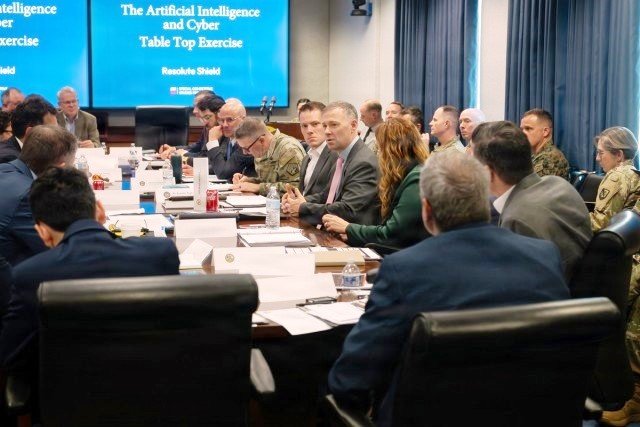
In a significant step toward modernizing military cyber capabilities, the US Army hosted its second Artificial Intelligence Tabletop Exercise (AI TTX 2.0) on April 27 at the Pentagon. The high-level event convened C-suite executives from 14 leading technology firms, including Amazon Web Services, Google, Microsoft, OpenAI, CrowdStrike, and Palo Alto Networks, alongside senior Army and Department of Defence officials.
Hosted by the Office of the Principal Cyber Advisor, with support from the Special Competitive Studies Project, US Cyber Command, Army Cyber Command, and the Army Cyber Institute at West Point, the half-day exercise focused on accelerating the adoption of agentic AI, autonomous systems capable of independent decision-making and action, to safeguard military networks against sophisticated threats.
Participants grappled with a realistic 2027 scenario involving an escalated Indo-Pacific crisis that triggered large-scale cyberattacks on US military infrastructure. Discussions cantered on two core challenges: deploying agentic AI tools to enhance defence across heterogeneous networks riddled with legacy systems, and addressing vulnerabilities stemming from uneven modernization. Unlike traditional AI that primarily detects anomalies; agentic systems are envisioned to autonomously neutralize threats, dramatically compressing response times in high-stakes environments.
Brandon Pugh, Principal Cyber Advisor to the Secretary of the Army, emphasized the urgency of this. He said that the exercise builds on the inaugural 2025 TTX, which launched Project ARIA to deliver AI capabilities to the tactical edge, automate administrative processes, and optimize supply chains. Army officials indicated plans to field and test initial agentic AI units soon, alongside development of a ‘Risk Continuum’ policy to govern autonomous operations, particularly in wartime.
This public-private collaboration underscores a broader Pentagon push to harness commercial innovation amid rapid AI evolution. By partnering with industry giants, the Army aims to build a resilient, AI-driven defence posture capable of countering peer adversaries in contested cyber domains.
Global Context: Comparative Efforts in India, Russia, and China
The U.S. initiative does not exist in isolation. Peer competitors are pursuing parallel, though distinct, paths in military AI and cyber defence.
India is advancing an ambitious ‘Aatmanirbhar (self-reliant) AI strategy for its armed forces. A new tri-services AI policy endorses lethal autonomous weapons, drone swarms, and AI-enabled cyber defences, including malware detection for avionics and maritime systems. The Ministry of Defence has invested significantly, such as a reported ₹300 crore collaboration with Sarvam AI for indigenous models tailored to Indian operational contexts, and established bodies like the Defence AI Project Agency. Emphasis remains on meaningful human oversight and deep industry-academia ties, with applications in predictive analytics, surveillance, and cyber warfare.
Russia leverages AI pragmatically, drawing from Ukraine conflict experience. It prioritizes mature applications in computer vision, sensor fusion, and electronic warfare, while using AI to automate and accelerate cyberattacks. Moscow’s hybrid approach adapts open-source models for sovereign use, focusing on tactical enhancements rather than full autonomy in command decisions. Dutch intelligence has warned of Russia’s growing use of AI to scale cyber operations against European targets.
China stands out for its aggressive integration of agentic AI into cyber espionage and military operations. Reports highlight state-linked actors employing autonomous AI agents for intrusion campaigns with minimal human intervention, serving as a ‘Force Multiplier.’ The People’s Liberation Army (PLA) invests heavily in C5ISRT (Command, Control, Communications, Computers, Cyber, Intelligence, Surveillance, Reconnaissance, and Targeting) capabilities, blending military-civil fusion to dominate AI by 2030. Pre-positioning and automated attacks on critical infrastructure remain key concerns for Western defenders.
As nations race to operationalize AI in cyber domains, the US Army’s transparent industry engagement highlights a key strength, which is its collaborative innovation within a rules-based framework. Success in fielding secure, ethical agentic systems could prove decisive in future conflicts, where speed and resilience in cyberspace may determine battlefield outcomes.

contact: drrajeshjauhri@gmail.com
Dr Rajesh Jauhri is a Journalist with an experience of over 25 years in Indian and foreign media, a Social Scientist, an Ac-complished Author, a Political & Strategic Analyst, a Marksman (Rifle & Pistol), an Orator, a Thinker and an Educationist. He holds a Ph.D. degree on “Impact of colonial heritage on Indian police”. He runs an NGO dedicated to the social and eco-nomic uplift of tribal communities in MP and two decades back, he established a school in a village of Indore district, providing education and moral values to children belonging to underprivileged and minority families. Has received multiple awards in various fields.