

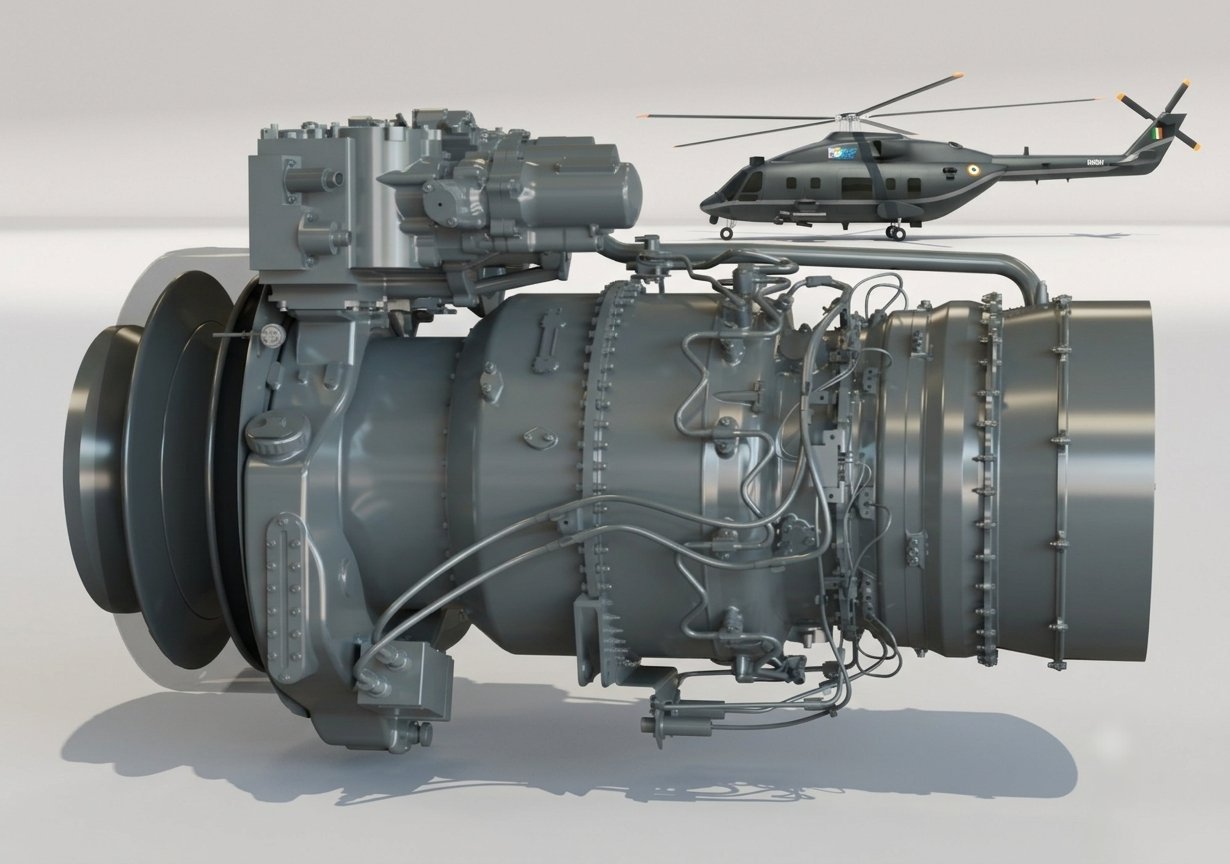
In a monumental leap toward self-reliance in military aerospace, Hindustan Aeronautics Limited (HAL) and France’s Safran Helicopter Engines have formally signed a landmark contract with their joint venture, SAFHAL Helicopter Engines. The deal marks the start of joint design, development, and manufacturing for the new high-power Aravalli engine. Rated at an impressive 3,500 to 4,000 shaft horsepower (shp), this advanced powerplant will drive HAL’s upcoming 13-ton Indian Multi-Role Helicopter (IMRH) and its naval variant, the Deck-Based Multi-Role Helicopter (DBMRH).
Keywords: Aravalli Engine HAL Safran, SAFHAL Co Development Deal, 13 Ton IMRH Propulsion, Indo French Defence Collaboration, Women in STEM Defence Aerospace
The agreement, signed by Ajay Kumar Shrivastava, Director (Engineering, R&D), HAL, and Olivier Savin, Director, SAFHAL & Executive VP, Safran, was presided over by Mr. Ravi K, CMD of HAL, and Mr. Cédric Goubet, CEO of Safran Helicopter Engines. Highlighting its strategic weight, HAL CMD Ravi K emphasized that the programme marks a major milestone in India’s quest for aero-engine self-reliance while cultivating a robust domestic MRO (Maintenance, Repair, and Overhaul) and aerospace ecosystem.
Named after the ancient Aravalli mountain range, this venture reflects the enduring strength of the India-France strategic defence partnership. Building upon decades of success, from powering the heritage Cheetah fleet to the Shakti engines on the Advanced Light Helicopter (ALH), this collaboration moves India from mere engine assembly into full co-development of critical turbine technology. Beyond military missions, the Aravalli engine is slated to unlock civil utility, offshore transport, and commercial aviation avenues.
For aspiring women engineers, scientists, and defence leaders, this historic milestone stands as a testament to what vision and technical innovation can achieve. Modern defence engineering is no longer defined by traditional boundaries; it thrives on collaborative intellect, high-tech research, and daring innovation. As SAFHAL builds the propulsion systems of tomorrow, it creates a powerful precedent: showing young women across STEM that their contributions are vital to building sovereign national power, driving world-class engineering, and conquering new horizons in aviation.

contact: drrajeshjauhri@gmail.com
Dr Rajesh Jauhri is a Journalist with an experience of over 25 years in Indian and foreign media, a Social Scientist, an Ac-complished Author, a Political & Strategic Analyst, a Marksman (Rifle & Pistol), an Orator, a Thinker and an Educationist. He holds a Ph.D. degree on “Impact of colonial heritage on Indian police”. He runs an NGO dedicated to the social and eco-nomic uplift of tribal communities in MP and two decades back, he established a school in a village of Indore district, providing education and moral values to children belonging to underprivileged and minority families. Has received multiple awards in various fields.