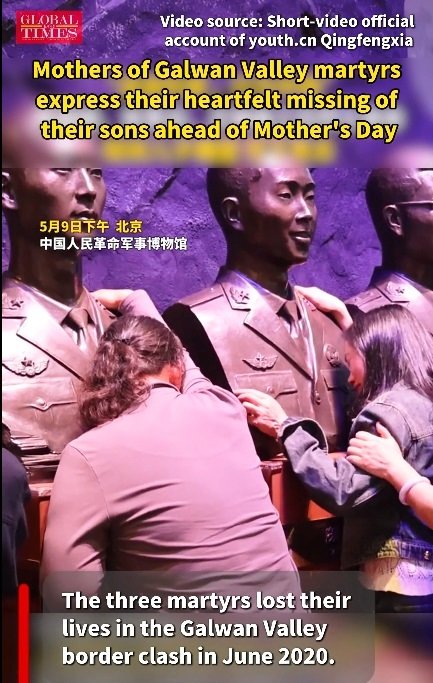
New Delhi: On the eve of Mother’s Day, Chinese state media released poignant footage showing the mothers of three People’s Liberation Army (PLA) soldiers killed in the June 2020 Galwan Valley clash visiting the Military Museum of the Chinese People’s Revolution in Beijing. The mothers of Chen Xiangrong, Xiao Siyuan, and Wang Zhuoran were seen gently touching statues of their sons and writing personal messages expressing their enduring grief and longing.
The video, aired by Global Times on May 10, 2026, highlights the human cost of the deadly hand-to-hand confrontation that marked the most serious India-China border clash since 1962. While the imagery evokes deep sympathy, it has also reignited international scrutiny over the opacity surrounding China’s casualty figures. Information Warfare experts are of the view that China has purposely shown statues and mothers of only three PLA soldiers because China wants to show to the world that only this much was the loss.
China officially maintains that four PLA soldiers died in the clash. The four named martyrs are Chen Hongjun (battalion commander), Chen Xiangrong, Xiao Siyuan, and Wang Zhuoran. Beijing first acknowledged these losses only in February 2021, more than eight months after the incident, following initial claims of no fatalities. In contrast, India promptly released the names of its 20 fallen soldiers on June 17, 2020, and has consistently honoured their sacrifice.
Independent reports and intelligence assessments from multiple sources have long suggested that Chinese casualties were significantly higher than the official count, with some estimates ranging between 35 and 45. Reports citing social media researchers in China have claimed that at least 38 PLA troops may have drowned while attempting to cross the fast-flowing Galwan River in darkness and freezing conditions. Beijing has repeatedly rejected such claims.
The latest video release comes amid ongoing border tensions, even as both sides have undertaken disengagement efforts and resumed patrolling arrangements in several friction points. For India, the Galwan incident remains a defining moment of national resolve and a reminder of the challenges in managing the Line of Actual Control (LAC).
Defence analysts note that China’s selective public acknowledgment of its fallen soldiers serves a dual purpose: paying tribute to its troops while carefully controlling the narrative around the clash. The timing on the eve of Mother’s Day appears designed to evoke patriotism and empathy within domestic audiences.
As the sixth anniversary of the Galwan clash approaches, the episode continues to cast a long shadow over India-China relations. While diplomatic and military dialogues have prevented further escalation, underlying differences over the border remain unresolved. The emotional tribute by the Chinese mothers underscores a universal truth in conflict: behind official numbers lie personal stories of loss that transcend borders.
Whether Beijing will eventually provide a fuller, transparent account of its losses remains uncertain. For now, the contrasting approaches of the two nations in handling the memory of Galwan continue to highlight fundamental differences in military transparency and accountability.

contact: drrajeshjauhri@gmail.com
Dr Rajesh Jauhri is a Journalist with an experience of over 25 years in Indian and foreign media, a Social Scientist, an Ac-complished Author, a Political & Strategic Analyst, a Marksman (Rifle & Pistol), an Orator, a Thinker and an Educationist. He holds a Ph.D. degree on “Impact of colonial heritage on Indian police”. He runs an NGO dedicated to the social and eco-nomic uplift of tribal communities in MP and two decades back, he established a school in a village of Indore district, providing education and moral values to children belonging to underprivileged and minority families. Has received multiple awards in various fields.