


Mhow: In the disciplined rhythm of military life, where combat readiness and operational excellence define the daily ethos, the Indian Army preserves a profound tradition that underscores its foundational commitment to unity in diversity. Every Sunday, soldiers across numerous units gather for the ‘Mandir Parade,’ a solemn assembly of prayer and reflection that has become an enduring pillar of spiritual and moral resilience within the force.
This weekly ritual, far from being a mere formality, serves as a collective reaffirmation of faith’s role in fortifying the warrior spirit. Troops of all backgrounds assemble under the open sky or at designated sacred spaces, participating in prayers that transcend individual beliefs. The parade is not limited to one faith; it embodies a broader institutional practice where attendance at religious observances of fellow soldiers is not optional but integral to regimental life.
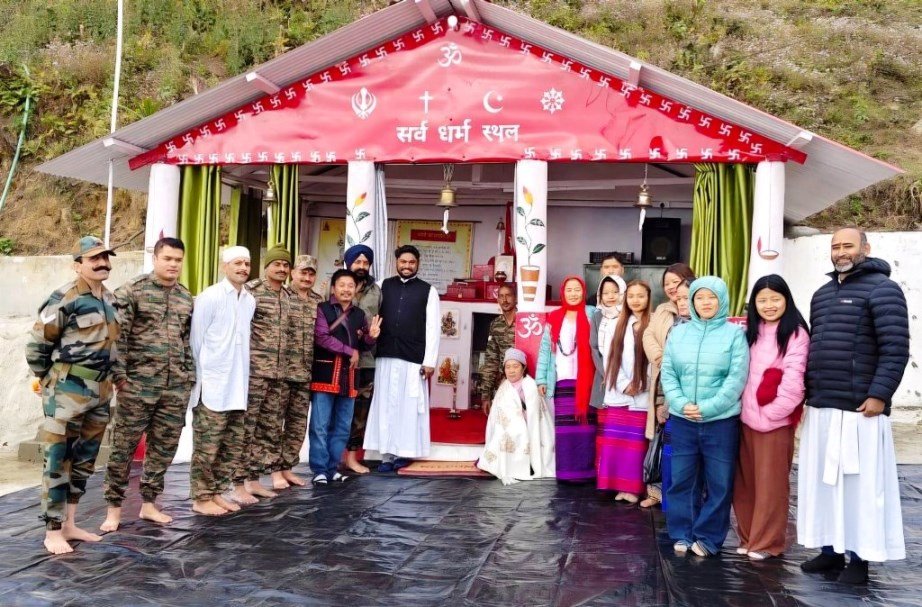
Central to this ethos is the ‘Sarva Dharma Prarthana Sthal’, a multi-faith prayer complex present in virtually every Army establishment. Here, symbols of India’s major religions, Hindu temples or idols, Islamic motifs, Christian crosses or altars, and Sikh Guru Granth Sahib, coexist harmoniously under one roof or in adjacent reverence. Troops from every religious background pay respects without discrimination, often led by religious teachers (Pandits, Maulvis, Granthis, and Padres) appointed across the Army, Navy, and Air Force.
This inclusive framework extends beyond Sundays. Participation in the religious functions of comrades, whether a Hindu Havan, Sikh Ardas, Islamic Prayers, or Christian Service, is mandatory, fostering a unique bond of brotherhood forged in shared respect. Senior officers, including commanding officers, actively participate; setting an example that faith strengthens rather than divides the ranks.
Such practices reflect the Indian Armed Forces’ distinctive interpretation of secularism, not as the absence of religion, but as equal respect (‘Sarva Dharma Sambhava’) for all faiths. In a force drawn from the length and breadth of the world’s most diverse democracy, this approach has proven instrumental in maintaining cohesion, morale, and operational effectiveness, particularly in high-stress environments ranging from icy Himalayan heights to desert frontiers.
Military analysts often highlight how these traditions distinguish the Indian military globally. While many armies maintain chaplaincy services primarily for dominant faiths, India’s model integrates spiritual leaders from multiple religions into the institutional fabric. This not only addresses the personal needs of soldiers but reinforces the constitutional values the forces swear to protect.
In an era of global geopolitical flux and internal societal challenges, the Mandir Parade and Sarva Dharma Sthal stand as quiet yet powerful testaments to the Indian soldier’s ability to rise above divisions. They remind the world that in the crucible of service, faith becomes a unifying force, bolstering the spirit of warriors who stand as one, ready to defend the nation with unwavering resolve.
As India’s defence capabilities evolve with modern technology and strategic ambitions, preserving this timeless tradition ensures that the human element, the soldier’s inner strength, remains anchored in harmony and mutual respect.
contact: drrajeshjauhri@gmail.com
Dr Rajesh Jauhri is a Journalist with an experience of over 25 years in Indian and foreign media, a Social Scientist, an Ac-complished Author, a Political & Strategic Analyst, a Marksman (Rifle & Pistol), an Orator, a Thinker and an Educationist. He holds a Ph.D. degree on “Impact of colonial heritage on Indian police”. He runs an NGO dedicated to the social and eco-nomic uplift of tribal communities in MP and two decades back, he established a school in a village of Indore district, providing education and moral values to children belonging to underprivileged and minority families. Has received multiple awards in various fields.