


“We must make it work, and never mess it up”[i]
In the spring of 2026, with West Asia still convulsed by conflict and global energy arteries under strain,[ii] U.S. President Donald J. Trump and Chinese President Xi Jinping concluded a two-day summit in Beijing.[iii] Far from marking a fundamental transformation in international politics, the meeting exemplified the timeless logic of realism that states, operating in an anarchic system, pursue relative power and security through calculated engagement when confrontation becomes too costly.[iv] It was a classic case of great powers managing their rivalry rather than transcending it.
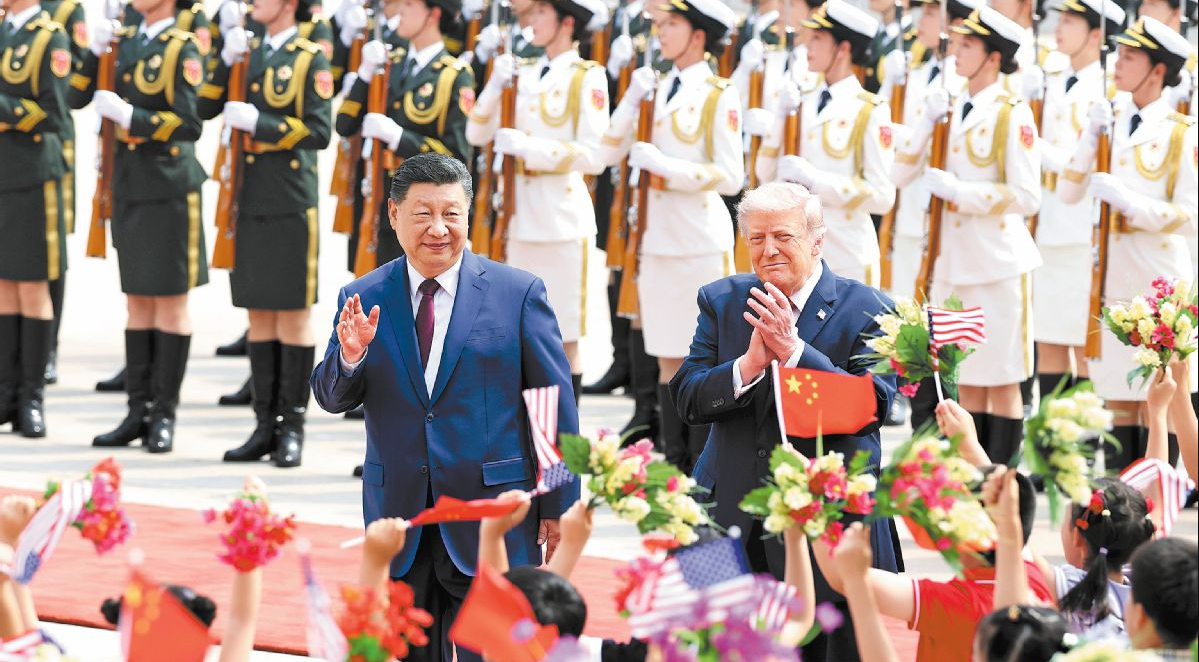
The pageantry of military honours at the Great Hall of the People, private talks at Zhongnanhai, and lavish toasts at the state banquet was deliberate statecraft.[v] Trump, consistent with his transactional worldview, pronounced the relationship “better than ever.”[vi] Xi Jinping, invoking the long view of Chinese strategic culture, spoke of forging “constructive strategic stability.”[vii] These rhetorical gestures masked the deeper structural dynamics at play.
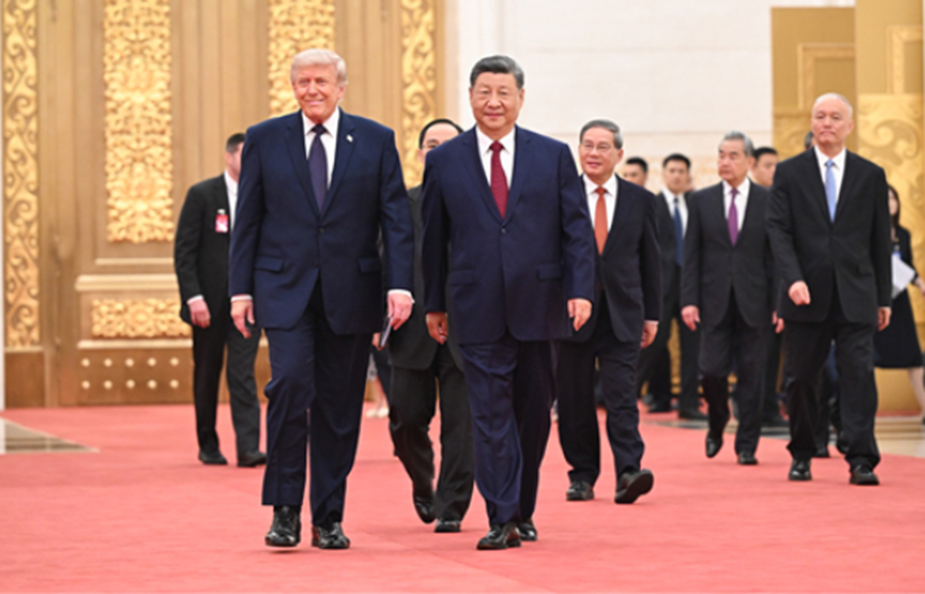
(Source: Ministry of Foreign Affairs People’s Republic of China)
Classical realism, as articulated by Hans Morgenthau, reminds us that international politics is rooted in the pursuit of power, driven by human nature and the will to dominate.[viii] In this tradition, the Beijing summit was not an exercise in idealism but an expression of interest defined in terms of power. Both leaders sought to advance their nations’ vital interests while avoiding the mutual destruction that unchecked escalation could invite.
John Mearsheimer’s offensive realism provides an even sharper lens.[ix] In The Tragedy of Great Power Politics, Mearsheimer argues that great powers in an anarchic system are compelled to maximise their relative power because they can never be certain of others’ intentions. China, as a rising peer competitor, seeks regional hegemony in Asia; the United States, as the offshore balancer, is determined to prevent it.[x]
The 2026 summit, therefore, represents not friendship but a temporary truce born of necessity, recognition that the costs of open conflict, especially amid the Iran-induced energy crisis, outweighed immediate gains.[xi] This encounter also illustrates the security dilemma and power transition theory which Professor Khong Yuen Foong, Lee Kuan Yew School of Public Policy, National University of Singapore explained.[xii] As China’s capabilities grow, the established hegemon (the United States) faces the dilemma famously captured in the Thucydides Trap, when a rising power threatens to displace an existing one, structural tension becomes nearly inevitable.[xiii] Graham Allison’s framework, rooted in Thucydides’ account of Athens and Sparta[xiv], warns that such transitions frequently end in war and both Trump and Xi appear acutely aware of this danger.[xv]
Their meeting reflects an effort to delay or mitigate the trap through managed competition, episodic cooperation on shared vulnerabilities (energy security, critical minerals) while maintaining robust deterrence postures elsewhere.[xvi] On Taiwan, Xi delivered a textbook realistic signal of commitment and credibility. He warned that mishandling the issue could lead to “clashes and even conflict,” placing the entire relationship in “great jeopardy”.[xvii] This was not bluster but a deliberate reinforcement of 4 red lines to deter what Beijing perceives as encirclement or creeping independence support.[xviii] In Thomas Schelling’s terms, it combined deterrence (preventing adverse action) with compellence (encouraging restraint).[xix] The United States, adhering to strategic ambiguity, preserved its own freedom of action without yielding ground an elegant demonstration of balancing resolve with flexibility.[xx]
Economically, the discussions embodied the realist distinction between absolute and relative gains. Trump’s delegation, which prominently featured executives from Apple, Tesla, and Nvidia, sought concrete commercial wins, market access, critical minerals supplies, and energy purchases.[xxi] China, leveraging its commanding position in rare earth processing and supply chains, bargained from strength.[xxii] No comprehensive trade reset emerged because neither side was willing to sacrifice relative advantage for mutual absolute benefit.[xxiii]
This is pragmatic economic statecraft interdependence used as a restraint mechanism, not a path to perpetual peace.[xxiv] The Iran dimension further highlighted convergent short-term interests. Xi’s reported remark that the war “should never have happened,”[xxv] coupled with indications of possible Chinese mediation and assurances against direct military aid to Tehran, showed Beijing exercising influence where its material stakes (energy imports and regional stability) aligned with de-escalation.[xxvi] For Trump, this offered a low-cost route to crisis management, classic buck-passing and burden-sharing in a multipolar context.[xxvii]
For India, the summit offers a master class in the virtues of pragmatic realism and strategic autonomy.[xxviii] New Delhi has correctly avoided the false binary of alignment versus isolation.[xxix] By deepening Quad cooperation, accelerating Atmanirbhar Bharat in defence technology and critical minerals, and maintaining multi-alignment, India is building its own comprehensive national power, precisely what realist theory prescribes for middle powers in an era of great power flux.[xxx] The renewed emphasis on critical minerals and supply chains underscores the centrality of resource power in contemporary realism.[xxxi] India must urgently scale domestic capabilities[xxxii] and forge resilient partnerships with Australia, the United States, and Japan to reduce vulnerabilities.[xxxiii]
In the Indo-Pacific, any tactical U.S.-China stabilisation must not lull New Delhi into complacency regarding naval modernisation or maritime domain awareness.[xxxiv] On the Line of Actual Control and in the Indian Ocean, India should continue to invest in credible conventional and nuclear deterrence.[xxxv] In West Asia, an enhanced Chinese diplomatic role presents both risks and opportunities.[xxxvi] India’s long-standing balancing diplomacy maintaining ties with Israel, the Gulf States, and Iran must be calibrated with cold-eyed assessment of shifting power equations.[xxxvii]
The Beijing summit of May 2026 confirms a central tenet of neorealism, the structure of the international system marked by anarchy and the distribution of capabilities shapes state behaviour more powerfully than individual leaders or fleeting personal chemistry. Summits such as this serve as safety valves, allowing great powers to recalibrate without dismantling their strategic postures. Trump’s deal-making pragmatism and Xi’s patient, party-led grand strategy represent different cultural expressions of the same imperative: survive, maximise influence, and prepare for the next contest.
History suggests such tactical resets are recurring features of power transitions, not their resolution. As the delegations left Beijing, the fundamental architecture of world order remained unchanged. In the unforgiving realm of great power politics, rivalry is the default. Cooperation is tactical, conditional, and always subordinate to the pursuit of security and relative advantage. India, drawing upon its civilizational realism Kautilya’s Arthashastra emphasis on mandala theory and prudent statecraft must continue navigating this environment with clarity, patience, and relentless capacity-building. The Beijing handshake may have bought time and lowered temperatures, but the larger drama of power transition is still unfolding.
[i] Xi holds welcome banquet for Trump-Xinhua
[ii] FM warns about “systemic tremor” to energy markets, hails India’s fiscal health
[iii] Live updates: Trump-Xi summit ends on cordial note but no breakthroughs announced yet | CNN Politics
[iv] Political Realism in International Relations (Stanford Encyclopedia of Philosophy)
[v] President Xi Jinping Holds Welcoming Banquet for U.S. President Donald J. Trump_Ministry of Foreign Affairs of the People’s Republic of China
[vi] Trump, Xi speak ahead of talks to make relations ‘better than ever’ | Xi Jinping | Al Jazeera
[vii] Xi Jinping Calls for New Paradigm in US-China Relations Amid Global Turbulence – South Asian Herald
[viii]http://slantchev.ucsd.edu/courses/ps240/04%20Conflict%20with%20States%20as%20Unitary%20Actors/Morgenthau%20-%20Politics%20among%20nations%20(selected%20chapters).pdf
[x] https://direct.mit.edu/isec/article-abstract/49/4/37/130811/Hedging-on-Hegemony-The-Realist-Debate-over-How-to?redirectedFrom=fulltext
[xi] https://www.japantimes.co.jp/news/2026/05/15/asia-pacific/politics/xi-trump-summit-analysis/
[xii] US-China Rivalry: Security Dilemma or Power Transition? | Coral Bell School of Asia Pacific Affairs
[xiii] Power Transition Theory and the Essence of Revisionism – Oxford Research Encyclopedia of Politics
[xiv] Allison, 2015.09.24 The Atlantic – Thucydides Trap.pdf
[xv] What is the ‘Thucydides Trap’? Why Xi Jinping brought it up during talks with Donald Trump in Beijing
[xvi] The Case for a Quad Mineral Security Partnership
[xvii] China ‘sole risk’ to peace: Taiwan slams Xi’s ‘jeopardy’ warning in talks with Trump – Firstpost
[xviii] Why the four red lines are critical to China-U.S. ties – China Military
[xxi] India and a Changing Global Order: Foreign Policy in the Trump 2.0 Era
[xxii] China’s Rare Earth Leverage Is the Frontline of 21st Century Geopolitics – The Diplomat
[xxiii] Trump-Xi Meeting to Focus on Trade, Rare Earths, and AI
[xxiv] At the Trump-Xi Summit, China Will Have the Upper Hand | Council on Foreign Relations
[xxv] https://www.reuters.com/world/china/trump-says-he-chinas-xi-agree-iran-cannot-have-nuclear-weapons-2026-05-15/
[xxvi] Trump and Xi begin Day Two of talks in Beijing, stress ‘constructive stability” in US-China relationship | CNN
[xxvii] Iran is set to dominate Trump-Xi summit. What else is at stake, and who has the upper hand? – CNA
[xxviii] How the Trump-Xi Beijing Summit Affects India’s Foreign and Economic Policy
[xxix] How PM Modi’s China visit is not a reactionary act, but a multi-alignment strategy – Firstpost
[xxx] The Trump-Xi Summit: China Negotiating from Strength? – MP-IDSA
[xxxi] Critical minerals geopolitics in 2026: risks, supply chains and global power shifts | ODI: Think change
[xxxii] Press Note Details: Press Information Bureau
[xxxiii] Press Release:Press Information Bureau
[xxxiv] INMSS-2026: What India’s New Maritime Strategy Means – MP-IDSA
[xxxv] India’s Nuclear Force Structure 2025 | Carnegie Endowment for International Peace
[xxxvi] CHINA’S STRATEGIC DILEMMA IN THE WEST ASIAN CRISIS
[xxxvii] India’s Strategic Balancing in the Middle East
Punit Shyam Gore (MA Defence and Strategic Studies) is an alumnus of the School of Internal Security, Defence & Strategic Studies of the Rashtriya Raksha University, Gandhinagar (an institution of national importance) under the Ministry of Home Affairs, Government of India.