


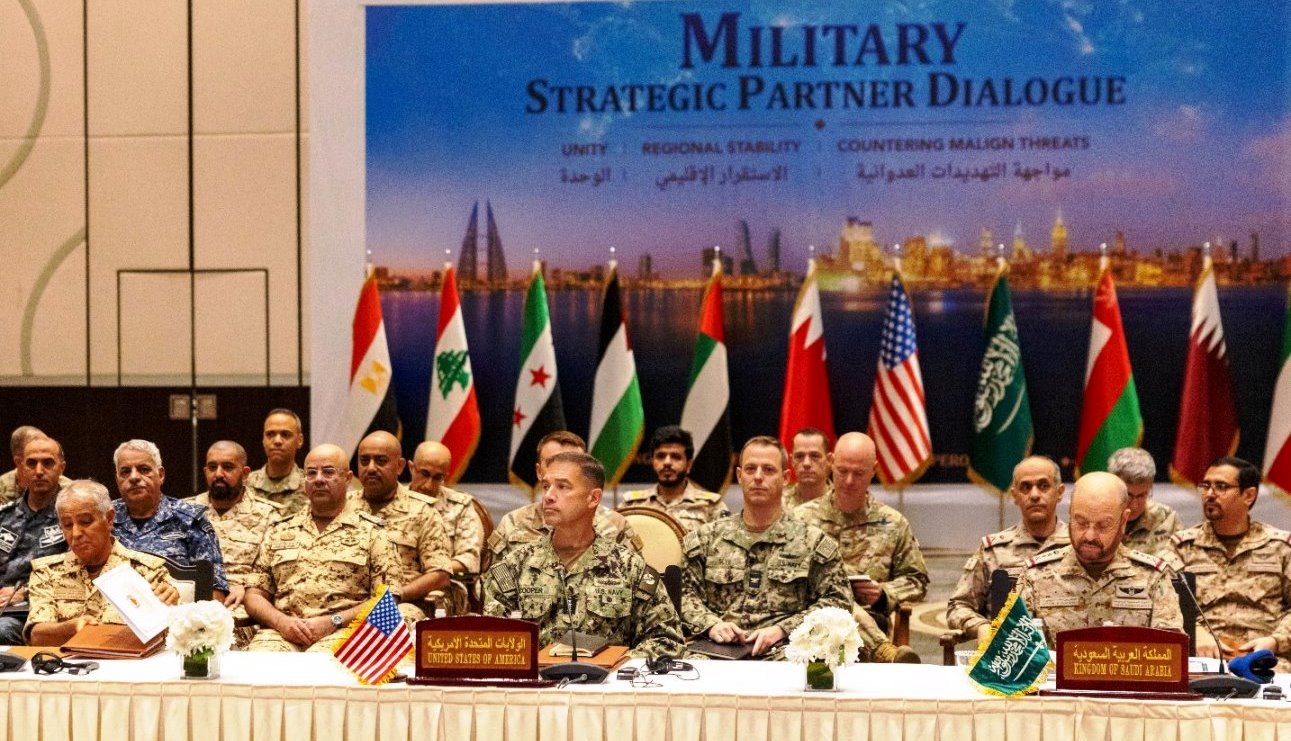
In a significant development underscoring evolving alliances in the Middle East, the U.S. Central Command (CENTCOM) convened a high-level regional security dialogue in Bahrain yesterday. Hosted by the Bahrain Defence Force, the meeting brought together senior military officials from 12 nations, including Bahrain, Egypt, Jordan, Kuwait, Lebanon, Oman, Qatar, Saudi Arabia, Syria, the United Arab Emirates, and Yemen.
Keywords: CENTCOM Bahrain Dialogue, Middle East Air Defense Coordination, Strait of Hormuz Security, Syria Lebanon US Security Talks, India Middle East Defence Cooperation, Regional Security Architecture 2026
Admiral Brad Cooper, Commander of CENTCOM, emphasised the collaborative spirit, stating, “We continue to stand shoulder to shoulder with our regional partners. The discussions underscored our shared commitment to regional security and stability.” Participants focused on the current security environment, opportunities to deepen defence cooperation, and ensuring the free flow of commerce through the Strait of Hormuz, a critical chokepoint for global energy supplies.
The dialogue stands out for its inclusivity. For the first time, military leaders from Syria and Lebanon participated in a US-led regional defence conference, signalling a pragmatic realignment amid shifting regional dynamics. This development coincides with broader efforts to integrate air and missile defence capabilities. In January this year, CENTCOM and partners established the Middle Eastern Air Defence- Combined Defence Operations Cell (MEAD-CDOC) at Al Udeid Air Base in Qatar. This facility enhances real-time information sharing, threat warnings, and coordinated responses, forming what officials describe as the world’s most sophisticated and largest active air and missile defence umbrella in the region.
Strategic Relevance Today
Against the backdrop of persistent tensions, including threats to maritime navigation in the Strait of Hormuz and residual instabilities following recent conflicts, the Bahrain meeting reinforces a collective approach to deterrence and stability. By bridging traditional divides, it aims to create a more resilient security framework capable of addressing hybrid threats, ballistic missiles, and disruptions to vital sea lanes.
Implications for India
For India, this evolving architecture holds direct strategic significance. As a major importer of Gulf energy, New Delhi relies heavily on the secure transit of oil and gas through the Strait of Hormuz. Over eight million Indian nationals reside and work in the Gulf, making regional stability a core national interest. Enhanced multilateral defence cooperation in the Middle East complements India’s own engagements through platforms like the Quad and its strategic partnerships with GCC nations, Israel, and the United States. A more stable Gulf reduces risks to sea lines of communication (SLOCs) critical for India’s trade and energy security, while offering opportunities for deeper defence diplomacy, joint exercises, and intelligence sharing in the Indian Ocean Region.
The Bahrain dialogue reflects a maturing regional order where practical security needs increasingly transcend past fault lines. As Admiral Cooper noted, such partnerships remain vital for safeguarding shared interests in an uncertain geopolitical landscape.

contact: drrajeshjauhri@gmail.com
Dr Rajesh Jauhri is a Journalist with an experience of over 25 years in Indian and foreign media, a Social Scientist, an Ac-complished Author, a Political & Strategic Analyst, a Marksman (Rifle & Pistol), an Orator, a Thinker and an Educationist. He holds a Ph.D. degree on “Impact of colonial heritage on Indian police”. He runs an NGO dedicated to the social and eco-nomic uplift of tribal communities in MP and two decades back, he established a school in a village of Indore district, providing education and moral values to children belonging to underprivileged and minority families. Has received multiple awards in various fields.