Leh
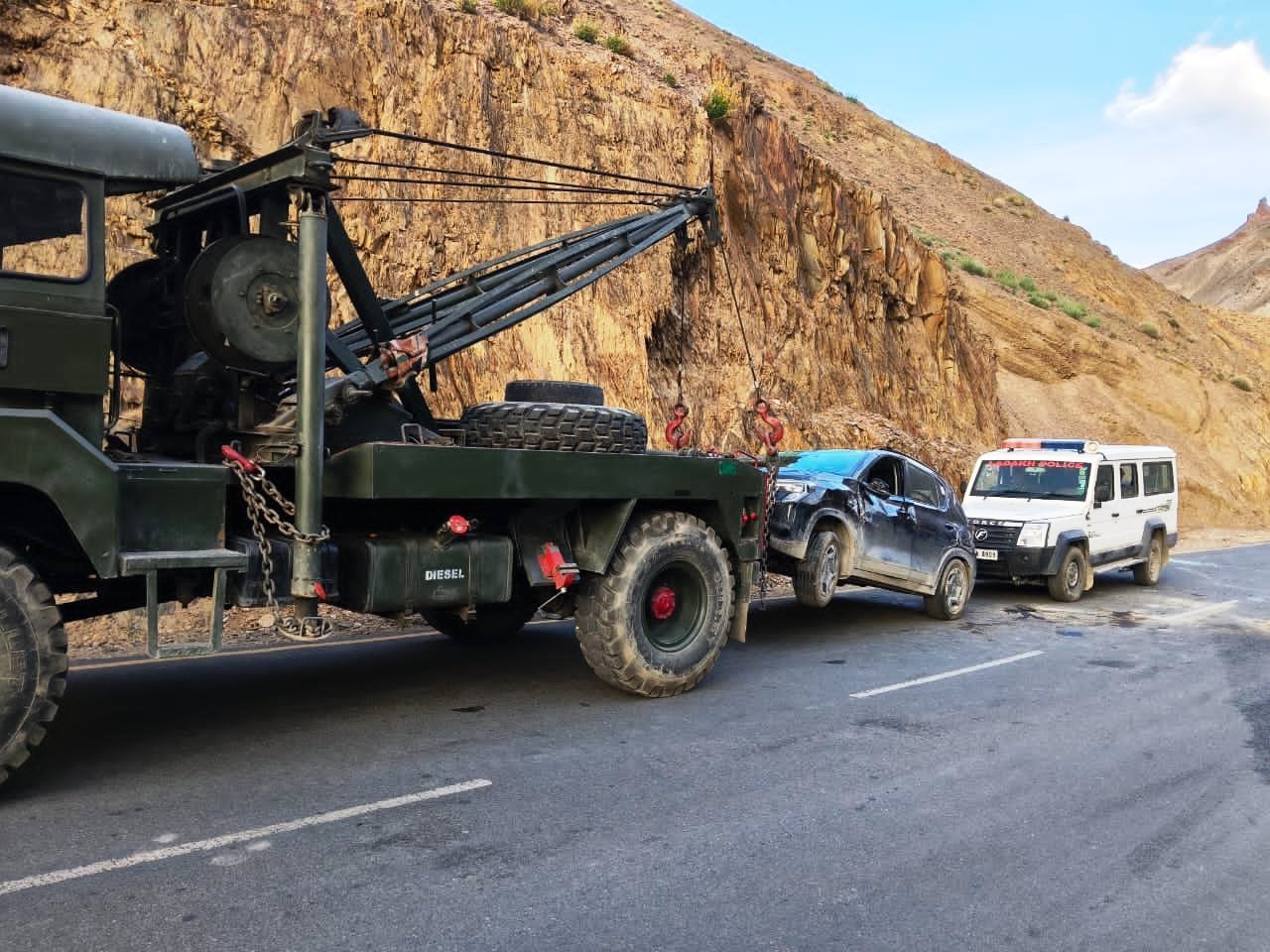
In a demonstration of their unwavering commitment to both national security and civilian welfare, troops from the Indian Army’s “Forever in Operations Division” (8 Mountain Division) swiftly recovered a vehicle involved in an accident near Heniskot in the Bodhkharbu area on July 1, 2026. Acting in close coordination with personnel from the Khangral Police Station, the soldiers cleared the obstruction on the strategically critical Srinagar–Leh National Highway, restoring normal traffic flow within hours and preventing potential disruptions for commuters traversing the challenging high-altitude terrain.
Keywords: Indian Army Ladakh rescue, Srinagar Leh Highway accident, Forever in Operations Division, Heniskot Bodhkharbu incident, Indian Army civilian aid high altitude, Fire and Fury Corps Ladakh
The Srinagar-Leh Highway, a lifeline connecting the Kashmir Valley with the Union Territory of Ladakh, remains one of India’s most demanding arterial routes. Spanning treacherous mountain passes, including the notorious Zozila, it serves as a vital corridor for military logistics, tourism, and civilian movement, particularly during the limited summer months when it is fully operational. Accidents in this region are not uncommon due to unpredictable weather, narrow roads, and steep gradients, underscoring the Army’s indispensable role beyond border defence.
This incident highlights the multifaceted responsibilities shouldered by the Indian Army in remote and high-altitude areas. While primarily tasked with safeguarding India’s frontiers amid complex geopolitical challenges, the forces frequently extend aid to civilians during emergencies. Recent examples abound: in July 2025, troops from the Fire and Fury Corps rescued and provided medical aid to two civilians injured in a vehicle overturn near Pang in Ladakh, successfully recovering their vehicle. Similar operations have been lauded across the region, from avalanche responses to medical evacuations, reinforcing the Army’s ethos of “Aid to Civil Authority.”
Defence experts familiar with Ladakh operations note that such proactive interventions not only save lives but also bolster public trust and maintain socio-economic continuity in frontier regions. “In high-altitude zones, the Army often acts as the first responder where civilian infrastructure is stretched thin,” observed a senior defence analyst. The Forever in Operations Division, with its storied legacy from counter-insurgency in the Northeast to the Kargil conflict, continues to embody this spirit of resilience and service.
The prompt resolution at Heniskot ensured seamless connectivity, averting longer disruptions that could impact supply chains and travellers. Local residents and travellers expressed gratitude for the Army’s professionalism and coordination with police authorities. As Ladakh grapples with increasing connectivity demands and environmental challenges, the Indian Army’s role as a steadfast guardian and humanitarian partner remains more relevant than ever.

contact: drrajeshjauhri@gmail.com
Dr Rajesh Jauhri is a Journalist with an experience of over 25 years in Indian and foreign media, a Social Scientist, an Ac-complished Author, a Political & Strategic Analyst, a Marksman (Rifle & Pistol), an Orator, a Thinker and an Educationist. He holds a Ph.D. degree on “Impact of colonial heritage on Indian police”. He runs an NGO dedicated to the social and eco-nomic uplift of tribal communities in MP and two decades back, he established a school in a village of Indore district, providing education and moral values to children belonging to underprivileged and minority families. Has received multiple awards in various fields.