


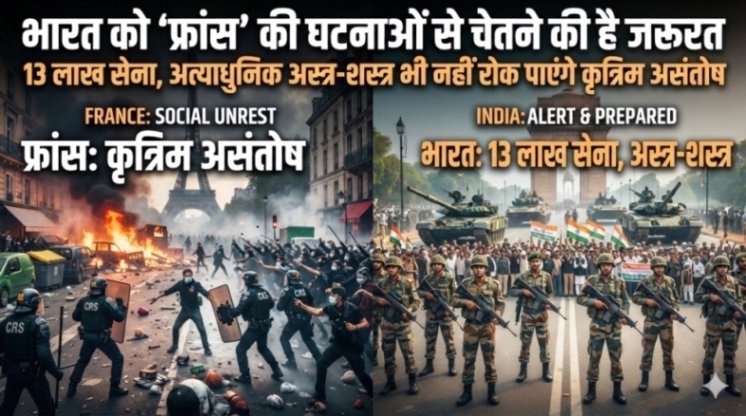
Modern national security relies heavily on state-of-the-art fighter jets, advanced missile defence networks, and standing armies. Yet, events unfolding across major urban centers in France reveal a stark strategic reality- elite hardware like Rafale fighters and advanced armaments offer zero defence against asymmetric, digitally fuelled internal destabilization. Same series of events have already occurred in Sri Lanka, Bangladesh and Nepal in the recent past and the reports coming from various parts of India also suggest a similar pattern.
Keywords: Hybrid Warfare Threats, France Lycée Protests 2026, Internal Security Vulnerabilities, Subversive Mobilization Tactics, Defence Chronicle Analysis
What began in mid-September 2026 as localized high school walkouts at Paris-area lycées has rapidly escalated into a full-scale public order crisis. Protests over rundown school infrastructure, long hours, and proposed budget cuts have blocked over 700 schools nationwide. Mass blockades, urban violence, and violent clashes with law enforcement, exemplified by an incident in Belfort where a plainclothes officer was brutally beaten during a teenager’s arrest, have led to nearly 5,000 detentions. Authorities blame external agitators for weaponising legitimate/ illegitimate/ artificial student grievances to trigger regime instability through coordinated social media campaigns.
France serves as a sobering template of hybrid subversion, following similar socio-political unrest seen in Sri Lanka, Bangladesh, and Nepal. For strategic planners in India, where a right-wing government has held power for twelve years, the parallels are deeply alarming. Prominent global actors and anti-establishment networks have repeatedly declared intentions to dismantle right-wing political ideologies across major democracies.
India is already witnessing early signals of coordinated civil disruption. In states like Madhya Pradesh, young hostel inmates and school students have been mobilized to march up to 20 kilometres toward district offices and police stations during late-night hours. Supervised by shadowy external handler networks, these marches are filmed and amplified across digital platforms to manufacture outrage before state intelligence apparatuses can react.
The core vulnerability is clear- no matter how militarily strong a nation is, state power cannot easily deploy heavy military force or kinetic assets against its own civilian youth. If a nation is not able to sense the coming situation, all its arms, ammunitions, fighter planes, 13-lakh strong army, police force, and central police organisations will be of no use and negative forces will be able to take over the rule in India too. National defence must pivot from traditional kinetic posture toward early warning, digital threat detection, and counter-subversion capabilities.

contact: drrajeshjauhri@gmail.com
Dr Rajesh Jauhri is a Journalist with an experience of over 25 years in Indian and foreign media, a Social Scientist, an Ac-complished Author, a Political & Strategic Analyst, a Marksman (Rifle & Pistol), an Orator, a Thinker and an Educationist. He holds a Ph.D. degree on “Impact of colonial heritage on Indian police”. He runs an NGO dedicated to the social and eco-nomic uplift of tribal communities in MP and two decades back, he established a school in a village of Indore district, providing education and moral values to children belonging to underprivileged and minority families. Has received multiple awards in various fields.