


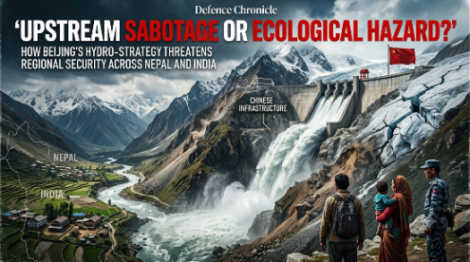
The recent catastrophic glacier collapse in the High Himalayas, which sent millions of cubic metres of rock, ice, and debris cascading down into Nepal’s downstream valleys, has sent shockwaves through regional security circles. While geologists point to thermal instability and rapid cryospheric changes, strategic analysts across the Indo-Pacific are examining the broader geopolitical canvas surrounding the disaster.
Keywords: Himalayan Glacier Avalanche Security, Nepal China Border Hydro Politics, India Nepal Defence Relations, Women in Military Disaster Response, Grey Zone Warfare Himalayan Region
The disaster unfolded amid a shifting geopolitical matrix in Kathmandu. The recent conferment of prestigious military honours upon the Indian Army Chief by the Nepalese government marked a significant deepening of bilateral defence ties. Concurrently, rising cultural resonance within Nepal advocating for its historical heritage, alongside Kathmandu’s growing strategic proximity to New Delhi, has altered regional equations. Against this backdrop, military strategists and intelligence observers are debating whether upstream environmental vulnerabilities could be leveraged as instruments of asymmetric pressure, or if the event underscores an urgent need for transboundary ecological oversight.
Yet, amid the swirling debates over Grey Zone tactics, environmental manipulation, and upper-riparian control, the true story of the Himalayas remains one of human fortitude.
The aftermath of the deluge brought forward extraordinary accounts of leadership, none more compelling than that of Captain Sunita Sharma (Name changed), a pioneering officer in the regional disaster response force. Standing on the mud-choked banks of the surging river, Captain Sharma led a high-risk evacuation unit into terrain where active landslides threatened to sever the remaining supply lines.
Refusing to step back despite hazardous weather and collapsing terrain, she coordinated air-drops, established emergency field communications, and personally spearheaded the extraction of dozens of stranded villagers near the border zone. Her unwavering composure under extreme pressure provided a beacon of hope in an area fraught with crisis.
Captain Sharma’s resolve offers a vital lesson for international observers: while geopolitical manoeuvring and ecological friction may redefine security dynamics along the Himalayan crest, the resilience of women officers on the frontlines remains unbreakable. Her courage serves as an inspiring blueprint for women entering non-traditional, combat-adjacent defence roles worldwide, proving that true strength lies in protecting lives against all odds.
Defence Chronicle is giving a point to ponder for the strategists, Indian as wells as international intelligence agencies and the governments of Nepal, India, Myanmar and Bangladesh, which are situated on the downstream of China or Tibet.

contact: drrajeshjauhri@gmail.com
Dr Rajesh Jauhri is a Journalist with an experience of over 25 years in Indian and foreign media, a Social Scientist, an Ac-complished Author, a Political & Strategic Analyst, a Marksman (Rifle & Pistol), an Orator, a Thinker and an Educationist. He holds a Ph.D. degree on “Impact of colonial heritage on Indian police”. He runs an NGO dedicated to the social and eco-nomic uplift of tribal communities in MP and two decades back, he established a school in a village of Indore district, providing education and moral values to children belonging to underprivileged and minority families. Has received multiple awards in various fields.