


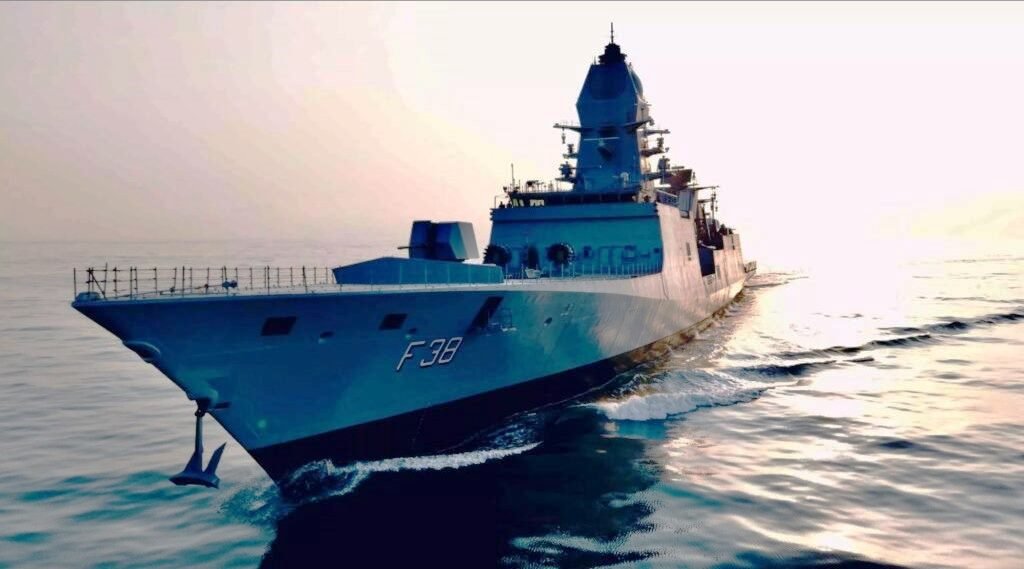
In a significant boost to India’s maritime capabilities and self-reliance in defence manufacturing, the Indian Navy commissioned INS Mahendragiri (F38), the sixth and final stealth frigate under the Project 17A (Nilgiri-class) programme, at the Naval Dockyard here today. Defence Minister Rajnath Singh graced the occasion, describing the event as a ‘proud moment’ for the nation and a testament to the ‘Aatmanirbhar Bharat’ vision.
Keywords: INS Mahendragiri commissioning, Project 17A frigate, Indian Navy indigenous warships, Rajnath Singh Visakhapatnam, Aatmanirbhar Bharat defence, Project 15C destroyers, Project 18A next generation destroyers, Project 17B frigates, Indian Navy Eastern Fleet
Designed by the Indian Navy’s Warship Design Bureau and built by Mazagon Dock Shipbuilders Limited (MDL) in Mumbai, INS Mahendragiri features approximately 75% indigenous content. The 149-metre-long vessel displaces around 6,670 tonnes and is powered by a Combined Diesel or Gas (CODOG) propulsion system, enabling speeds up to 28 knots. Equipped with advanced stealth features, state-of-the-art sensors, weapons, and electronic warfare suites, the frigate is optimised for multi-role operations, including air defence, anti-surface, and anti-submarine warfare. It will strengthen the Eastern Fleet’s operational readiness in the strategically vital Indo-Pacific region.
The commissioning of Mahendragiri marks the successful completion of the seven-ship Project 17A programme, which builds upon the earlier Shivalik-class (Project 17) frigates with superior stealth and combat systems. This achievement underscores the growing prowess of Indian shipyards in delivering complex frontline warships indigenously.
Looking ahead, the Ministry of Defence is vigorously pursuing three major follow-on indigenous programmes collectively valued at over ₹1 lakh crore. Project 15C envisages four advanced destroyers at an estimated cost of ₹50,000 crore, with the Request for Proposal (RFP) expected around early 2027. These ships will incorporate upgraded sensors, weapons, and air defence systems, serving as a bridge to more ambitious platforms.
Project 17B involves six next-generation stealth frigates worth ₹40,000 crore, to be split between MDL and Garden Reach Shipbuilders & Engineers (GRSE). Meanwhile, Project 18A (Next Generation Destroyers) plans for six large vessels of 14,000–15,000 tonnes displacement, representing a significant leap in size and capability.
These programmes reflect India’s strategic intent to build a 200-ship navy capable of safeguarding sea lanes, deterring regional challenges, and contributing to a stable Indo-Pacific. By prioritising domestic design, integration of indigenous weapons, and participation of MSMEs, the initiatives are fostering technological sovereignty and economic multipliers in the defence sector.
As geopolitical dynamics evolve, the timely induction of platforms like INS Mahendragiri and the robust pipeline of future warships position the Indian Navy as a credible net security provider in the Indian Ocean and beyond. The journey towards self-reliance continues, promising a more potent and future-ready blue-water force.

contact: drrajeshjauhri@gmail.com
Dr Rajesh Jauhri is a Journalist with an experience of over 25 years in Indian and foreign media, a Social Scientist, an Ac-complished Author, a Political & Strategic Analyst, a Marksman (Rifle & Pistol), an Orator, a Thinker and an Educationist. He holds a Ph.D. degree on “Impact of colonial heritage on Indian police”. He runs an NGO dedicated to the social and eco-nomic uplift of tribal communities in MP and two decades back, he established a school in a village of Indore district, providing education and moral values to children belonging to underprivileged and minority families. Has received multiple awards in various fields.