

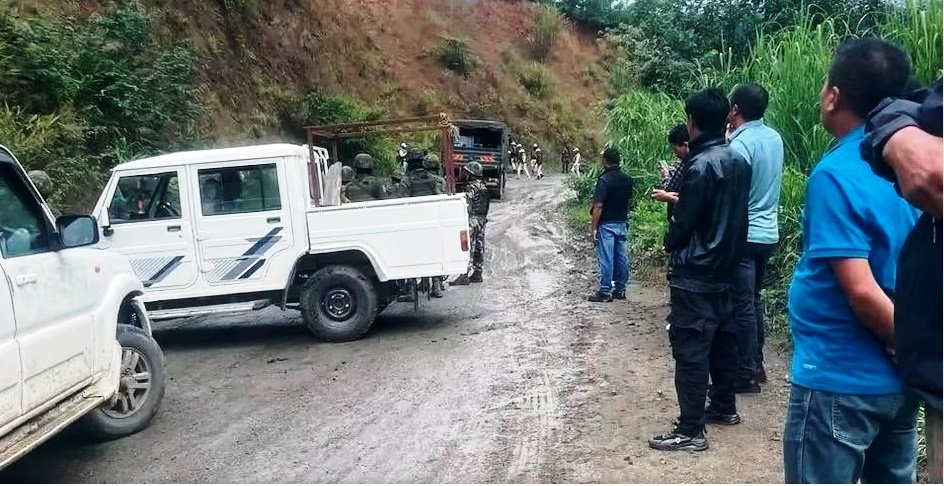
In a significant setback to security operations in India’s volatile Northeast, two Assam Rifles personnel were killed and several others injured when suspected militants ambushed a convoy of the 40 Assam Rifles near Nungshang Kong village on National Highway 202 in Manipur’s Ukhrul district on July 6, 2026. The attack occurred around 1:30 pm, approximately 8-15 km from Ukhrul town, a key Naga stronghold and headquarters area for Assam Rifles sector-26.
Keywords: Assam Rifles ambush Ukhrul, Manipur IED attack 2026, NSCN-IM Manipur violence, Northeast India insurgency, AFSPA Naga stronghold, Manipur ethnic tensions security forces.
According to preliminary reports, militants detonated an Improvised Explosive Device (IED) targeting the convoy, followed by sustained small arms fire that lasted nearly two hours. Security forces responded robustly with mortars and rifle fire before launching extensive combing operations. An unexploded IED was recovered from the site, indicating a well-planned ambush. The fallen personnel have been identified as Warrant Officer Balwant Singh and Havildar CM Singh, the driver of one of the vehicles.
Senior officials swiftly condemned the incident. Assam Rifles Director General Lt Gen Vikas Lakhera paid tribute to the martyrs. Manipur Governor Ajay Kumar Bhalla described it as a “Dastardly Act,” while Chief Minister Yumnam Khemchand Singh and Home Minister Govindas Konthoujam vowed strict action against the perpetrators. The NSCN-IM has denied involvement, with some sources suggesting possible links to breakaway factions or other insurgent elements operating in the region.
This incident underscores the persistent fragility of peace in Manipur amid longstanding ethnic tensions. Ukhrul, a predominantly Tangkhul Naga area, has witnessed recurring violence despite ceasefire agreements with major Naga groups. The broader Northeast, particularly Nagaland and Manipur, remains a complex theatre where insurgent activity predates even India’s independence in 1947. Large-scale deployment of central forces and the continuation of the Armed Forces (Special Powers) Act (AFSPA) in several districts highlight the enduring challenges. Unlike the more publicized threats in Kashmir, the Northeast’s volatility often receives less national attention, yet it demands sustained strategic focus due to its intricate ethnic mosaic, porous borders, and overlapping territorial claims.
For India’s defence establishment, the ambush serves as a reminder that counter-insurgency efforts must combine kinetic operations with deeper political engagement, intelligence-led pre-emption, and community outreach. As combing operations continue, the priority remains neutralizing threats while advancing inclusive peace processes that address root causes of discontent in the Naga hills.
The sacrifice of the two brave soldiers will not be in vain if it galvanizes renewed resolve to secure India’s eastern frontiers.

contact: drrajeshjauhri@gmail.com
Dr Rajesh Jauhri is a Journalist with an experience of over 25 years in Indian and foreign media, a Social Scientist, an Ac-complished Author, a Political & Strategic Analyst, a Marksman (Rifle & Pistol), an Orator, a Thinker and an Educationist. He holds a Ph.D. degree on “Impact of colonial heritage on Indian police”. He runs an NGO dedicated to the social and eco-nomic uplift of tribal communities in MP and two decades back, he established a school in a village of Indore district, providing education and moral values to children belonging to underprivileged and minority families. Has received multiple awards in various fields.