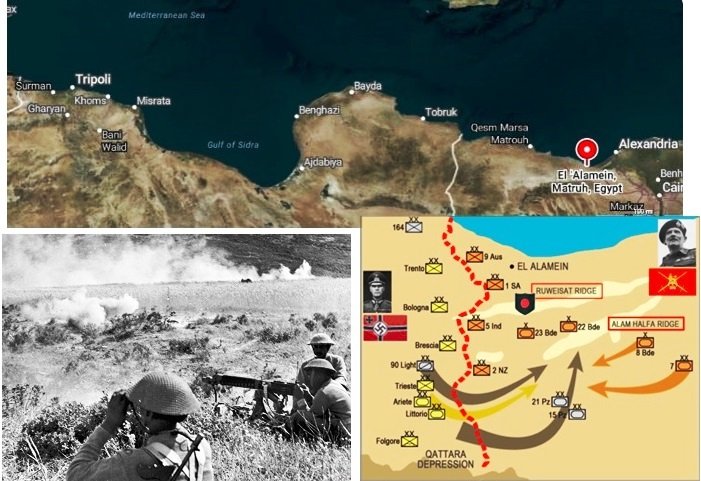
“Before Alamein we never had a victory. After Alamein we never had a defeat.”- Winston Churchill
In the annals of the Second World War, few battles resonate with the same strategic and symbolic weight as the First Battle of El Alamein. Fought between 1 and 27 July 1942 in the scorching sands of the Western Desert, this engagement marked the moment when the momentum of the North African Campaign shifted decisively. While the final triumph came later at the Second Battle of El Alamein in October-November 1942, it was the resolute defence in July, and the subsequent stand at Alam el Halfa, that halted Field Marshal Erwin Rommel’s seemingly unstoppable advance toward Alexandria and the Suez Canal.
The Desert Fox Advances
Following the rapid successes of the Afrika Korps after Rommel’s arrival in Tripoli in March 1941, Axis forces had pushed the Allies back across Cyrenaica. The fall of Tobruk on 21 June 1942 was a devastating blow. By early July, Rommel stood at the gates of Egypt. Yet, stretched supply lines, superior Allied artillery, extensive minefields, and dug-in positions at the narrow 80-square-kilometre bottleneck between the Mediterranean Sea and the impassable Qattara Depression began to tell.
Under General Claude Auchinleck, the British Eighth Army prepared its defences. Among the formations holding the line were battle-hardened Indian Divisions whose contributions remain a proud but often under-celebrated chapter in India’s military history.
Indian Divisions in the Crucible
4th Indian Division** (“The Red Eagles”), equipped with infantry brigades and supported by the Central India Horse (light tanks), had already distinguished itself across multiple theatres. By early 1943, it had fought in more major actions than any other Allied division in North Africa. Its record included the capture of Benghazi, the defence and later operations around Tobruk, the brilliant assault on the Fatnassa Heights at Wadi Akarit in April 1943 that forced a 240-km Axis withdrawal, and the final push into Tunis.
Field Marshal Archibald Wavell, Commander-in-Chief of the Indian Army, later wrote of the formation:
“The Fourth Indian Division will surely go down as one of the greatest fighting formations in military history… in five years it fought nine campaigns, travelled more than 15,000 miles, suffered over 25,000 casualties, captured upwards of 150,000 prisoners…”
5th Indian Division (“The Ball of Fire”), comprising the 9th, 10th, and 29th Infantry Brigades, played a pivotal role in the July fighting. Deployed around the vital Ruweisat Ridge, it repulsed fierce German attacks on 14 July 1942. The division had earlier executed a disciplined fighting withdrawal and helped hold the Alam Halfa Ridge during Rommel’s last major offensive in Egypt. Later, it would continue its distinguished service in the Burma Campaign under Lord Louis Mountbatten, who paid glowing tribute to its performance at Kohima and Imphal.
3rd Indian Motor Brigade fought with exceptional aggression despite limited equipment, Fordson trucks, few radios, and light anti-tank weapons. Its delaying actions bought precious time for the stabilisation of the Alamein line. The 10th Indian Division later joined for the final encirclement operations.
From Defensive Stand to Strategic Initiative
Auchinleck’s forces stopped Rommel’s July offensive, though the commander was criticised for piecemeal counterattacks lacking proper armour-infantry coordination. Replaced by General Bernard Montgomery on 13 August 1942, the Eighth Army benefited from a lull that allowed reorganisation.
Rommel, obsessed with seizing Alexandria and hampered by fuel shortages, launched one final thrust north of Alam el Halfa Ridge at the end of August. Strong defence by the 4th Indian Division, combined with air attacks, minefields, and logistical collapse, turned the operation into a failure. Montgomery’s measured counter-thrust further exhausted the Axis forces.
Military historians regard the ‘First Battle of El Alamein (July 1942)’ and the ‘Battle of Alam el Halfa (August 30- September 5, 1942) as the true strategic turning point, not because they delivered final victory, but because they seized the initiative. By May 1943, the Afrika Korps had been driven 2,000 km west and forced to surrender in Tunisia, ending the North African Campaign.
A Legacy of Pride
The exploits of the Indian Divisions at El Alamein and beyond exemplify courage, professionalism, and adaptability under extreme conditions. An apocryphal yet telling story from Cairo’s Shepheard’s Hotel captures their reputation: when soldiers of the 4th Indian Division entered the bar, drinks were said to be on the house, a mark of respect for one of the finest fighting formations of the war.
As India commemorates its military heritage, the sacrifices and achievements of these divisions at El Alamein deserve prominent recognition. They not only helped turn the tide in North Africa but also laid the foundation for later victories in Italy and Burma.
Lest We Forget- the fighting skills and bravery of the Indian Divisions at El Alamein must be celebrated with great pride.
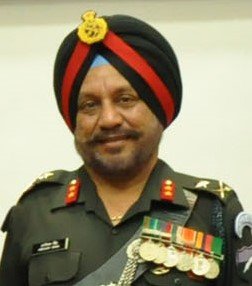
Major General Harvijay Singh is a third-generation officer, his two sons are also army officers.
He holds degree of B.Tech. and Master’s Degree in Management Sciences. He is a Certified Ethical Hacker and Cyber Forensic Investigator.
He is Member and Historian of the Punjab Military Literature Society, Chandigarh.
He has written books on Indo Pak Wars: 1948, 1965, 1971 – ‘Battles That Made History’, ‘Indo Pak War 1947-48’ (for Part D) and ‘Gallant Soldiers: Short Stories of Big Deeds’. He has also written Monographs on Grey Zone Warfare and Lessons Learnt from the Ukraine War. He is a regular contributor to Magazines on Military Strategy and Technology and a speaker on current Global Military events.
He is the winner of ARTRAC Scholar Warrior Badge for writing on Contemporary Military Thinking and Strategy.