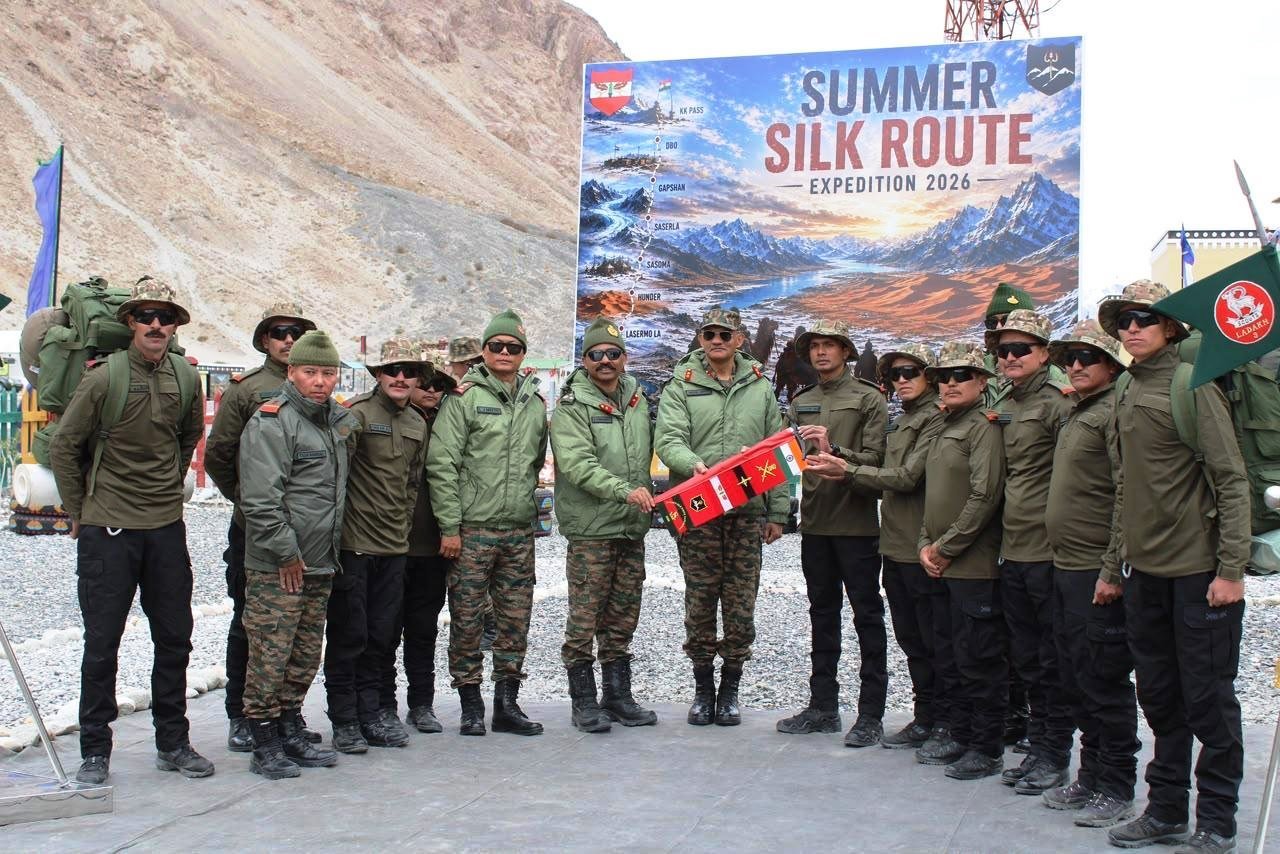
In a compelling display of operational readiness and cultural stewardship, the Indian Army’s Fire & Fury Corps has launched a 12-day summer expedition along the historic Old Silk Route in Ladakh region. Flagged off from Leh by senior officers of Fire & Fury Corps, the mission covers a demanding 264-kilometre stretch through some of the world’s most inhospitable high-altitude terrain, with elevations ranging from 11,000 to 18,000 feet.
Keywords: Indian Army Silk Route Expedition, Fire and Fury Corps Ladakh, High Altitude Training Ladakh, Old Silk Route Heritage, India PoJK Strategic Significance, Ladakh Defence Operations
Soldiers are navigating icy winds, rarefied air, and treacherous passes while retracing ancient caravan paths that once linked the civilisations of India, Tibet, China, and Central Asia. The expedition not only honours Ladakh’s pivotal role as a vibrant crossroads of trade, ideas, and Buddhism but also serves as a rigorous training module in extreme conditions. It emphasises endurance, teamwork, and leadership, core attributes essential for operations in high-altitude border regions.
Beyond physical conditioning, the initiative strengthens the timeless bond between the Indian Army and the people of Ladakh. By engaging with local communities and reviving narratives of trans-Himalayan exchange, it reinforces trust and mutual support in a strategically vital sector. Such endeavours underscore the Army’s multifaceted role: defender of territory, guardian of heritage, and partner in regional development.
The Old Silk Route’s historical extensions once branched into areas that today form parts of Pakistan-occupied Jammu and Kashmir (PoJK), including Gilgit-Baltistan. These ancient linkages highlight the enduring geostrategic significance of the broader Himalayan frontier. In the contemporary context, the expedition subtly reaffirms India’s presence and resolve along these contested landscapes, where history, culture, and security converge. It serves as a reminder that control over such corridors remains central to regional stability and India’s long-term strategic posture in the Union Territories.
As India modernises its high-altitude warfare capabilities amid evolving threats, initiatives like this Silk Route Expedition blend tradition with tactical preparedness. They prepare troops for real-world contingencies while projecting soft power through cultural engagement. In an era of assertive border management, such operations embody the seamless integration of military prowess with civilisational continuity.
Another very important aspect emerges when one sees this expedition from a strategic point of view. As is known to the whole world, present Indian leadership is continuously reiterating its resolve to take PoJK back from the clutches of Pakistan. An expedition on the same silk route, not only the extension of which is in Gilgit- Baltistan region but this region is also very important for India to connect with the whole world. Revisiting the past and reminding the world and the adversaries about our claim is a very important aspect of this expedition.
The successful completion of this expedition will undoubtedly add another chapter to the Indian Army’s legacy of operating with professionalism and purpose in the world’s highest battlegrounds.

contact: drrajeshjauhri@gmail.com
Dr Rajesh Jauhri is a Journalist with an experience of over 25 years in Indian and foreign media, a Social Scientist, an Ac-complished Author, a Political & Strategic Analyst, a Marksman (Rifle & Pistol), an Orator, a Thinker and an Educationist. He holds a Ph.D. degree on “Impact of colonial heritage on Indian police”. He runs an NGO dedicated to the social and eco-nomic uplift of tribal communities in MP and two decades back, he established a school in a village of Indore district, providing education and moral values to children belonging to underprivileged and minority families. Has received multiple awards in various fields.