
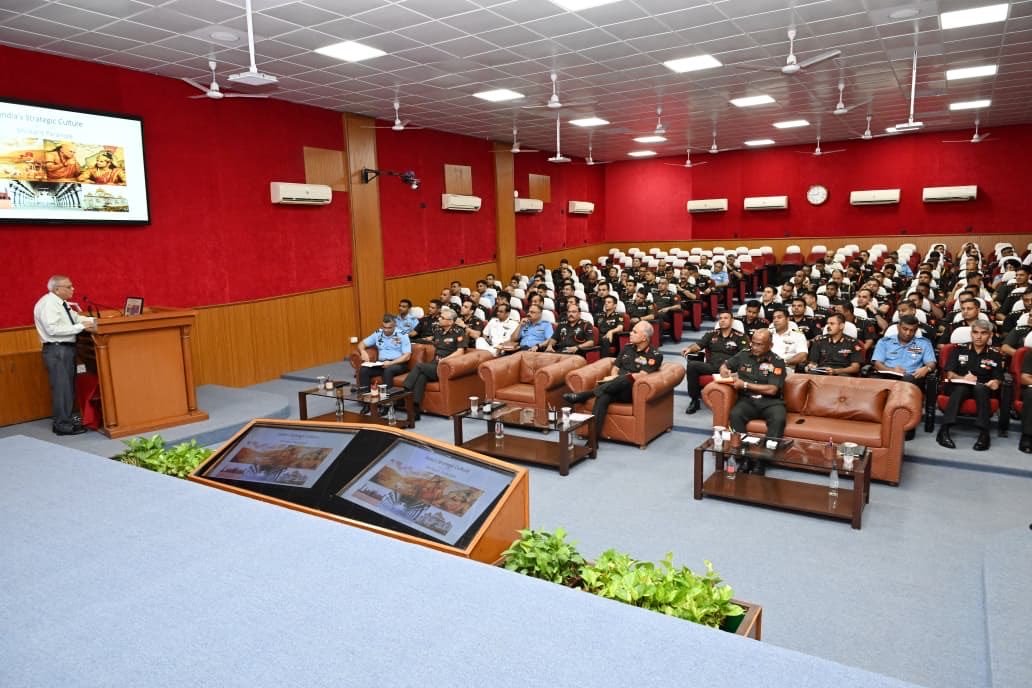
Mhow: In an era where strategic thinking increasingly draws upon both historical precedents and contemporary realities, the Army War College (AWC) in Mhow, Madhya Pradesh, hosted a compelling session that bridged ancient Indian intellectual traditions with the demands of modern military leadership. Titled “Ancient Wisdom to Modern Statecraft @ Arthashastra,” the lecture by Prof Shrikant Paranjpe offered thought-provoking insights into the enduring relevance of Kautilya’s seminal work and its influence on the evolution of India’s strategic culture.Prof Paranjpe, Head of the Department of Defence and Strategic Studies at Savitribai Phule Pune University and a distinguished scholar with extensive contributions to the study of Indian strategic thought, addressed officers of the Higher Command Course (HCC).
The HCC is a prestigious programme designed for Colonel-rank and equivalent officers from the Army, Navy, and Air Force, focusing on advanced strategic leadership, joint operations, and doctrinal development.
Kautilya’s Visionary Legacy Kautilya, also known as Chanakya, the ancient Indian scholar and strategist who served as the chief advisor to Emperor Chandragupta Maurya in the 4th century BCE, authored the ‘Arthashastra’, a comprehensive treatise on statecraft, economics, military strategy, diplomacy, and governance. Far from being a relic of antiquity, the text remains a cornerstone for understanding pragmatic realism in politics and security.
During his address, Prof. Paranjpe delved into the visionary aspects of Kautilya’s philosophy, highlighting how concepts such as the ‘Mandala’ theory of interstate relations, intelligence gathering, and the balance between ‘Dharma’ (ethical duty) and ‘Artha’ (material prosperity) continue to resonate in today’s complex geopolitical landscape. He explored how these ancient principles have shaped, and can further inform, India’s approach to national security in an increasingly multipolar world.
Attendees described the session as enriching, with Prof Paranjpe drawing connections between classical Indian thought and the contemporary challenges faced by military leaders. The lecture emphasised the evolution of India’s strategic culture, from its civilizational roots through colonial influences to its post-independence articulation under leaders who blended idealism with pragmatic realism.
India’s Strategic Culture in Transition. Prof Paranjpe, author of the acclaimed book ‘India’s Strategic Culture: The Making of National Security Policy’ (Routledge), has long advocated for a nuanced understanding of how historical, cultural, and geopolitical factors mould a nation’s security policy. In his writings and lectures, he underscores that India’s strategic outlook is not merely reactive but rooted in a deep civilizational ethos that values strategic autonomy, cultural resilience, and ethical governance.
The session at AWC aligned seamlessly with the College’s mandate to prepare senior officers for higher command responsibilities through participative learning and doctrinal innovation. Interactions like these foster a deeper appreciation among participants for how ancient wisdom can provide timeless frameworks for decision-making in areas ranging from border management and regional diplomacy to technological integration in warfare.
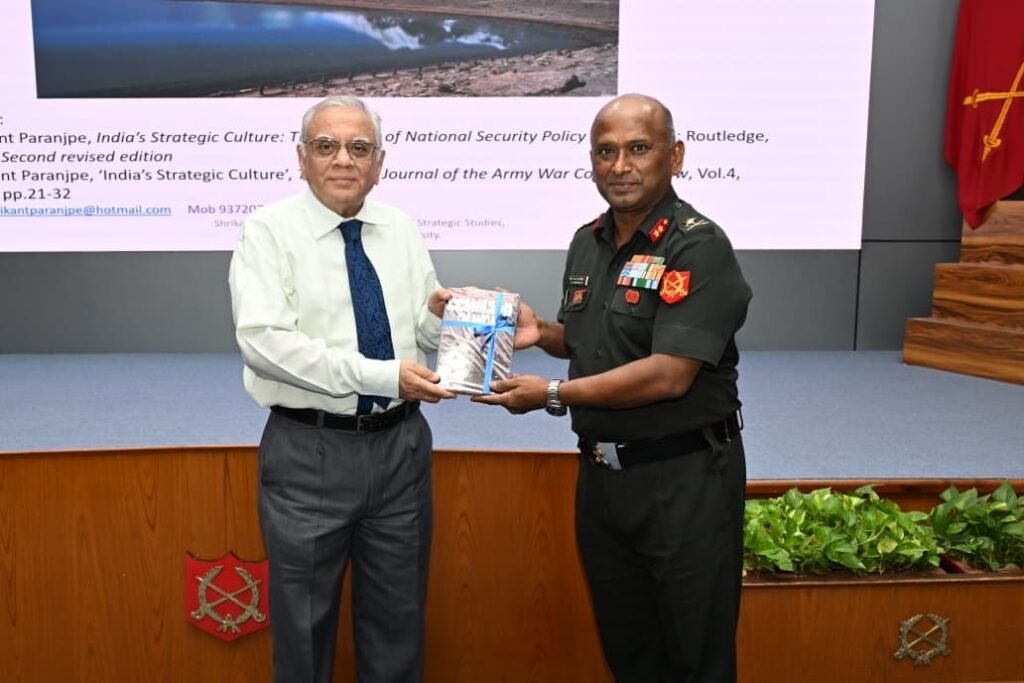
A notable moment included the presentation of a memento by Maj Gen SS Kartikeya, Commander, Higher Command Wing of AWC, symbolising the fruitful exchange between academia and the armed forces.
Relevance in Today’s Context As India navigates a dynamic strategic environment marked by technological disruptions, hybrid threats, and shifting alliances, initiatives like this lecture underscore the Indian military’s commitment to intellectual rigour and historical awareness. By engaging with texts like the ‘Arthashastra,’ future commanders are better equipped to craft responses that are both rooted in tradition and adaptive to modernity.
The AWC, often referred to as the ‘cradle of military leadership’ where officers earn their stripes, continues to play a pivotal role in shaping the intellectual backbone of the Indian Armed Forces. Events such as Prof Paranjpe’s address reinforce the synergy between scholarly expertise and operational excellence.This engagement not only honours India’s rich intellectual heritage but also signals a forward-looking strategic culture, one that draws strength from its past to secure its future. As global security paradigms evolve, such dialogues between academia and the military will remain indispensable.
contact: drrajeshjauhri@gmail.com
Dr Rajesh Jauhri is a Journalist with an experience of over 25 years in Indian and foreign media, a Social Scientist, an Ac-complished Author, a Political & Strategic Analyst, a Marksman (Rifle & Pistol), an Orator, a Thinker and an Educationist. He holds a Ph.D. degree on “Impact of colonial heritage on Indian police”. He runs an NGO dedicated to the social and eco-nomic uplift of tribal communities in MP and two decades back, he established a school in a village of Indore district, providing education and moral values to children belonging to underprivileged and minority families. Has received multiple awards in various fields.