

Introduction
In the evolving West Asian geopolitical landscape, the Strait of Hormuz has emerged as the fulcrum of global energy security. Apart from a maritime passage, it is now a critical geographic vulnerability with immense implications on the global economic system. The continuing conflict in the region highlights the effectiveness of disruption over outright closure, as a more effective strategic tool[i]. The narrow shipping lanes near Iranian waters create structural asymmetry, compelling defenders to secure every vessel, while disruptors need to only generate uncertainty.
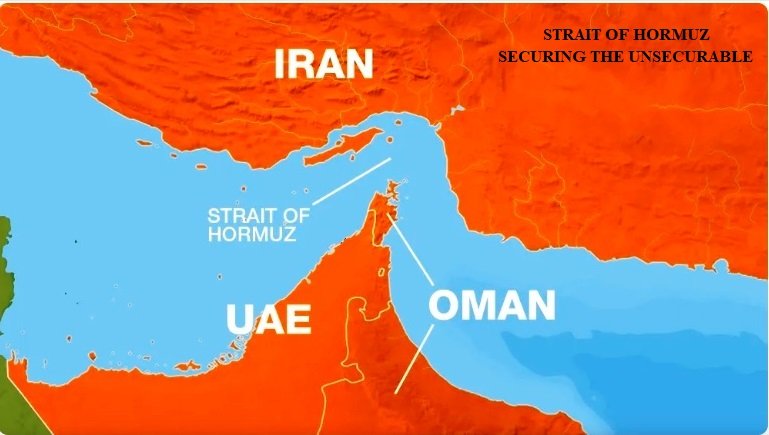
The Strait of Hormuz handles nearly one-fifth of global oil consumption which is about 20 million barrels per day. This is almost a quarter of the total seaborne oil trade[ii]. The strait situated between Iran and Oman, links the Persian Gulf with global markets and serves as the primary export route for major Gulf producers, including Saudi Arabia, Iraq, Kuwait, UAE and Qatar. Security of the waterways remain indispensable for energy-dependent economies such as India, China, Japan, South Korea, and parts of Europe.
Implications and Impact of Geography
At its narrowest the Strait of Hormuz is just 33 kilometres wide, with shipping lanes compressed into even tighter corridors of just two nautical miles wide in each direction. Huge oil tankers and LNG carriers are forced into predictable routes, creating inherent vulnerability. The risk is further amplified by Iran’s rugged and elevated coastline and islands that provide ideal positions for surveillance and targeting. The geography of the Strait allows Iran to wield greater influence than its limited naval strength and exert disproportionate influence over one of the world’s busiest energy corridors.
This geographical advantage has led to a new reality where disruption matters more than complete closure. Traditional ideas of controlling chokepoints through blockades or military action do not entirely apply to the Strait of Hormuz. The Strait need not be fully closed to affect global trade. Even limited actions such as attacks on ships, laying mines, or harassing vessels can disrupt maritime traffic and create wider economic effects[iii]. The risk increases further because of Iran’s growing asymmetric capabilities, including its expanding drone arsenal.
Even short-term interruptions in the past have sharply reduced maritime traffic, sometimes by as much as 80 percent. Such disruptions have also caused Brent crude prices to rise by around 15 to 20 percent within days[iv]. Alternate routes are available, but do not have the similar capacity or cost efficiency as the Strait of Hormuz. This makes the Strait a major global vulnerability as the impact of disruption goes far beyond energy markets. Its effects swiftly spread through global supply chains and affect everyday life. Higher energy prices increase transportation and manufacturing costs and raise food prices because fertiliser and logistics become more expensive. Consequently, inflation rises and steadily reduces purchasing power across economies.
The current crisis must be understood as part of a larger network of maritime chokepoints. The Red Sea is already facing disruptions due to Houthi attacks. Thus, many ships are now forced to take longer routes around Africa. This emphasises an important reality that even comparatively weaker actors can disrupt global trade. The impact of similar instability in Strait of Hormuz will not remain limited to the region. It could create widespread global consequences.
Global Power Dynamics
Rivalry and Interdependence. The Strait of Hormuz is central to the global power politics, where competition and mutual dependence exist together. The United States maintains a strong naval presence to ensure free movement of ships and prevent blockades. China relies heavily on uninterrupted energy supplies from the Gulf. Regional countries also see the Strait as both an economic lifeline and a strategic tool. Despite their different interests, all major players share a common need to keep the Strait open. This creates an important paradox; the Strait is both an area of possible conflict and a place of limited but necessary cooperation.
Efforts to mitigate risks in the Strait of Hormuz are intricate due to political fragmentation in the region. The Gulf Cooperation Council lacks full strategic cohesion[v]. Saudi Arabia and the UAE have often pursued divergent regional policies. This fragmentation limits the development of effective collective resilience mechanisms.
Trade. Roughly twenty percent of global oil trade transits through Hormuz, along with a substantial portion of LNG exports, particularly from Qatar. This makes it the single most important energy chokepoint in the world after Malacca. Even minor disruptions have immediate and far-reaching consequences. The recent surge of Brent crude prices by around 11%, with price of barrel going beyond $100 and contraction in shipping activity with traffic reportedly dropping by over 80% at peak disruption, triggered cascading inflationary pressures across energy-importing economies from India to Europe. This underscores that the Strait’s critical importance lies not just in the sheer volume of energy it carries, but in the absence of any viable redundancy, as no alternative route exists at scale to compensate for its disruption.
Oil Prices. The consequences of disruption extend far beyond energy markets. Fuel shortages caused disruption in aviation operations, break-down in supply chains and spread of inflationary pressures across global economies[vi]. For major importers like India, the impact is especially severe as it affects fiscal stability, weakens currency strength and slackens growth trajectories.
Insurance Impact on Commercial Shipping. The militarily significant lesson from the blockades is that the Strait need not be physically obstructed to be effectively “closed.” In present-day global trade, commercial shipping is critically dependent on insurance mechanisms. When perceived risks rise significantly and insurers either increase premiums exorbitantly or withdraw coverage altogether, shipping companies often adjourn operations. This result is instant drop in tanker movement and disruption of trade flows. Traffic in Hormuz dropped substantially not because of direct obstruction, but because the route was considered excessively risky by insurers. This reflects the ability to disrupt commerce which now extends beyond military action. Financial instruments, market perceptions, and psychological factors have emerged as equally powerful tools in shaping outcomes.
Strategic Signalling and Influence of Iran
Iran’s naval doctrine, especially under the Islamic Revolutionary Guard Corps (IRGC), is positioned on asymmetric maritime warfare. Although its conventional navy is limited, Iran’s disruptive capabilities are significant. These include swarm-capable fast attack craft, naval mines, mini-submarines, coastal anti-ship missiles, explosive small boats and a rising drone arsenal. Rather than overwhelming a superior navy directly, these systems are envisioned to make safe navigation costly and risky. Even if major assets are destroyed, mines, drones, and small-boat attacks can sustain disruption.
For decades, Iranian threats to shut Strait of Hormuz were considered as rhetorical deterrence, since such closure would also impair Iran’s own energy exports. Recent developments suggest a doctrinal shift. Iran has increasingly framed the ongoing conflict in existential terms, indicating that if its security is threatened, regional stability will also be at risk. Hormuz has now evolved from a mere deterrent into a dynamic tool of coercion, with Iran preferring calibrated disruption rather than a total blockade that would actuate overwhelming retaliation. Iran’s strategy suggests asymmetric leverage, underlining disruption over dominance[vii]. This controlled unpredictability may enhance its bargaining power in broader geopolitical negotiations by its ability to disrupt global energy flows when required. As a result, Hormuz is no longer assumed as a binary space that is either open or closed. Instead, it operates along a spectrum of usability, where even limited instability can significantly degrade its functionality and global economic role.
Indian Concerns
With most of India’s 85% imports of crude oil and LNG from the Gulf, the Strait of Hormuz is a major strategic vulnerability. Any disruptions increase inflation, strain public finances, disrupt industry and agriculture, and deepen dependence on other supply chains. Strategic reserves, supplier diversification, and naval preparedness help, but cannot offset Hormuz’s central importance to India’s energy security[viii]. Recognising this, the Indian Navy treats Hormuz as a primary area of interest and a key maritime choke point. Along with passages such as Strait of Malacca, Bab-el-Mandeb, and Suez Canal, it directly affects India’s trade, maritime interests, and economic stability.
Challenges in Securing Hormuz
The efficacy of Naval power though essential in managing risks in the Strait of Hormuz, is at times constrained. The United States and its allies have overwhelming naval superiority, yet securing Hormuz remains challenging. Escorting daily traffic requires major resources, prolonged operations strain fleets, and mines and small-boat attacks can still disrupt commerce. Minesweeping is slow and dangerous and low-level threats cannot be fully mitigated. Even a single efficacious attack can disrupt shipping. Hormuz therefore cannot be “secured” in the traditional military sense[ix]. Reopening the strait after disruption entails restoring commercial confidence as physical safety. Insurers, shipping firms, and markets decide whether traffic resumes normally. Even after threats decline, high insurance costs and lingering risks can keep shipping subdued. In practice, the strait is open only when it is economically viable to use.
The deployment of 2,500 Marines and amphibious assets by US signal a clear intent to ensure freedom of navigation[x]. US has pursued allied participation in a broader maritime security coalition. However, sustained escort missions are operationally demanding and difficult to maintain over time. Insurance guarantees may reduce risk, but they cannot eliminate it. The fundamental issue that military presence alone cannot fully neutralise asymmetric disruption persists.
Myth of Alternatives. The regional actors, in response to vulnerabilities in the Strait of Hormuz, have developed alternative routes, but these alternatives have major limitations. These include the Saudi East–West Pipeline to the Red Sea, the UAE’s Abu Dhabi–Fujairah pipeline that bypasses Hormuz, and the option of rerouting tankers around the Cape of Good Hope[xi]. The capacity of alternatives is inadequate to replace the volumes that pass-through Hormuz, apart from higher costs and longer transit times. These routes are also vulnerable to attacks, as seen in Houthi strikes. Therefore, while these options offer partial relief, they cannot substitute the central role of the Strait.
Future Trends in Warfare
The Hormuz crisis unwraps broader trends in modern conflicts. Asymmetric tactics can equipoise conventional inferiority and financial systems are now integral to warfare outcomes[xii]. Perception management is now as important as physical control of spaces and globalisation has created deep systemic vulnerabilities. In this context, chokepoints are no longer merely geographic features. They have evolved into complex hybrid battle spaces.
The evolving realities demand a more nuanced understanding of security beyond traditional military frameworks. While deterrence and maritime presence remain essential, stability increasingly depends on economic mechanisms that sustain trade and insurance confidence, efforts that prevent escalation, and advanced technologies that strengthen monitoring and resilience. In this integrated methodology, security is no longer defined solely by control of sea lanes, but by the ability to maintain confidence, ensure continuity, and withstand disruptions.
Conclusion
The Strait of Hormuz will continue to be world’s most critical and most vulnerable energy chokepoint. Securing it is not simply a matter of deploying more warships but requires integrated military and financial strategies. It demands sustained international coordination and calls for risk mitigation rather than the illusion of complete risk elimination. The broader lesson that in an interconnected world, the weakest link can shape the fate of the entire system. Hormuz is therefore not just a passage of water, it is a test of whether global order can withstand the pressures of modern, hybrid conflict.
[i] Nataliia Katser-Buchkovska, “Decoding the Hormuz Shock,” The Times of India, Always Question, March 25, 2026
[ii] https://gulfnews.com/business/energy/will-reopening-hormuz-quickly-reverse-damage-from-near-three-month-closure-1.500551766
[iii] The Times of India, “Strait of Hormuz: Why Reopening It Is So Tough,” Times Nation, March 26, 2026.
[iv] Himendra Kumar, “The Strait of Hormuz and the New Geography of Energy Security,” Takshashila Geospatial Bulletin, no. 15.
[v] https://gulfnews.com/uae/uae-no-party-can-dominate-the-strait-of-hormuz-1.500552386
[vi] https://apnews.com/article/afghanistan-iran-war-hormuz-supplies-fa22df522fef9a4db873d4e8d9df0013
[vii] https://www.aljazeera.com/news/2026/5/20/iran-says-it-coordinated-crossing-of-26-vessels-out-of-strait-of-hormuz
[viii] India Today News Desk, “Good News for India: UAE Can Now Send More Oil via Fujairah, Bypassing Hormuz,” India Today, April 29, 2026.
[ix] The Times of India, “Strait of Hormuz: Why Reopening It Is So Tough,” Times Nation, March 26, 2026.
[x] Akash Chatterjee, “Iran Approves Strait of Hormuz Toll Plan, Bans US, Israeli Vessels,” India Today, March 31, 2026.
[xi] https://gulfnews.com/business/energy/will-reopening-hormuz-quickly-reverse-damage-from-near-three-month-closure-1.500551766
[xii] John Sipher, “The Age of Asymmetry: The Weak Have Learned How to Make the Strong Bleed,” Tomorrow’s Affairs, April 30, 2026.

Brigadier (Retd) Preet Pal Singh, AVSM, VSM is an Army veteran with over 35 years of distinguished service. After retirement, he served as a Senior Research Fellow at a leading national think tank focused on defence and strategic affairs. He currently holds a senior corporate leadership role overseeing security architecture and risk management, while also contributing regularly to defence discourse as a speaker and writer.