

The Captagon earned its grim nickname as the Jihadi Drug not through exaggeration, but through its documented role in the battlefields of the Middle East.[i] Originally developed in the 1960s as a pharmaceutical containing fenethylline (a synthetic stimulant that metabolises into amphetamine and theophylline), it was intended to treat conditions like narcolepsy and depression.
By the 1980s, it was banned in most countries due to its high addictive potential and harmful side effects.[ii] In the chaos of the Syrian civil war and subsequent regional conflicts, however, Captagon found a deadly second life.[iii] In war-torn area of Syria and Lebanon, large-scale clandestine laboratories began mass-producing the drug. It suppresses fatigue, reduces fear and inhibitions, and allows fighters to remain operational for days with little sleep.
While its direct link to terrorist groups is sometimes overstated in popular narratives, the ground reality is clear: Captagon has become a lucrative commodity in conflict economies.[iv] Its profits have helped sustain armed networks, militias, and criminal enterprises amid sanctions and collapsed governance.[v] In the Gulf countries, particularly Saudi Arabia, it has also fuelled a serious public health crisis, with widespread abuse among young men seeking stimulation or escapism.[vi]
This is the dangerous substance that arrived on Indian shores in May 2026.
Operation RAGEPILL began with intelligence shared by a foreign drug law enforcement agency warning that India was being eyed as a transit route. Acting on the tip, NCB officers raided a house in Neb Sarai, South Delhi, on 11 May 2026.[vii] Inside a commercial chapati-cutting machine scheduled for export to Jeddah, they recovered 31.5 kg of Captagon tablets.[viii]
The tenant of the house was a Syrian national who had entered India on a tourist visa in November 2024, His visa had expired in January 2025, yet he had continued to stay illegally. Questioning of the accused led investigators to Mundra Port in Gujarat. On 14 May, a container imported from Syria officially carrying sheep wool was thoroughly examined.
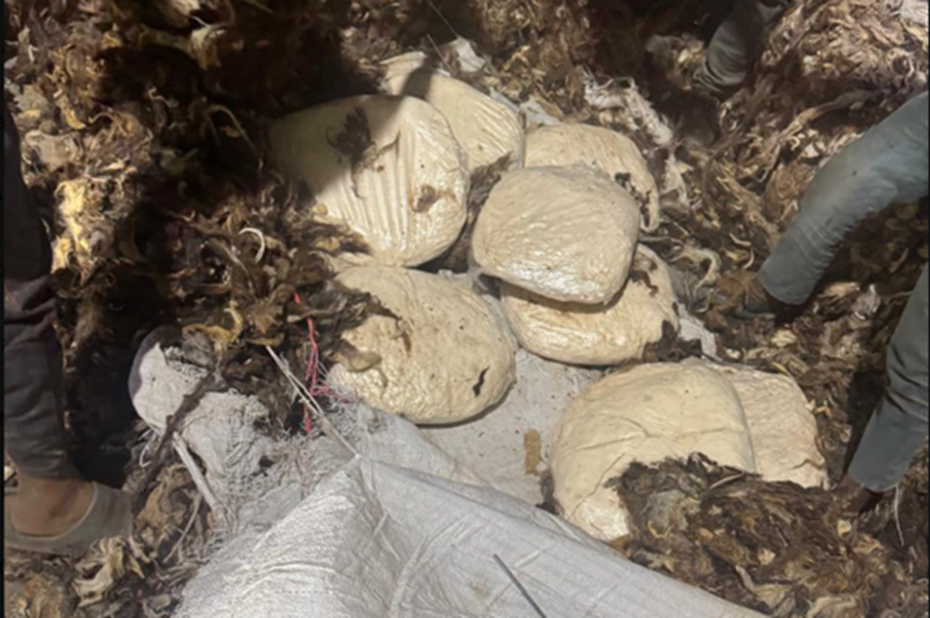
Hidden inside were three bags containing 196.2 kg of Captagon powder. The total seizure stood at 227.7 kg, with an estimated street value of around ₹182 crore in the destination Gulf markets.[ix] This marked India’s first-ever seizure of Captagon. The modus operandi was professional. The syndicates had used legitimate commercial cargo and trade routes to move the drug from Syrian production zones through India for onward shipment to Saudi Arabia and neighbouring countries.
It was a calculated attempt to exploit India’s busy ports and growing trade volumes with West Asia. Union Home Minister Amit Shah congratulated the NCB team and was categorical in his message; the Modi government’s policy of zero tolerance would not allow Indian Territory to become a comfortable transit corridor for international drug syndicates.[x]
“We will clamp down on every gram of drugs entering India or leaving the country using our territory as the transit route,” he stated.
This operation is significant for several practical reasons. First, it confirms an emerging pattern. Just weeks earlier, the NCB had seized 349 kg of cocaine in Mumbai hidden in a container from Ecuador. International syndicates are clearly testing multiple routes through India both for drugs entering for local consumption and for those merely passing through. India’s long coastline, major container ports like Mundra, and expanding legitimate trade make it an attractive mid-point for such logistics.
Second, the Syrian connection raises legitimate concerns. Overstaying foreign nationals, hawala networks, and complex logistics chains can easily overlap with other security threats. The NCB has rightly launched a deeper investigation into the full network procurement sources in Syria, financial trails, logistics facilitators, and final receivers.
For India, this is less about one successful bust and more about new problems which are emerging. As the country integrates further into global trade, its exposure to transnational organised crime increases. The strengths that drive economic growth busy ports, high cargo volumes, and open commercial routes are the same features that criminals seek to exploit.
Preventing India from becoming a preferred transit hub requires consistent, unglamorous effort: better risk profiling at ports, faster adoption of scanning technology, tighter coordination between NCB, Customs, and intelligence agencies, and quicker action on overstaying foreigners involved in criminal activity.
Operation RAGEPILL is a solid operational success that demonstrates improved responsiveness and international intelligence cooperation. But it also serves as a clear early warning. The syndicates are adapting. India must now build systems and procedures that make such transit attempts consistently difficult, expensive, and risky. In the long run, winning against narco-trafficking is not about dramatic single victories it is about creating structural disadvantages for the networks that try to use Indian soil for their illicit business.
[i] https://www.aljazeera.com/news/2023/5/9/what-is-captagon-the-addictive-drug-mass-produced-in-syria
[ii] https://pmc.ncbi.nlm.nih.gov/articles/PMC10977473/
[iii] https://www.trtworld.com/article/18244830
[iv] https://ctc.westpoint.edu/the-future-of-the-illicit-captagon-drug-trade/
[v] https://newlinesinstitute.org/wp-content/uploads/20220404-Captagon_Report-NLISAP-final-1.pdf
[vi] https://www.atlanticcouncil.org/blogs/menasource/middle-east-captagon-crisis/
[vii] https://www.pib.gov.in/PressReleasePage.aspx?PRID=2261701®=3&lang=1
[viii] https://www.ndtv.com/india-news/in-1st-captagon-bust-227-kilograms-of-jihadi-drug-worth-rs-182-crore-seized-11504170
[ix] https://x.com/ANI/status/2055574403069722957?s=20
[x] https://indianexpress.com/article/india/union-home-minister-amit-shah-hails-ncb-for-seizing-rs-182-crore-jihadi-drug-10692751/
Punit Shyam Gore (MA Defence and Strategic Studies) is an alumnus of the School of Internal Security, Defence & Strategic Studies of the Rashtriya Raksha University, Gandhinagar (an institution of national importance) under the Ministry of Home Affairs, Government of India.