


Introduction
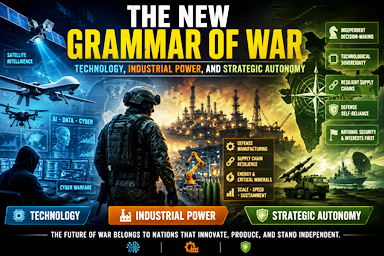
Contemporary conflicts and the rapid rise of global defence-industrial giants are reshaping the nature of military power in the 21st century. The dominance of companies such as Lockheed Martin, RTX, Northrop Grumman, AVIC, and many other American, European, and Chinese firms demonstrates that strategic power today rests not merely on battlefield capabilities, but on deep technological ecosystems, industrial capacity, software control, innovation, and sustained research and development. Modern military systems are increasingly driven by artificial intelligence, cyber networks, semiconductors, autonomous systems, electronic warfare, secure communications, and integrated digital architectures, making technological sovereignty as important as conventional firepower.
Recent conflicts, from the Russia-Ukraine War to West Asia, have reinforced a critical lesson; wars cannot be sustained on imported technologies alone. Nations that possess strong indigenous industrial ecosystems can innovate, absorb disruptions, sustain prolonged operations, and adapt under pressure. For India, these developments underline the importance of Atmanirbharta not merely as domestic manufacturing, but as genuine control over critical technologies, supply chains, software architectures, propulsion systems, sensors, encryption, and advanced defence ecosystems. While India has made important progress in indigenous missiles, drones, naval platforms, and networked warfare capabilities, critical gaps remain in areas such as aero-engines, advanced electronics, semiconductors, and core digital architectures that are essential for long-term strategic autonomy.
Indicators from SIPRI
The latest rankings of global defence companies reveal that military power in the 21st century is rooted in industrial depth, technological ecosystems, and sustained innovation capacity rather than merely battlefield strength. According to data compiled by Voronoi App using figures from the Stockholm International Peace Research Institute (SIPRI), American defence firms continue to dominate the global arms industry. Lockheed Martin retained the top position with arms revenues of approximately $64.65 billion, followed by RTX Corporation at $43.6 billion and Northrop Grumman at $37.85 billion. BAE Systems generated $33.79 billion in arms revenues, while General Dynamics remained among the leading global defence manufacturers. American companies occupied six of the world’s top ten positions, underlining the scale advantage enjoyed by the United States defence-industrial ecosystem.
The rankings also demonstrate the continued strength of European defence firms such as Airbus Defence and Space, Thales Group, Leonardo, and Rheinmetall, alongside the growing presence of large Chinese state-backed conglomerates including AVIC and CETC. SIPRI data further indicates that the combined arms revenues of the world’s top 100 arms-producing companies reached a record $679 billion in 2024, marking a 5.9 percent increase over the previous year and the highest level ever recorded by the institute. Over the decade from 2015 to 2024, total arms revenues of the Top 100 companies increased by nearly 26 percent.
Role of Conflicts in Shaping Military Technology
The SIPRI data also reflects how contemporary geopolitical instability is driving rapid growth in global defence spending. The wars in Russia-Ukraine War and West Asia have accelerated military modernisation and weapons demand across different regions. According to SIPRI, 39 American companies in the Top 100 generated combined arms revenues of approximately $334 billion in 2024 alone, while European firms recorded major increases as governments expanded defence spending in response to the deteriorating security environment. Russian arms revenues reportedly grew by 23 percent despite sanctions, while Middle Eastern defence firms also recorded significant growth.
What is particularly significant, however, is that these firms are no longer merely manufacturers of military hardware. They represent integrated technological ecosystems encompassing aerospace, cyber systems, artificial intelligence, semiconductors, radars, missile systems, secure communications, electronic warfare, advanced manufacturing, and software-driven military architectures. Modern military power increasingly depends not simply on owning platforms such as aircraft, missiles, or warships, but on controlling the software, supply chains, data systems, and technological architectures that enable those platforms to function effectively in combat.
Implications for India
For India, the implications of contemporary conflicts and global defence industry trends are profound. The dominance of American and Chinese defence companies reflects decades of sustained investment in indigenous research and development, advanced manufacturing, artificial intelligence, cyber systems, electronics, and integrated defence-industrial ecosystems. The critical lesson is that contemporary military power is no longer determined by possession of advanced weapons, but by the strength, resilience, and technological sovereignty of the national industrial ecosystem supporting them.
While imported platforms do provide immediate operational capability, prolonged conflicts can only be sustained through indigenous production, repair, innovation, software control, secure supply chains, and technological adaptation. Consequently, atmanirbharta in defence cannot remain limited to assembling foreign-origin systems domestically; genuine strategic autonomy requires sovereign control over design capabilities, software architectures, sensors, propulsion systems, encryption technologies, upgrade cycles, and critical supply chains. In future wars characterised by sanctions, disrupted global logistics, cyber-attacks, and prolonged mobilisation, continued dependence on foreign OEMs could emerge as a serious national security vulnerability.
Future Warfare Will Be Multi-Domain
- Modern conflicts indicate that future warfare will be driven by the integration of multiple domains rather than by any single technology. Drones, stealth aircraft, cyber warfare, hypersonic weapons, and electronic warfare will coexist and operate together within integrated battlefield networks. Emerging technologies are not replacing traditional military systems entirely; they are transforming how these systems interact and function jointly. Success in future wars will depend less on acquiring advanced platforms individually and more on integrating them effectively through resilient operational architectures, rapid decision-making, and technological adaptability.
- These trends showcase the need for innovation and the ability to merge civilian technological ecosystems with military requirements. Countries that are able to integrate industry, academia, private technology firms, and defence institutions are likely to gain significant strategic advantages. For India, this necessitates greater collaboration between the armed forces, DRDO, private industry, start-ups, and research institutions, along with sustained investments in indigenous defence and advanced technologies.
- Contemporary conflicts also demonstrate that wars are no longer fought only on battlefields. They are increasingly contests between entire national ecosystems which include industrial, technological, economic, informational, and military. Strategic endurance now matters equally as battlefield superiority. Military power depends not only on weapons and platforms, but also on industrial capacity, economic resilience, and the ability to sustain prolonged conflict under pressure.
- The Russia-Ukraine War has shown that Ukraine’s resilience depended not only on Western military assistance, but also on its ability to improvise indigenous drone production, decentralise repair networks, integrate civilian technologies into military operations, and innovate continuously on the battlefield. Similarly, Iran has sustained regional influence for decades despite sanctions and isolation through indigenous missile programmes, drone technologies, and asymmetric warfare capabilities developed over time.
- The larger strategic lesson is clear. Countries which depend on imported military technologies remain vulnerable during prolonged crises. Supply chains can be disrupted, spare parts denied, software support restricted, and external political pressures can limit access to critical systems precisely when they are needed most. For India, long-term security cannot rely excessively on imported technologies or external support during crises. Genuine military preparedness requires a strong indigenous industrial and technological base capable of supporting sustained operations in uncertain environments.
- Given the possibility of a prolonged two-front contingency involving both continental and maritime theatres, the challenge for India is graver. Such a scenario could involve extended mobilisation, supply chain disruptions, cyber-attacks on logistics and communication systems, and simultaneous military pressures across multiple domains. In these circumstances, operational readiness and strategic flexibility will depend fundamentally on indigenous industrial capacity, technological sovereignty, and the ability to sustain prolonged conflict without excessive external dependence.
Conclusion
The major lesson emerging from modern conflicts is that military power today is increasingly determined by the resilience of national industrial and technological ecosystems rather than by weapon platforms alone. Modern technology and AI-enabled systems are transforming warfare, but their effectiveness ultimately depends on domestic innovation, manufacturing depth, secure supply chains, software sovereignty, and the ability to sustain prolonged conflicts without excessive external dependence. Countries that integrate defence preparedness with industrial policy, technological research, academia, private industry, and advanced manufacturing are likely to possess enduring strategic advantages.
For India, the path ahead requires moving beyond licensed production and assembly towards genuine technological sovereignty. Indigenous achievements such as advanced missile systems, warships, space capabilities, digital networks, and emerging autonomous platforms like Divyastra MK2 indicate important progress in building a self-reliant defence ecosystem. However, continued dependence on imported propulsion systems, critical electronics, advanced semiconductors, source codes, and foreign-controlled digital architectures remains a significant vulnerability.
The challenge therefore is not only to make weapons in India, but to master the technologies, industrial bases, and innovation networks that power them. In an age of geopolitical uncertainty and supply-chain disruptions, genuine Atmanirbharta will depend on India’s ability to create a resilient, integrated, an indigenous defence-industrial-technological base capable of sustaining national security under all conditions.
Endnotes
- Observer Research Foundation, “World Creativity and Innovation Day (21 April–Today) 2026: Sparks and Shields,” April 20, 2026, accessed May 8, 2026.
- LinkedIn, Ravinder Ravi Singh, “Why the Divyastra MK2 Matters Strategically, Not Just Technically,” April 2026, accessed May 8, 2026.
- Strategy and Defence Review: Spring 2026 Edition (New Delhi: Sabre and Quill Publishers, 2026), accessed May 8, 2026.
- Iswardi Ishak, “The World’s Largest Defense Companies by Arms Revenues,” Voronoi App, accessed May 8, 2026.
- BharatShakti, Nitin A. Gokhale, “Wars Can’t Be Fought on Imported Tech; Build Indigenous Capacity: Veterans at BSI Dialogues,” accessed May 8, 2026.
- Nitin A. Gokhale, “On The Shop Floor: Dynamatic Technologies and India’s Aerospace Manufacturing Journey,” YouTube video, accessed May 8, 2026, https://www.youtube.com/.
- Arun Prakash, “The Long Wait for Indigenous Engines,” The Tribune, accessed May 8, 2026.
- Snehesh Alex Philip, “Atmanirbharta in Defence Can’t Be Just about Making Weapons, Need Sovereignty: Air Marshal at Ran Samwad,” ThePrint, May 8, 2026, accessed May 8, 2026.
- “Army Bats for Rs 250 Crore Fund to End Startup ‘Trial Trap’, Proposal with MoD,” The New Indian Express, accessed May 8, 2026.
- Voronoi, “Arms Imports: Share of Global Arms Imports in 2025,” infographic, Visual Capitalist, March 2026, based on SIPRI Arms Transfers Database.
- Lt Gen V.K. Saxena (Retd), interview by Nitin A. Gokhale, “DAP 2026 Marks Shift from ‘Make in India’ to ‘Owned by India’,” BharatShakti YouTube Channel, YouTube video, accessed May 8, 2026, https://youtu.be/odYJLMhRD4w?si=fl1zjy9bpkavYpCJ.
- “Taking Innovation as a Serious Pillar of National Growth: Are the Green Shoots Visible?” YouTube video, accessed May 8, 2026, https://youtu.be/tqeXVVYvqb0?si=HteRE-Vn8GMgAvZQ.

Brigadier (Retd) Preet Pal Singh, AVSM, VSM is an Army veteran with over 35 years of distinguished service. After retirement, he served as a Senior Research Fellow at a leading national think tank focused on defence and strategic affairs. He currently holds a senior corporate leadership role overseeing security architecture and risk management, while also contributing regularly to defence discourse as a speaker and writer.
Recommended reading: השכרת מלווה בישראל
где сделать тату https://taty-salon-spb.ru