


Defence Chronicle New Delhi Correspondent
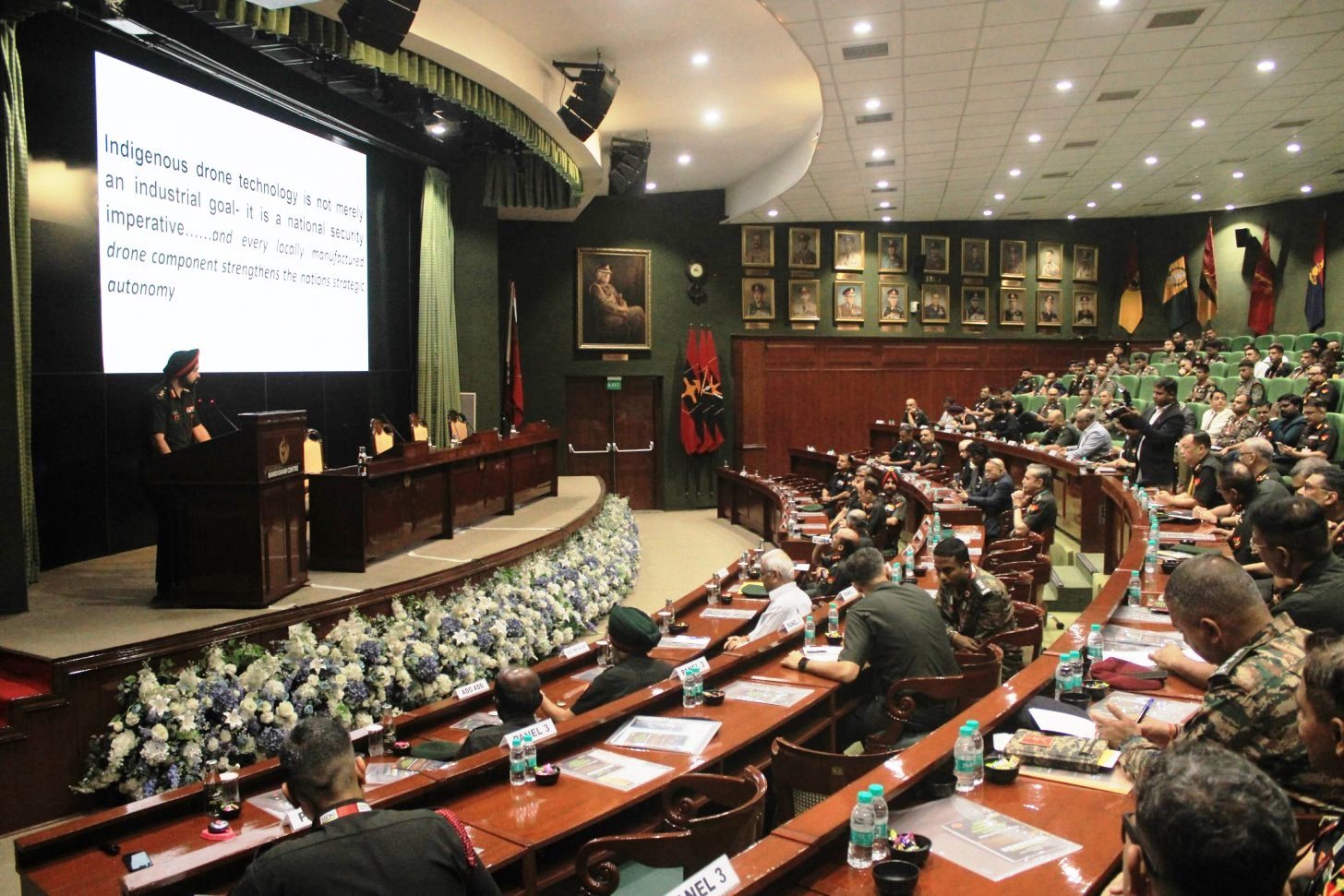
In a significant push towards enhancing indigenous unmanned capabilities, the Indian Army organised a two-day Symposium of Drone Component Manufacturers on May 12-13 at the Manekshaw Centre here. The event brought together leading domestic drone component manufacturers and senior representatives from all Army Commands to forge stronger civil-military collaboration.
Jointly driven by the Army’s Capability Development Directorate and the Society of Indian Defence Manufacturers (SIDM), the symposium focused on addressing critical technology gaps and operational requirements for scalable, high-quality drone production. Participants deliberated on key areas including propulsion systems, sensors, avionics, payloads, and components essential for both surveillance and combat drones tailored to the Army’s diverse operational environments.
A major highlight of the event was the release of the SIDM Compendium of Indigenous Drone Component Manufacturers by Lieutenant General Rahul R. Singh, Deputy Chief of the Army Staff (Capability Development and Sustenance). The compendium profiles 36 participating companies across five critical component categories and is expected to serve as a ready reference for future Army procurements, facilitating faster integration of indigenous solutions.
Senior defence officials described the symposium as a practical step in translating battlefield lessons, particularly the growing prominence of drones in modern conflicts, into structured indigenisation efforts. Discussions yielded a clear roadmap aimed at rapidly scaling both the quality and quantity of drone production while reducing dependence on imports for critical sub-systems.
This initiative aligns with India’s broader Atmanirbhar Bharat vision in defence. By deepening industry-military synergy at the component level, the Army seeks to build resilient supply chains capable of supporting large-scale induction of indigenous unmanned aerial systems, including loitering munitions and swarm technologies.
Defence analysts view the event as part of a sustained effort to create a robust domestic drone ecosystem. As threats evolve, such platforms are becoming central to intelligence, surveillance, target acquisition, and precision strike capabilities across high-altitude, desert, and jungle terrains. The successful conclusion of the symposium underscores the Indian Army’s proactive approach to future-ready capabilities. With the compendium now in hand, the focus is expected to shift towards rapid prototyping, testing, and induction, further strengthening India’s strategic autonomy in unmanned warfare.

contact: drrajeshjauhri@gmail.com
Dr Rajesh Jauhri is a Journalist with an experience of over 25 years in Indian and foreign media, a Social Scientist, an Ac-complished Author, a Political & Strategic Analyst, a Marksman (Rifle & Pistol), an Orator, a Thinker and an Educationist. He holds a Ph.D. degree on “Impact of colonial heritage on Indian police”. He runs an NGO dedicated to the social and eco-nomic uplift of tribal communities in MP and two decades back, he established a school in a village of Indore district, providing education and moral values to children belonging to underprivileged and minority families. Has received multiple awards in various fields.
Recommended reading: השכרת מלווה בישראל
сделать тату в спб сделать тату цена