
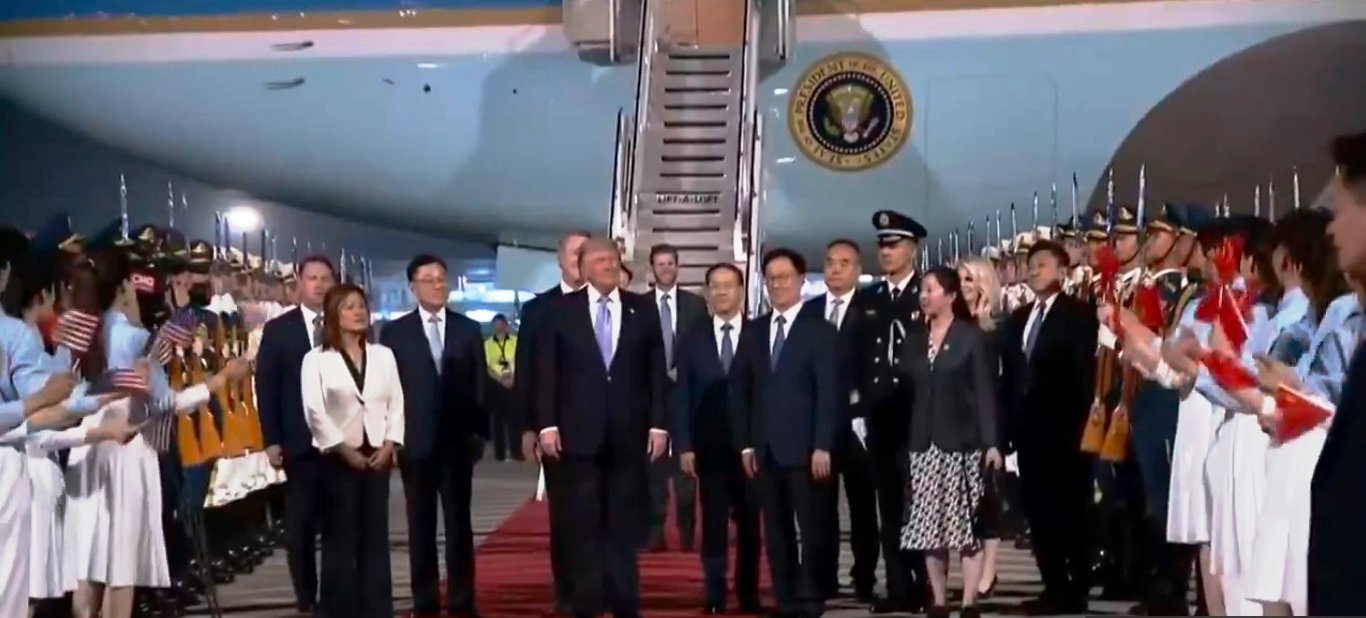
Beijing: President Donald J Trump touched down in Beijing on Wednesday evening, kicking off a two-day state visit to China, the first by a US president since his own trip in 2017. The arrival marks a significant diplomatic engagement between the world’s two leading powers amid persistent tensions over trade, technology, Taiwan, and the ongoing crisis in the Strait of Hormuz.
Trump was received with elaborate ceremonial pomp, including a military honour guard, a band performance, and a vibrant welcome by several hundred Chinese youth waving both American and Chinese flags. Chinese Vice President Han Zheng, the foreign minister, and senior officials were present as Trump stepped off Air Force One, accompanied by a high-profile business delegation that included Elon Musk of Tesla, Jensen Huang of Nvidia, Tim Cook of Apple, and other prominent CEOs. The delegation signals a strong emphasis on economic deliverables alongside strategic discussions.
Key talks are scheduled for Thursday at the Great Hall of the People. US officials aim to secure enhanced market access for American firms, progress on semiconductor supply chains and AI-related restrictions, and approximately $30 billion in tariff relief measures. On the security front, Washington is pressing Beijing to leverage its influence with Iran to help reopen the Strait of Hormuz, a critical chokepoint for global energy flows currently disrupted by regional conflict. Discussions are also expected to address Taiwan, including arms-related issues and the need to avoid destabilising actions in the Indo-Pacific.
Secretary of State Marco Rubio, joining the delegation despite past Chinese sanctions, adds weight to the diplomatic track. His presence underscores the administration’s intent to tackle both economic and geopolitical flashpoints directly with Chinese leadership.
This summit occurs at a delicate juncture. The US-China relationship remains the defining strategic rivalry of the era, influencing everything from supply chain resilience in critical defence technologies to stability in the Western Pacific. For the Indian Armed Forces and regional partners, outcomes on Taiwan contingencies, semiconductor controls, and freedom of navigation carry direct implications for deterrence and operational planning.
While expectations are tempered, breakthroughs on core strategic issues are rarely announced in single summits, the visit offers a platform for managing competition and exploring limited areas of cooperation. Observers will watch closely for signals on de-escalation in the Middle East and any recalibration of tech export regimes that could reshape global defence industrial dynamics.
As President Trump and President Xi Jinping meet, the world’s defence community will be assessing whether this engagement stabilises great-power relations or merely manages their inherent volatility.
contact: drrajeshjauhri@gmail.com
Dr Rajesh Jauhri is a Journalist with an experience of over 25 years in Indian and foreign media, a Social Scientist, an Ac-complished Author, a Political & Strategic Analyst, a Marksman (Rifle & Pistol), an Orator, a Thinker and an Educationist. He holds a Ph.D. degree on “Impact of colonial heritage on Indian police”. He runs an NGO dedicated to the social and eco-nomic uplift of tribal communities in MP and two decades back, he established a school in a village of Indore district, providing education and moral values to children belonging to underprivileged and minority families. Has received multiple awards in various fields.