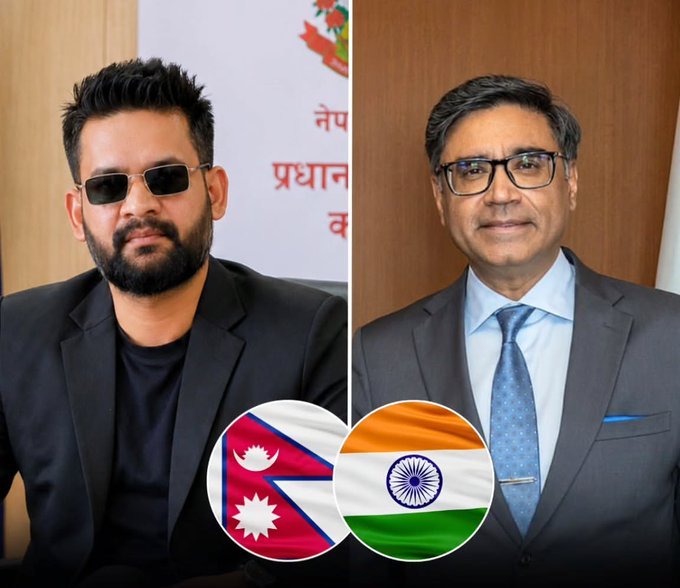
New Delhi: In a notable diplomatic development, Nepal’s Prime Minister Balendra Shah has declined to meet India’s Foreign Secretary Vikram Misri, prompting the postponement of the senior Indian diplomat’s scheduled visit to Kathmandu. The episode underscores persistent sensitivities in India-Nepal relations, even as both nations navigate complex border, trade, and security issues in the Himalayan region.
According to reports, Prime Minister Shah, who assumed office in late March 2026 following his party’s strong electoral performance, insisted on engaging only with officials of equivalent political stature. Indian officials had proposed Misri’s visit, aimed at extending a formal invitation for Shah to visit New Delhi, reviving stalled dialogues on trade, connectivity, and border management. The deferral comes amid recent frictions, including differing perspectives on the Lipulekh route for the Kailash Mansarovar Yatra.
Defence and strategic analysts view the incident through the lens of asymmetric interdependence. India’s economy, now the world’s fourth largest at approximately $3.9 trillion, dwarfs Nepal’s $43 billion GDP by a factor of roughly 90. This economic disparity translates into significant leverage in areas such as defence cooperation, infrastructure development, and energy trade. India remains a principal provider of development assistance, security training, and open-border facilitation to Nepal.
Historically, the two countries share deep civilizational, cultural, and people-to-people links, with an open border allowing free movement. Defence ties have traditionally been robust, encompassing joint exercises, equipment support, and intelligence sharing critical for Himalayan border management. Nepal’s strategic location makes it a key player in India’s northern security calculus, particularly concerning regional stability and external influences.
The current Nepali leadership’s emphasis on ‘selective engagement’ and focus on domestic priorities has drawn comment. While asserting sovereignty is a legitimate diplomatic prerogative, observers note that major powers routinely engage at working levels to maintain momentum. For context, high-level Russian engagement with Indian counterparts, including meetings involving National Security Advisor Ajit Doval, highlights pragmatic diplomacy that transcends protocol rigidity.
Nevertheless, Indian officials have downplayed the episode as a temporary scheduling matter rather than a rupture. New Delhi continues to extend invitations and support, including recent grants, while stressing the enduring foundation of bilateral relations. Nepal, for its part, has reiterated commitment to mutual respect and shared prosperity.
In the defence domain, sustained dialogue remains vital. Outstanding boundary discussions, hydrological cooperation, and countering non-traditional threats require continuous high-level attention. As Nepal’s new government consolidates, its approach to neighbourhood policy will shape not only economic opportunities but also long-term strategic stability in South Asia.
Seasoned diplomats on both sides emphasise that enduring partnerships thrive on pragmatism over posturing. With PM Shah reportedly open to a future visit to India at an appropriate time, the coming months will test whether protocol differences can be bridged to advance substantive cooperation in defence, trade, and connectivity.
contact: drrajeshjauhri@gmail.com
Dr Rajesh Jauhri is a Journalist with an experience of over 25 years in Indian and foreign media, a Social Scientist, an Ac-complished Author, a Political & Strategic Analyst, a Marksman (Rifle & Pistol), an Orator, a Thinker and an Educationist. He holds a Ph.D. degree on “Impact of colonial heritage on Indian police”. He runs an NGO dedicated to the social and eco-nomic uplift of tribal communities in MP and two decades back, he established a school in a village of Indore district, providing education and moral values to children belonging to underprivileged and minority families. Has received multiple awards in various fields.