


Defence Chronicle, Mhow
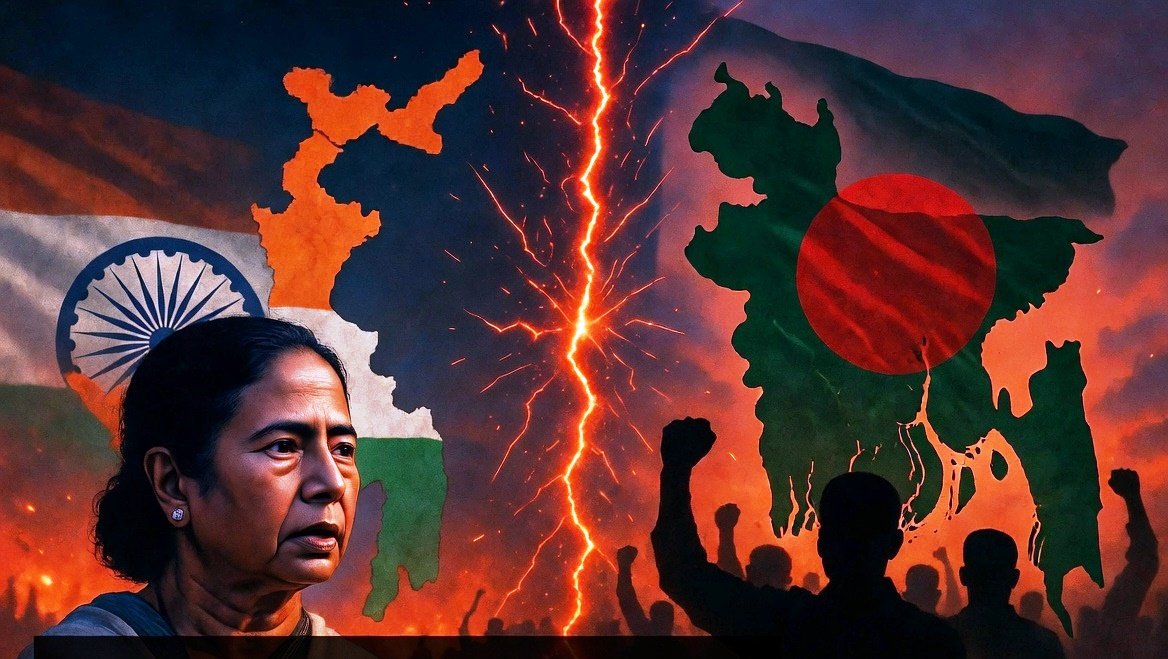
In a provocative escalation of cross-border rhetoric, senior Bangladeshi political figures have openly urged defeated West Bengal Chief Minister Mamata Banerjee to reject the electoral verdict and confront the Indian state, raising fresh concerns over regional stability and internal security in India’s eastern flank.
The latest remarks came from Nahid Islam, a Bangladeshi Member of Parliament and leader of the anti-India National Citizens’ Party (NC), who declared that “Mamata Banerjee has just lost election, not our support.” He exhorted her to “fight with Delhi, asserting that 17 crore Bangladeshi Muslims stand firmly behind her. Islam’s statement echoes an even more direct appeal made a day earlier by Md Nurul Huda, a prominent leader of Bangladesh’s Jamaat-e-Islami. Huda reportedly called upon Banerjee to declare West Bengal’s independence from India and ‘Wage War against Delhi,’ claiming full backing from Bangladesh’s 170 million Muslims.
These interventions from across the international border come at a sensitive time, following the significant setback suffered by Banerjee’s Trinamool Congress (TMC) in the recently concluded West Bengal Assembly elections. Analysts tracking eastern regional security had earlier described the poll outcome as a potential turning point for national security dynamics in the area, citing long-standing concerns over demographic shifts, radical networks, and porous borders.
The statements reveal what appears to be a deep and troubling nexus between certain elements within West Bengal’s ruling ecosystem and anti-India forces operating from Bangladesh. Such open encouragement of separatism and defiance of constitutional processes by foreign actors is unprecedented in recent memory and poses direct challenges to India’s sovereignty and territorial integrity.
Compounding these verbal provocations are disturbing incidents on the ground. Recent killings of Suvendu Adhikari’s personal assistant, a retired Indian Air Force officer, and another BJP supporter in the Basirhat area of West Bengal point to a pattern of targeted violence. Security experts note that such attacks, allegedly carried out by radicalised elements, align with a broader strategy to destabilise the region and transform Bengal into a zone of perpetual unrest, potentially facilitating larger anti-India designs.
For years, the eastern border has been a theatre of multifaceted threats, including illegal infiltration, radical Islamist mobilisation, and attempts to create demographic enclaves sympathetic to neighbouring narratives. The latest developments underscore the urgency for New Delhi to adopt a firmer posture. Strengthened border management, enhanced intelligence coordination with state agencies, and a decisive crackdown on networks promoting separatism or foreign interference are imperative.
India’s eastern neighbourhood remains volatile. As Bangladesh grapples with its own internal political transitions and rising radical influences, any attempt to export instability into Indian territory must be met with calibrated but resolute responses. The time for strategic complacency in the east is over; national security in the region now demands proactive vigilance and integrated policy action.

contact: drrajeshjauhri@gmail.com
Dr Rajesh Jauhri is a Journalist with an experience of over 25 years in Indian and foreign media, a Social Scientist, an Ac-complished Author, a Political & Strategic Analyst, a Marksman (Rifle & Pistol), an Orator, a Thinker and an Educationist. He holds a Ph.D. degree on “Impact of colonial heritage on Indian police”. He runs an NGO dedicated to the social and eco-nomic uplift of tribal communities in MP and two decades back, he established a school in a village of Indore district, providing education and moral values to children belonging to underprivileged and minority families. Has received multiple awards in various fields.
A pigmy cannot destabilize a giant. If our border forces are efficient, no cross border movement can take place.
Border states have an inherent challenge of being located close to the enemy. Punjab and Jammu & Kashmir saw huge volume of Pak drones live during Op Sindoor and our Air Defence firing at them while the rest of India saw them on TV – this is a huge difference, mind you a huge difference.
Political parties have to calm down with their narratives when dealing with border states. Why such hate is created within citizens internally simply to win elections is the point to ponder.
Can India afford to sideline it’s Muslims? In 1947 Bengal and Punjab were divided. Which states are now willing to be divided to push the nearly 20% Muslims in – the world will demand that; no other country will accept 30 – 40 Million refugees.
Let’s do it India, let’s push out the Muslims. Let’s sacrifice for India. Lest we forget Punjab and Bengal have done it before in 1947.
A pigmy cannot destabilize a giant. If our border forces are efficient, no cross border movement can take place.
Border states have an inherent challenge of being located close to the enemy. Punjab and Jammu & Kashmir saw huge volume of Pak drones live during Op Sindoor and our Air Defence firing at them while the rest of India saw them on TV – this is a huge difference, mind you a huge difference.
Political parties have to calm down with their narratives when dealing with border states. Why such hate is created within citizens internally simply to win elections is the point to ponder.
Can India afford to sideline it’s Muslims? In 1947 Bengal and Punjab were divided. Which states are now willing to be divided to push the nearly 20% Muslims in – the world will demand that; no other country will accept 30 – 40 Million refugees.
Let’s do it India, let’s push out the Muslims. Let’s sacrifice for India. Lest we forget Punjab and Bengal have done it before in 1947.
You are right Sir,
Thanks for your valuable comments