


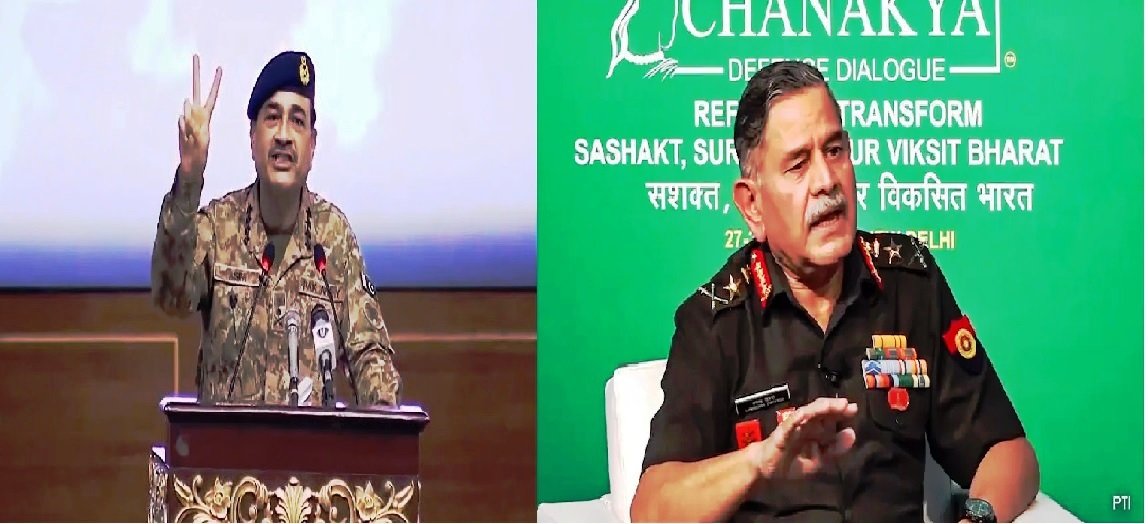
Indore: In a detailed exposition of operational decision-making that has drawn both praise and pointed criticism, Indian Army Chief General Upendra Dwivedi has described how Indian forces deliberately calibrated the timing of retaliatory strikes during Operation Sindoor to avoid periods when targets might be engaged in Namaz. The May 2025 operation, conducted in response to the massacre of 26 Hindu tourists in Pahalgam, Jammu and Kashmir, has become a case study in the tension between military ethics and the uncompromising realities of counter-terrorism.
Operation Sindoor unfolded over May 6-7, 2025, when Indian drone and missile assets struck nine verified terror infrastructure sites deep inside Pakistan and Pakistan-occupied Kashmir. Official figures confirm more than 70 militants were eliminated in the coordinated strikes, which Indian authorities described as a proportionate and precise response to the Pahalgam attack. Intelligence had established that the Pahalgam assailants had separated victims along religious lines before executing them, an act widely condemned as terrorism laced with communal intent.
Speaking about the planning phase, General Dwivedi emphasised that strike windows were deliberately shifted to sidestep moments of congregational prayer (Namaz) at the targeted locations. “We conduct ourselves as a professional force bound by rules of engagement and a higher ethical standard,” the Army Chief stated, according to accounts widely circulated from his remarks. The decision, he framed, was not born of hesitation but of conscious adherence to the Indian military’s doctrinal commitment to discriminate between combatants and non-combatants wherever operationally feasible.
The disclosure has split strategic opinion. Supporters within defence and diplomatic circles argue that such restraint reinforces India’s image as a responsible democratic power that refuses to mirror the brutality of its adversaries. “It is precisely this professionalism that distinguishes a modern armed force from the irregular militias it confronts,” noted a senior retired Indian officer who declined to be named. When he referred irregular militias, he meant Pak army. Critics, however, contend that the approach risks appearing naïve against an enemy that has repeatedly demonstrated no reciprocal restraint. They point to the Pahalgam attackers’ explicit selection of Hindu victims as evidence that the adversary operates without moral or legal inhibitions.
The Indian position stands in sharp ideological contrast to repeated statements from Pakistan’s military leadership. In a widely reported address to an audience of eminent Pakistanis, the then Pakistan Army Chief (now Field Marshal) General Asif Munir reaffirmed the enduring relevance of the two-nation theory, the 1947 ideological foundation of Pakistan that posits Hindus and Muslims as two separate nations inherently unable to coexist under a single political order. Pakistani official discourse has long framed India’s Hindu-majority character as a perpetual threat, providing what many Indian analysts interpret as doctrinal justification for sustained proxy warfare.
Defence observers note that the divergence is not merely rhetorical. While India’s military leadership publicly underscores ethical targeting and proportionality, Pakistan’s establishment continues to view the conflict through a civilisational lens that treats the very existence of a Hindu-majority India as justification for hostility. This fundamental asymmetry, analysts say, complicates any attempt at strategic parity or confidence-building measures.
Operation Sindoor itself reflected years of doctrinal evolution within the Indian Army. Post-2016 surgical strikes and the 2019 Balakot airstrikes, the force has refined its ability to conduct deep, time-sensitive strikes while maintaining political and legal deniability. The additional layer of temporal restraint described by General Dwivedi adds a self-imposed discipline rarely discussed openly by modern militaries.
As South Asia grapples with the persistent threat of cross-border terrorism, General Dwivedi’s comments have reignited debate on whether ethical self-restraint enhances or undermines deterrence. For now, the Indian Army maintains that its actions during Operation Sindoor achieved their military objectives without compromising the moral framework that defines it. Whether that calculus will deter future attacks, or merely invite further exploitation, remains the central unanswered question in India’s ongoing campaign against terrorism.

contact: drrajeshjauhri@gmail.com
Dr Rajesh Jauhri is a Journalist with an experience of over 25 years in Indian and foreign media, a Social Scientist, an Ac-complished Author, a Political & Strategic Analyst, a Marksman (Rifle & Pistol), an Orator, a Thinker and an Educationist. He holds a Ph.D. degree on “Impact of colonial heritage on Indian police”. He runs an NGO dedicated to the social and eco-nomic uplift of tribal communities in MP and two decades back, he established a school in a village of Indore district, providing education and moral values to children belonging to underprivileged and minority families. Has received multiple awards in various fields.