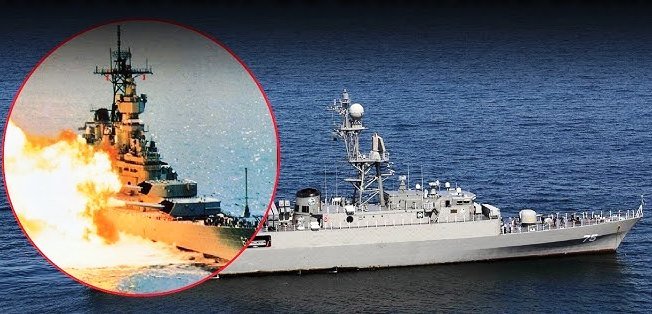
Colombo, March 5, 2026: In a dramatic escalation of U.S.-Iran hostilities into the Indo-Pacific theatre, an American attack submarine torpedoed and sank the Iranian Navy frigate IRIS Dena in international waters off Sri Lanka’s southern coast, according to U.S. and Sri Lankan officials. The incident, which occurred shortly after the vessel’s participation in India’s biennial MILAN naval exercise, has drawn sharp international condemnation from Tehran and sparked debates over maritime security in one of the world’s busiest shipping lanes.
The IRIS Dena, a Moudge-class guided-missile frigate commissioned in 2018 and considered one of Iran’s most advanced surface combatants, was struck by a single heavy torpedo that detonated beneath its stern, causing the 1,500-ton vessel to break apart and sink rapidly. Carrying approximately 180 crew members, the frigate went down around 2:00 PM local time on Wednesday, approximately 120 nautical miles southeast of Galle. Sri Lankan naval and coast guard forces, alerted by automated distress signals, mounted a swift rescue operation, recovering 87 bodies and saving 32 survivors from the debris field. At least 61 personnel remain unaccounted for, with Iranian state media reporting fears of a higher toll amid choppy seas.
Pentagon footage, declassified and released late Thursday, captured the strike in stark detail: the sleek silhouette of the U.S. submarine—believed to be a Virginia-class attack boat from the U.S. Seventh Fleet—surfacing briefly before unleashing the Mk 48 torpedo. U.S. Defense Secretary Pete Hegseth confirmed the operation in a briefing from the White House, framing it as a “preemptive defensive measure” against perceived Iranian threats to regional allies. “The IRIS Dena was armed with anti-ship missiles and had been shadowing U.S. assets post-MILAN. We will not allow Tehran to export its aggression to the Indian Ocean,” Hegseth declared, alluding to ongoing U.S. strikes against Iranian proxies in the Middle East.
The sinking marks the first direct U.S. Navy engagement with an Iranian warship since the 1988 Tanker War and extends the shadow conflict—sparked by Iran’s ballistic missile barrages on Israel last year—into South Asian waters. The frigate had just detached from the multinational MILAN 2026 exercise in Visakhapatnam, where over 50 nations, including the U.S. and Iran as observers, conducted joint maneuvers to enhance interoperability against piracy and non-state threats. Iranian officials claim the Dena was en route to Bandar Abbas when it was “ambushed without provocation,” labeling the attack a “barbaric act of piracy” and vowing retaliation.
Sri Lanka, caught in the crossfire, has protested the incident’s proximity to its exclusive economic zone, with President Ranil Wickremesinghe convening an emergency cabinet meeting. Colombo’s navy led the recovery efforts, deploying patrol vessels and helicopters in coordination with Indian and Australian assets. “This tragedy unfolds perilously close to our shores, underscoring the need for de-escalation in our waters,” a government spokesperson said, while expressing gratitude for the 32 survivors now receiving medical care in Galle Hospital.
Global reactions have been swift and polarized. Iran’s Supreme Leader Ali Khamenei decried the sinking as “state terrorism” in a televised address, mobilizing naval reinforcements to the Strait of Hormuz. In the U.S., the move garnered bipartisan support, with Pennsylvania Senator John Fetterman posting on X: “Iran’s been playing with fire for too long—time to put it out. Prayers for the innocent, but zero sympathy for the regime.” Critics, including UN Secretary-General António Guterres, called for an immediate investigation under the International Maritime Organization, warning of risks to global trade routes handling 80% of the world’s oil.
Defence experts view the strike as a calculated demonstration of U.S. undersea dominance, leveraging the Virginia-class’s stealth and precision weaponry to neutralize a threat without surface escalation. “The torpedo strike was surgical, minimizing collateral damage while sending a clear message: Iran’s blue-water ambitions end where American interests begin,” said retired U.S. Navy Capt. John Kirby, now a CNN analyst. However, the loss of the IRIS Dena—equipped with Ghader anti-ship missiles and capable of 30-knot speeds—represents a blow to Tehran’s nascent ocean-going fleet, potentially deterring further forays into the Indian Ocean.
As search operations continue amid heightened naval patrols, the incident raises alarms over hybrid warfare spilling into neutral waters. India, host of MILAN, has urged restraint while bolstering its Andaman and Nicobar Command surveillance. With U.S. carrier strike groups redeploying to the region, analysts predict a tense standoff, testing the resilience of Quad partnerships and the fragile détente in South Asia’s strategic backyard.
‘Defence Sentinel’ will provide ongoing coverage of this developing story, including analysis of implications for Indo-Pacific deterrence.

contact: drrajeshjauhri@gmail.com
Dr Rajesh Jauhri is a Journalist with an experience of over 25 years in Indian and foreign media, a Social Scientist, an Ac-complished Author, a Political & Strategic Analyst, a Marksman (Rifle & Pistol), an Orator, a Thinker and an Educationist. He holds a Ph.D. degree on “Impact of colonial heritage on Indian police”. He runs an NGO dedicated to the social and eco-nomic uplift of tribal communities in MP and two decades back, he established a school in a village of Indore district, providing education and moral values to children belonging to underprivileged and minority families. Has received multiple awards in various fields.