
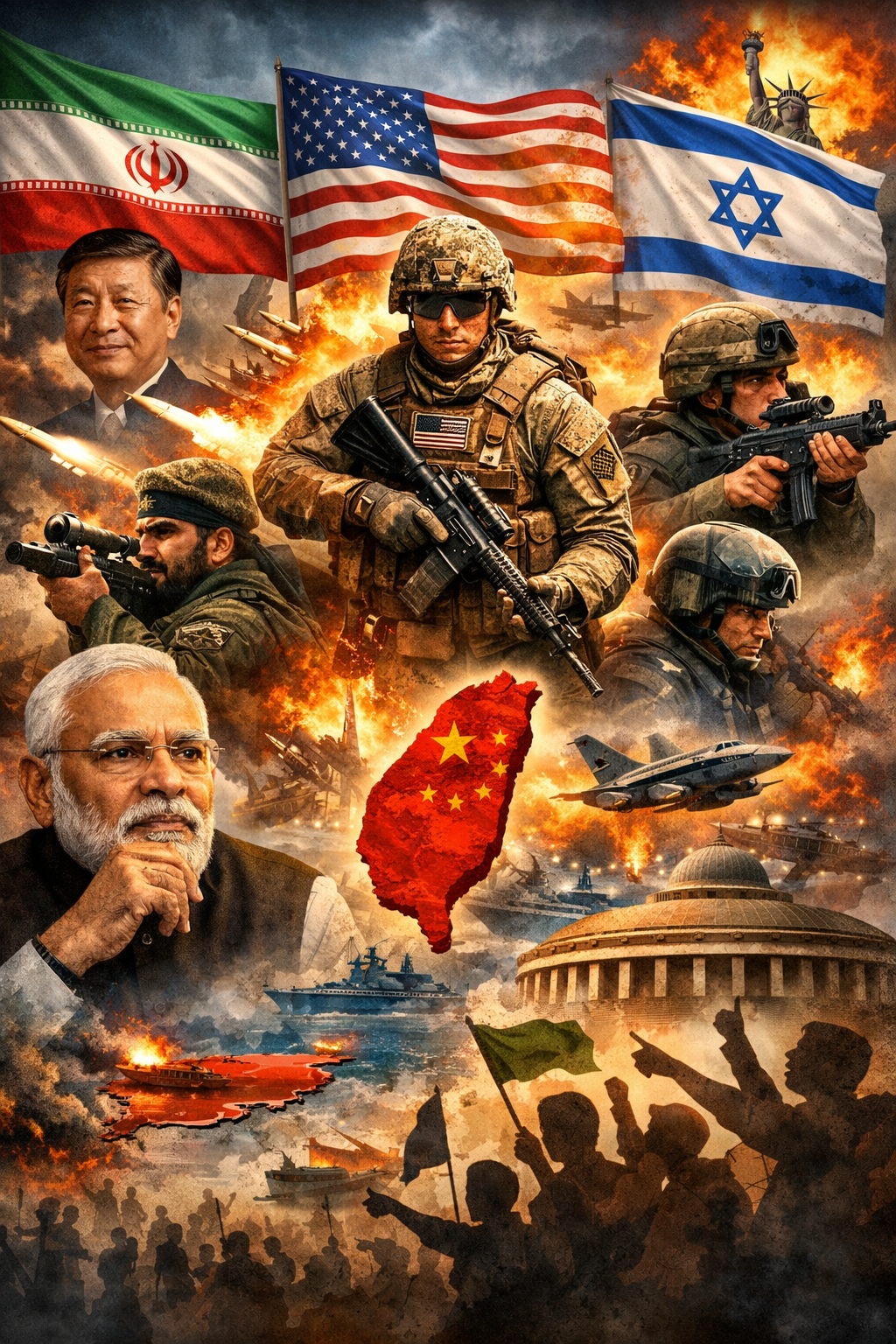
After a considerable gap, the Middle East has once again become the crucible of great-power competition, where tactical precision collides with strategic unpredictability. What began as a calibrated joint operation by the United States and Israel launched on 28 February under the operational rubric associated with “Epic Fury”, has, within days, evolved into a multifaceted regional conflagration. Strikes on Iranian nuclear infrastructure at Natanz, ballistic-missile complexes, command nodes in Tehran, and leadership targets (including the reported elimination of Supreme Leader Ayatollah Ali Khamenei) were accompanied by parallel actions against Hezbollah assets in Beirut and southern Lebanon. Iranian retaliation has been swift if asymmetric: barrages of ballistic missiles and drones against Israeli population centres and U.S. facilities in Kuwait (resulting in six American service members killed), attempts to interdict commercial shipping in the Strait of Hormuz, and probing attacks on Gulf energy infrastructure. By 3 March, the conflict had entered its fourth day, with civilian casualties in Iran numbering at least 787 according to the Iranian Red Crescent (internal estimates suggest several thousand) and ripple effects already registering in global energy markets.
This is no mere recurrence of the perennial Iran-Israel shadow war. It represents a qualitative shift in the triangular relationship that has defined Middle Eastern security since the 1979 Iranian Revolution. To understand its trajectory and to separate verifiable strategic logic from the speculative narratives proliferating in public discourse and television studios, one must apply the lenses of classical strategy: Clausewitzian friction, the escalation ladder articulated by Herman Kahn, and the contemporary realities of proxy architectures and economic interdependence.
Operational Design and the Limits of “Short-War” Doctrine
Initial reporting and official statements indicate that planners in Washington and Jerusalem envisaged a campaign of finite duration and delimited scope, reminiscent, in intent if not execution, of limited punitive operations conducted by other powers. India’s Operation Sindoor in May 2025 offers a instructive parallel: a swift, non-contact sequence of precision missile and drone strikes against terrorist infrastructure in Pakistan following the Pahalgam outrage, executed over roughly four to five days, achieving stated objectives without crossing into full-spectrum conventional war. The Indian approach rested on doctrinal clarity, restoration of deterrence through calibrated force, avoidance of nuclear thresholds, and rapid diplomatic re-engagement.
The U.S.-Israeli opening salvo similarly targeted high-value, time-sensitive assets: air-defence radars, missile-production facilities, and command-and-control nodes. US B-1 bombers and Israeli stand-off munitions degraded Iranian integrated air defence within 48 hours, establishing local air superiority over western Iran and Tehran. Yet friction, Clausewitz’s “fog and chance”, intervened immediately. Iranian residual launchers (approximately half of an estimated 250 remaining post-2025 exchanges) fired salvos that, while largely intercepted, demonstrated persistent asymmetric reach. Proxy activation of Hezbollah rocket fire into northern Israel, Houthi posturing, and Iraqi militia probes expanded the theatre. Tehran’s decision to threaten (and partially enact) closure of the Strait of Hormuz transformed a surgical strike into a maritime and economic contest.
President Trump’s public articulation of objectives- destruction of missile capabilities, neutralisation of naval assets, prevention of nuclear breakout, and severance of support to designated terrorist organisations, remains internally consistent with a counter-proliferation and counter-terror logic. Israeli sources have spoken of a notional two-week horizon, while US statements emphasise flexibility (“four to five weeks, or longer if necessary”). The expansion of scope is therefore not evidence of initial miscalculation so much as the inherent difficulty of imposing unilateral termination conditions on an adversary possessing depth, proxies, and geographic chokepoints. Doctrine teaches that limited wars remain limited only when both sides share a mutual interest in de-escalation; when one party perceives existential stakes, the ladder lengthens.
Verifying the “China Trap” Narrative: Opportunity, Not Orchestration
Public commentary in several capitals has advanced a seductive thesis: that Beijing engineered or welcomed the present crisis as a laboratory for testing anti-access/area-denial (A2/AD) concepts and as a strategic diversion to facilitate future coercion against Taiwan. Independent examination of open-source diplomatic behaviour, military posture, and economic indicators yields a more nuanced verdict.
China’s official response has been measured condemnation coupled with calls for immediate ceasefire and return to dialogue. Foreign Minister Wang Yi described the strikes as a “serious violation” during ongoing negotiations, while spokesperson Mao Ning reiterated that Taiwan remains an internal affair and that Beijing opposes unilateral force in international relations. No credible reporting indicates material military support to Iran, consistent with Beijing’s long-standing aversion to direct entanglement beyond its immediate periphery. Chinese analysts and state media have, however, scrutinised the performance of U.S. and Israeli munitions, Iranian air defences, and proxy coordination. Such observation is standard great-power practice; every conflict from Ukraine to Yemen has served as an empirical dataset for PLA modernisation.
Economically, the conflict is not an unambiguous boon for Beijing. China remains the world’s largest crude importer; disruption in the Strait of Hormuz (through which roughly 20% of global oil transits) and the loss of Iranian and Venezuelan supplies (approximately 17% of China’s 2025 imports) impose immediate costs. Brent crude has surged above $82 per barrel, with analysts warning of spikes to $100+ under full closure scenarios. While Russia benefits marginally as an alternative supplier, China’s strategic petroleum reserves and diversified sourcing provide buffers, not windfalls. Claims of a premeditated “trap” therefore lack evidentiary foundation; they conflate opportunistic learning with causal orchestration. Beijing’s long-game focus remains the Indo-Pacific. The present crisis may temporarily divert U.S. naval assets, yet it also risks accelerating Gulf realignment away from Iranian influence and toward partners more amenable to US security architectures, hardly the outcome a rational strategist in Zhongnanhai would engineer.
Nor do Russian incentives align with deliberate prolongation for financial attrition of the United States. Moscow’s budget assumes Urals crude around $59 equivalent; current discounts under sanctions mean even elevated global prices yield limited fiscal relief. Both authoritarian powers are observers and occasional beneficiaries of volatility, not architects of a coordinated financial siege.
India’s Strategic Calculus: Autonomy Amid Domestic Contestation
Within India, the crisis has reignited familiar debates about alignment versus strategic autonomy. Prime Minister Narendra Modi’s visit to Israel on February 25-26 for elevating bilateral ties to a “special strategic partnership” with 16 new agreements in defence, technology, and critical minerals, occurred against a backdrop of rising regional tension. Subsequent telephone diplomacy with UAE leadership, coupled with a measured Ministry of External Affairs statement urging restraint and civilian protection on all sides (without explicit condemnation of the initial strikes), reflects calibrated interest-based diplomacy. India’s priorities are transparent: protection of its large diaspora and workers in the Gulf, energy security (as a net importer vulnerable to price spikes), and preservation of residual stakes in Iranian infrastructure such as Chabahar.
Opposition voices, particularly from the Indian National Congress, have criticised the timing of the Israel visit and the perceived tilt toward the US-Israel axis as an “abdication” of balanced foreign policy and a betrayal of India’s historical engagement with Iran and the broader Global South. Such critiques, while vigorous, have not translated into calls for Indian military entanglement. Rather, they question whether New Delhi has forfeited diplomatic flexibility. From a strategic perspective, India’s restraint is prudent. No vital Indian interest, territorial integrity, economic lifelines, or diaspora security, has been directly imperilled by the triangular conflict. Insertion into a distant theatre would dilute focus on core challenges along the Line of Actual Control and in the Indian Ocean, while offering negligible leverage over outcomes. The Opposition’s rhetorical pressure tests democratic accountability but does not alter the underlying logic of non-involvement.
Broader Implications: Entropy in the International System
The conflict underscores three enduring truths of contemporary strategy. First, the proliferation of precision munitions and proxy networks has compressed decision timelines while expanding escalation surfaces; “limited” operations now carry inherent risk of horizontal and vertical spread. Second, economic interdependence acts as both deterrent and accelerator: energy chokepoints magnify costs for all parties, yet also create incentives for rapid termination once pain thresholds are approached. Third, middle powers retain significant agency; Gulf states’ interception of Iranian salvos and their warnings of proportionate response illustrate that regional actors are not passive pawns.
For the United States, the campaign tests the sustainability of simultaneous deterrence across theatres- an issue long flagged in Pentagon planning documents. For Israel, it offers a window to degrade existential threats but risks overstretch and diplomatic isolation. For Iran, survival of the clerical regime and residual deterrent capacity remain paramount; succession processes and internal cohesion will prove decisive. Globally, the episode reinforces the need for renewed investment in diplomatic off-ramps and energy resilience.
The Virtue of Strategic Patience
The Iran-US-Israel confrontation is neither a Chinese masterstroke nor an inevitable march toward global conflagration. It is the product of accumulated grievances, doctrinal assumptions about adversary rationality, and the perennial difficulty of imposing finite limits on infinite strategic space. Public commentary that reduces complex state behaviour to conspiracy or partisan provocation serves neither truth nor policy. What the situation demands—from Washington, Jerusalem, Tehran, and observers alike, is the classical statesman’s blend of firmness and flexibility: clear red lines, credible deterrence, and open channels for de-escalation once core objectives are secured or costs become prohibitive.
India’s posture of concerned non-belligerence exemplifies such prudence. In an era of strategic entropy, where great-power rivalry manifests in multiple theatres simultaneously, the wisest course for secondary actors is to safeguard vital interests, preserve diplomatic capital, and resist the siren calls of entanglement. The triangular conflict will resolve, whether through negotiated pause or exhaustion, according to its own logic. The measure of statesmanship will be the ability to shape that resolution without becoming its casualty.

contact: drrajeshjauhri@gmail.com
Dr Rajesh Jauhri is a Journalist with an experience of over 25 years in Indian and foreign media, a Social Scientist, an Ac-complished Author, a Political & Strategic Analyst, a Marksman (Rifle & Pistol), an Orator, a Thinker and an Educationist. He holds a Ph.D. degree on “Impact of colonial heritage on Indian police”. He runs an NGO dedicated to the social and eco-nomic uplift of tribal communities in MP and two decades back, he established a school in a village of Indore district, providing education and moral values to children belonging to underprivileged and minority families. Has received multiple awards in various fields.
I feel the article is insightful and well-structured, giving a clear understanding of the complex tensions between Iran, the United States, and Israel. It explains the situation thoughtfully and highlights how growing geopolitical pressures are increasing instability in the region. I also feel the focus on the risks of escalation and the need for restraint adds depth to the piece. Though the language is slightly academic at times, the overall message is still impactful. Overall, I feel it is an informative and balanced read.
Thanks Mam for your valuable comments