
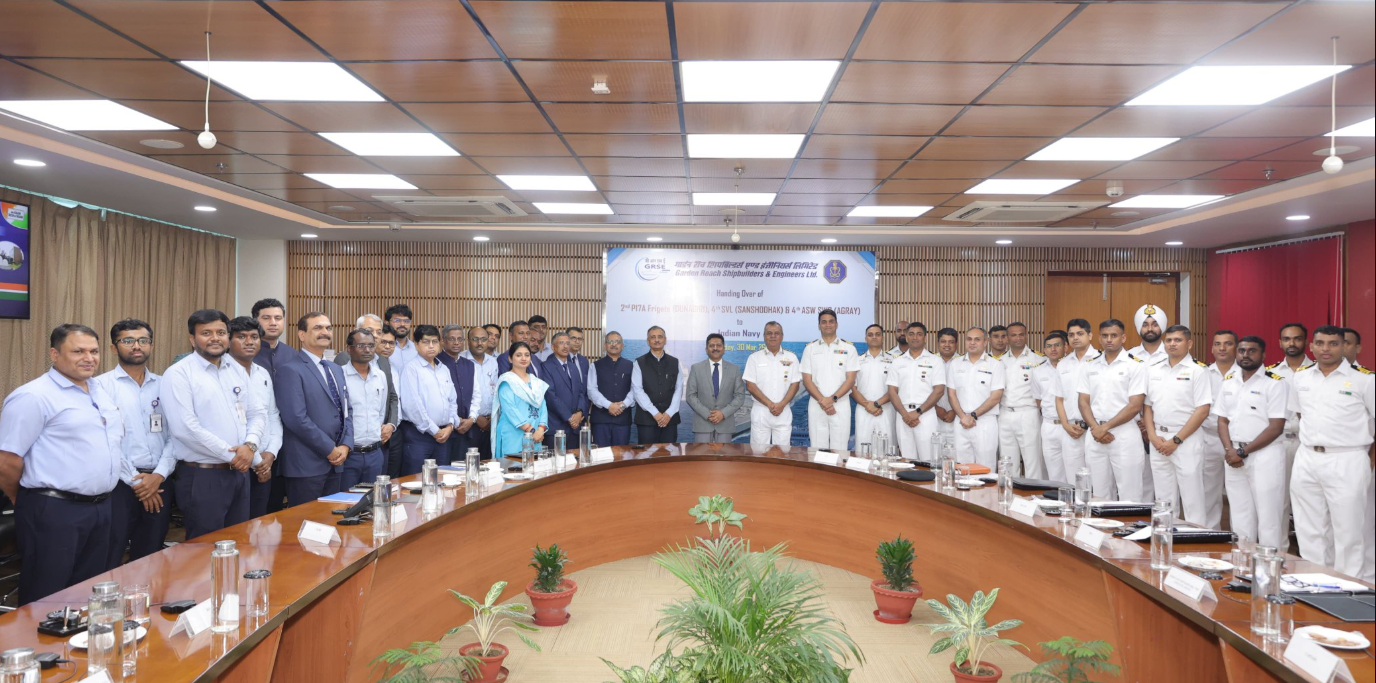
On March 30, 2026, Garden Reach Shipbuilders and Engineers executed an unprecedented triple-hull delivery to the Indian Navy in Kolkata, serving as a definitive metric of stabilizing domestic shipyard throughput.
This concurrent handover of the Project 17A guided-missile frigate Dunagiri, the Anti-Submarine Warfare Shallow Water Craft Agray, and the Survey Vessel Large Sanshodhak signals a maturing defense industrial base capable of parallel-processing highly disparate naval architectures.
For Naval Headquarters, this tri-platform induction translates into immediate, deployable capability engineered to dominate three distinct operational vectors: deep-water sea control, coastal acoustic sanitization, and comprehensive bathymetric intelligence gathering.
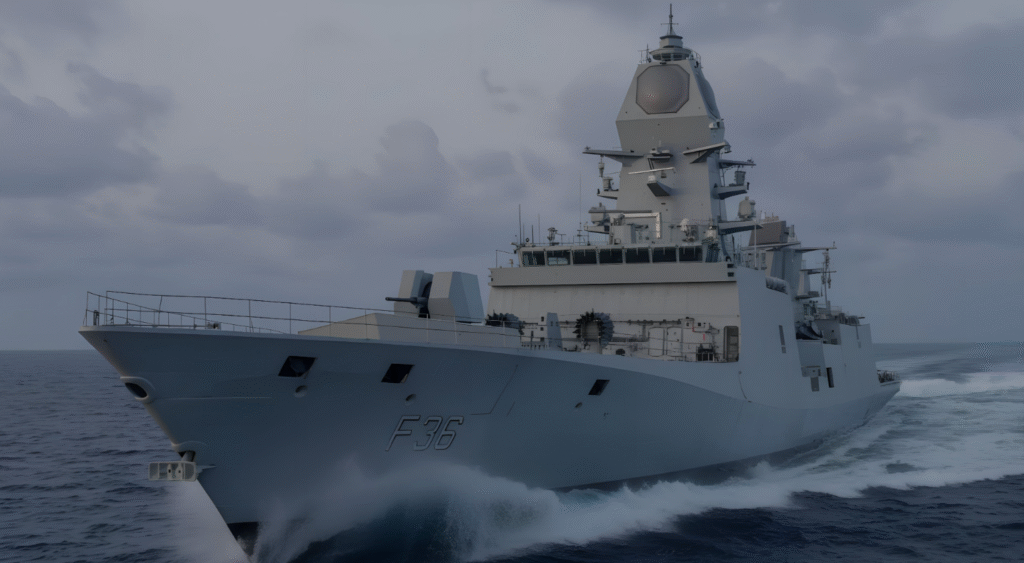
Operating at the apex of the fleet’s kinetic hierarchy, Dunagiri, the fifth hull of the Nilgiri-class, is constructed explicitly around signature management and high-density offensive payloads.
Engineered in-house by the Warship Design Bureau, the hull form and superstructure are physically contoured to drastically degrade radar cross-section, thereby compressing the vessel’s detection envelope against active-seeker sea-skimming munitions.
Below the waterline, the platform relies on a Combined Diesel or Gas propulsion architecture, utilizing twin diesel engines to maximize fuel endurance and minimize acoustic transients during transit, while reserving twin marine gas turbines for high-speed tactical intercepts.
This mechanical output is transferred to Controllable Pitch Propellers via a complex reduction gear array, governed entirely by an Integrated Platform Management System that simultaneously automates rapid damage control protocols.
Tactically, the frigate is anchored by a dense, multi-domain kill web that fuses over-the-horizon BrahMos supersonic cruise missiles with an MFSTAR active electronically scanned array radar and an MRSAM battery to establish a layered air-defense perimeter.
By adopting modular integrated construction methodologies, the shipyard brought Dunagiri from keel to delivery in an accelerated 80-month timeframe, confirming the successful negotiation of the production learning curve for capital surface combatants.
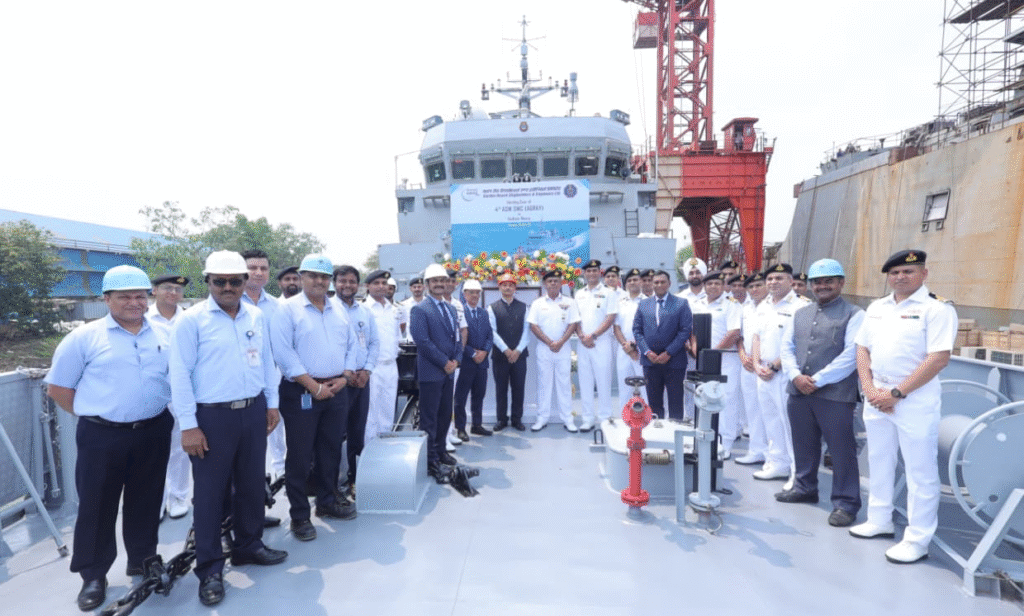
While the P17A frigate is engineered to project power across the open ocean, the Anti-Submarine Warfare Shallow Water Craft Agray is purpose-built to navigate the acoustically hostile environment of the littorals.
Measuring 77 meters in length, this platform is specifically designed to hunt and prosecute diesel-electric and Air-Independent Propulsion submarines operating within the complex thermal layers of the Indian coastline.
The defining engineering choice for this class is the integration of waterjet propulsion.
Because traditional propellers operating in shallow water suffer from draft limitations and severe cavitation a phenomenon that simultaneously degrades propulsion efficiency, blinds onboard sonar arrays, and broadcasts the ship’s acoustic signature waterjets provide superior low-speed maneuverability and a drastically cleaner acoustic profile.
Built under the stringent classification rules of the Indian Register of Shipping, her tactical utility relies on specialized shallow-water sonar arrays optimized to filter out extreme coastal reverberation, effectively completing the kill chain via advanced lightweight torpedoes and indigenous anti-submarine rocket systems.
Preceding both surface action and anti-submarine prosecution is the absolute requirement for subsurface intelligence, a capability fundamentally realized through the induction of Sanshodhak.
As the fourth and final vessel of the Survey Vessel Large class, this 3,400-ton, 110-meter platform operates as the fleet’s premier hydrographic and oceanographic data-gathering node, essential for mapping the topographical and geophysical realities of the seabed.
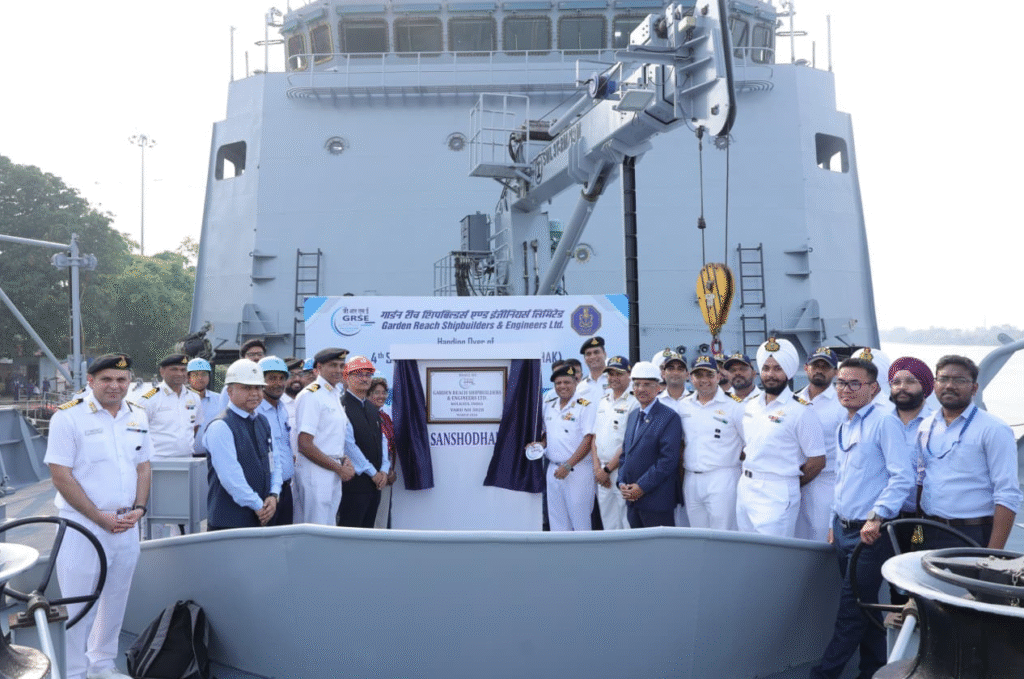
Powered by twin marine diesel engines capable of sustaining transit speeds in excess of 18 knots, her engineering profile is optimized for extended operational endurance.
In the battlespace, the ship functions as a forward-deployed mothership for autonomous systems, utilizing an integrated Data Acquisition and Processing System to deploy Autonomous Underwater Vehicles and Remotely Operated Vehicles alongside Digital Side Scan Sonar and long-range DGPS.
Because modern submarine navigation, mine-laying, and bottom-bounce sonar tactics rely entirely on accurate bathymetric data, Sanshodhak guarantees that Indian subsurface and surface combatants possess the precise oceanographic intelligence required to exploit the water column effectively.
Ultimately, the operational necessity for these three distinct platforms is dictated by the rapidly evolving geopolitical calculus of the Indian Ocean Region.
Confronted with the steady proliferation of ultra-quiet subsurface assets near critical Sea Lanes of Communication, the Indian Navy demands a multi-domain response where heavy frigates secure transit corridors, littoral craft sanitize naval approaches, and survey vessels map the hydrographic battlespace in advance.
Beyond their immediate tactical applications, however, the strategic value of these ships lies in their manufacturing origin, featuring a 75 percent indigenous content baseline for Dunagiri and exceeding 80 percent for both Agray and Sanshodhak.
By integrating a massive, nationwide network of micro, small, and medium enterprises into the defense industrial base, this procurement strategy fundamentally insulates the military’s operational readiness from global supply chain shocks.
Therefore, relying on domestic yards to concurrently deliver heavily armed combatants and highly technical support vessels is no longer merely an economic preference, but a rigid tactical imperative that cements India’s transition into a self-sustaining maritime power.

Punit Shyam Gore (MA Defence and Strategic Studies) is an alumnus of the School of Internal Security, Defence & Strategic Studies of the Rashtriya Raksha University, Gandhinagar (an institution of national importance) under the Ministry of Home Affairs, Government of India.