
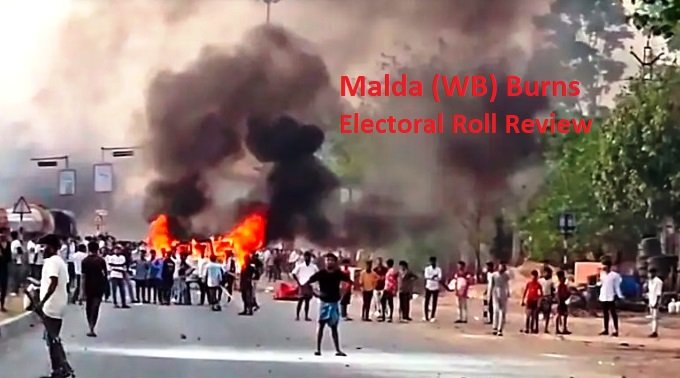
New Delhi: A large-scale protest by local residents in Sujapur town of Malda district, West Bengal, led to an 18-hour blockade of National Highway-12 on April 1, 2026, severely disrupting road connectivity between northern and southern parts of the state and extending towards the Siliguri Corridor, India’s critical land link to the northeastern region. During the standoff, reports emerged that Indian Army trucks were briefly held up by the agitating crowd, underscoring potential vulnerabilities in military logistics along one of eastern India’s key arterial routes.
The blockade, which began in the morning of April 1 and was lifted late night, following administrative intervention and deployment of central security forces, brought traffic to a standstill on the stretch of NH-12 passing through Sujapur. Protesters used bamboo poles and burning tyres to obstruct the highway, stranding long queues of civilian trucks, buses, and private vehicles. Eyewitness accounts and videos circulating on social media platforms indicated that military convoys were also caught in the disruption, with the agitating group preventing their passage for a period before the situation was resolved.
The protests stemmed from widespread discontent over the Election Commission of India’s ongoing Special Intensive Revision (SIR) of electoral rolls in West Bengal. Residents in Sujapur and surrounding areas in Malda district claimed that a significant number of names, reportedly over 1.35 lakh out of 2.69 lakh voters in the constituency, had been placed under adjudication or deleted without adequate verification, affecting genuine voters across communities. Local leaders, including a Congress candidate from the area, described the process as arbitrary and a “mockery of democracy,” forcing repeated visits to block development offices amid administrative confusion caused by frequent transfers of officials.
While mainstream reports confirmed the highway obstruction and deployment of central forces to maintain order, the specific detention of Army trucks has been highlighted primarily through social media narratives, which have amplified the incident’s security dimensions. No official statement from the Indian Army or the Ministry of Defence has been issued so far regarding any impact on operational movements.
In this matter, one thing is sure that Army is not authorised to issue any media statement in a situation, where the matter is political. Thus, it is baseless to comment that holding the army vehicles in the blockade was deliberately highlighted to amplify security dimensions. In fact, it is evident from every piece of information coming from Malda that the matter is very serious in terms of National Security because of the Chicken’s Neck being very close to that area. People like Sharjeel Imam have already appealed in open public forums for blocking of this crucial land area to cut rest of India from Northeast.
Strategic Significance of the Affected Route
NH-12 serves as a vital feeder to the Siliguri Corridor, commonly referred to as the “Chicken’s Neck”, a narrow 20-40 kilometre-wide strip of land that connects mainland India to the eight northeastern states. This corridor is not merely an economic lifeline but a cornerstone of India’s defence posture in the east. It facilitates the rapid movement of troops, equipment, and supplies to forward areas along the China border and supports operations by the Army, Air Force, and paramilitary forces stationed in the region.
Any prolonged disruption to NH-12, even if triggered by domestic protests, raises legitimate concerns about the resilience of India’s internal supply chains in a strategically sensitive zone. Defence analysts have long flagged the Chicken’s Neck as a potential chokepoint vulnerable to both external threats and internal instability. In times of heightened border tensions or national emergencies, seamless connectivity along such routes becomes indispensable for force projection and sustainment.
The Malda incident, though localised and resolved without reported violence against military personnel, serves as a reminder of how civilian agitations, however legitimate their grievances, can inadvertently impinge on national security infrastructure. Malda district, located in the northern part of West Bengal, lies in close proximity to the corridor’s approaches, making incidents here particularly noteworthy for security planners.
Strategic analysts are also viewing this as an experiment by the anti-nationals for blocking the Chicken’s Neck, when they feel to do so.
Broader Context and Implications
West Bengal has witnessed multiple instances of highway blockades in recent months, often linked to local issues ranging from migrant worker concerns in neighbouring districts to administrative disputes. The current wave of protests related to the SIR exercise has been particularly intense in Muslim-majority pockets of Malda, where political parties across the spectrum have traded accusations over implementation lapses and alleged demographic engineering.
For the defence establishment, the episode highlights the need for robust contingency planning. Military convoys routinely use NH-12 and parallel routes to support deployments in the Northeast. While the brief hold-up in this case appears to have been incidental rather than targeted, it exposes gaps in real-time coordination between civil authorities and the armed forces during public unrest.
Senior defence sources, speaking on the condition of anonymity, emphasised that such disruptions, however short, cannot be dismissed lightly in a region already under strategic scrutiny. “The Siliguri Corridor is India’s Achilles’ heel in the east,” one officer noted. “Any interference with movement on its primary access roads must be addressed with zero tolerance to prevent escalation or exploitation.”
As investigations into the SIR-related protests continue and the state gears up for assembly elections, security agencies are likely to maintain heightened vigil along NH-12 and other feeder routes to the Chicken’s Neck. The incident also calls for a closer examination of protocols to ensure unhindered passage for essential defence traffic during civilian disturbances.
The resolution of the Sujapur blockade, following assurances from district officials on expediting voter list corrections, brought normalcy to the highway. Yet the episode has left a broader question lingering in defence circles: in an era of hybrid threats and internal fault lines, how effectively can India safeguard its most critical logistical arteries from domestic disruptions?

contact: drrajeshjauhri@gmail.com
Dr Rajesh Jauhri is a Journalist with an experience of over 25 years in Indian and foreign media, a Social Scientist, an Ac-complished Author, a Political & Strategic Analyst, a Marksman (Rifle & Pistol), an Orator, a Thinker and an Educationist. He holds a Ph.D. degree on “Impact of colonial heritage on Indian police”. He runs an NGO dedicated to the social and eco-nomic uplift of tribal communities in MP and two decades back, he established a school in a village of Indore district, providing education and moral values to children belonging to underprivileged and minority families. Has received multiple awards in various fields.
He(Me Johri) is superb, I know hi personally. Very helpful and down to earth
Thank You Bhai