

In an era of precision strikes, advanced surveillance, and rapid military mobility, geography continues to assert itself as the most enduring factor in warfare. Few nations illustrate this truth more vividly than Iran. Its terrain, a formidable combination of towering mountain ranges, unforgiving deserts, and a strategically positioned coastline, transforms the country into what can justly be described as the most naturally defended landmass on Earth.
At the heart of Iran’s strategic posture lies the Strait of Hormuz, a narrow, deep, and island-studded bottleneck that connects the Persian Gulf to the Gulf of Oman and the Arabian Sea. Measuring approximately 167 km in length, with widths varying from 97 km to as little as 35 km (and a narrowest shipping corridor of just 35–45 km), the strait is no ordinary waterway. Its depth of 60–100 metres accommodates supertankers, yet its geography hands Iran immense leverage. Some 20–25% of global seaborne oil and 20% of global liquefied natural gas (LNG) pass through this chokepoint daily, with traffic historically ranging between 80 and 130 ships.
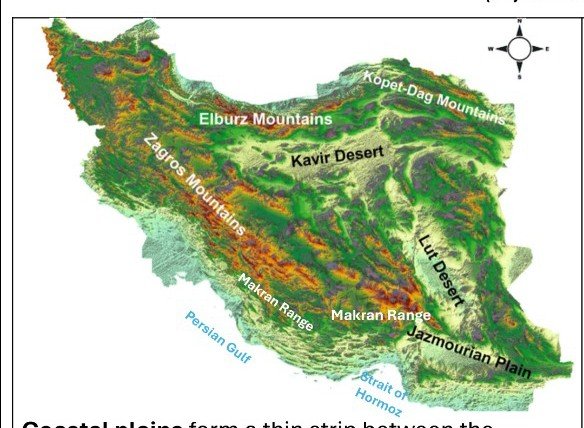
Iran controls the mountainous northern coastline, which rises sharply like a dramatic fortress wall. The Makran and Hormozgan coastal ranges create a natural barrier where defenders need not hold every inch of shore, the terrain itself performs much of the work. Key islands under Iranian influence, including Qeshm, Larak, Abu Musa, and Hormuz, host underground bunkers, missile sites, and swarm-boat facilities. From these elevated positions, anti-ship missiles, mobile launchers hidden in wadis and cliff tunnels, radars with long sea horizons, fast attack boats, drones, and even mines (real or dummy) can be deployed with devastating effect.
A look toward the Iranian coast reveals not a flat, inviting shoreline but a rugged escarpment. Ships must navigate within striking range of these heights, turning the strait into a potential killing zone for asymmetric warfare. Swarm attacks by drone boats, kamikaze strikes by Shahed-type drones, and dispersed mobile systems that “shoot and scoot” exploit this geography perfectly. The defender enjoys redundancy, decoys, and the advantage of high ground overlooking vast sea horizons.Yet the Strait of Hormuz is merely the southern sentinel of a far broader natural fortress. Iran’s overall geography presents multiple layered defences that would make any large-scale ground offensive extraordinarily costly.To the north, the Elburz (Alborz) Mountains form a formidable shield for the Iranian plateau, with the highest peak, Mount Damavand, soaring to 18,403 feet. In the northeast, the Kopet Dag Mountains provide another barrier, peaking at over 10,469 feet. To the west, the Zagros Mountains, with peaks reaching 14,465 feet at Qash-Mastan, create a massive western wall stretching hundreds of kilometres, historically slowing invaders from ancient times to the Iran-Iraq War.The south is guarded by the Makran Range, a rugged southern fortress with heights averaging 3,500–4,500 feet facing the Arabian Sea and Strait of Hormuz. Its highest peak, Kuh-e-Bazman, rises to 11,450 feet. Between the Makran Range and the Persian Gulf lie narrow coastal plains, often only 3–30 km wide, offering little room for manoeuvre and leaving any landing force vulnerable to fire from the overlooking mountains.Further inland, the Dasht-e Kavir and Dasht-e Lut deserts act as natural anti-invasion barriers. These vast, harsh wastelands are virtually impassable for mechanized armies, forming one of the deadliest interior obstacles of any nation. Enclosed within this mountain-and-desert ring lies the high Iranian Plateau, which provides defensible depth, elevated positions for cities and fallback lines, and space for dispersed population centres.
Iran’s landmass of approximately 1.65 million square kilometres, roughly half the size of India, yet with a population about 1/15th as large, grants strategic depth and room for dispersion. The rugged, folded, and vast terrain is ideally suited for underground construction, hardened facilities, and guerrilla-style defence. Mobile launchers tucked into tunnels and wadis, radars on high ground, and the ability to sustain prolonged attrition warfare all stem from this geography.
A full-scale ground invasion of Iran would confront extreme challenges: prohibitive costs in men and material, nightmarish logistics across mountain passes and deserts, vulnerability of extended supply lines, and the certainty of fierce asymmetric resistance. The terrain would favour the defender at almost every turn, turning any advance into a grinding, high-casualty campaign with uncertain political outcomes.
History has repeatedly shown that mountains, deserts, and chokepoints do not yield easily to superior technology alone. While air and naval power can inflict damage, they cannot easily occupy or pacify such a naturally fortified land without enormous commitment. Iran’s geography does not make it invincible, but it raises the threshold of any military undertaking to levels that demand the most careful strategic calculation.
In today’s volatile geopolitical environment, where energy security and regional stability hang in delicate balance, understanding Iran’s natural defences is not merely an academic exercise. It is a vital reality that any policymaker contemplating confrontation must confront squarely on the map, before considering action on the ground.As soldiers and strategists, we ignore geography at our peril. In the case of Iran, nature itself has drawn the battle lines with formidable clarity.
Major General Harvijay Singh, SM (Retd) is a veteran of the Indian Army with extensive experience in military strategy and training. He has authored numerous articles on military history and contemporary defence issues.

contact: drrajeshjauhri@gmail.com
Dr Rajesh Jauhri is a Journalist with an experience of over 25 years in Indian and foreign media, a Social Scientist, an Ac-complished Author, a Political & Strategic Analyst, a Marksman (Rifle & Pistol), an Orator, a Thinker and an Educationist. He holds a Ph.D. degree on “Impact of colonial heritage on Indian police”. He runs an NGO dedicated to the social and eco-nomic uplift of tribal communities in MP and two decades back, he established a school in a village of Indore district, providing education and moral values to children belonging to underprivileged and minority families. Has received multiple awards in various fields.