
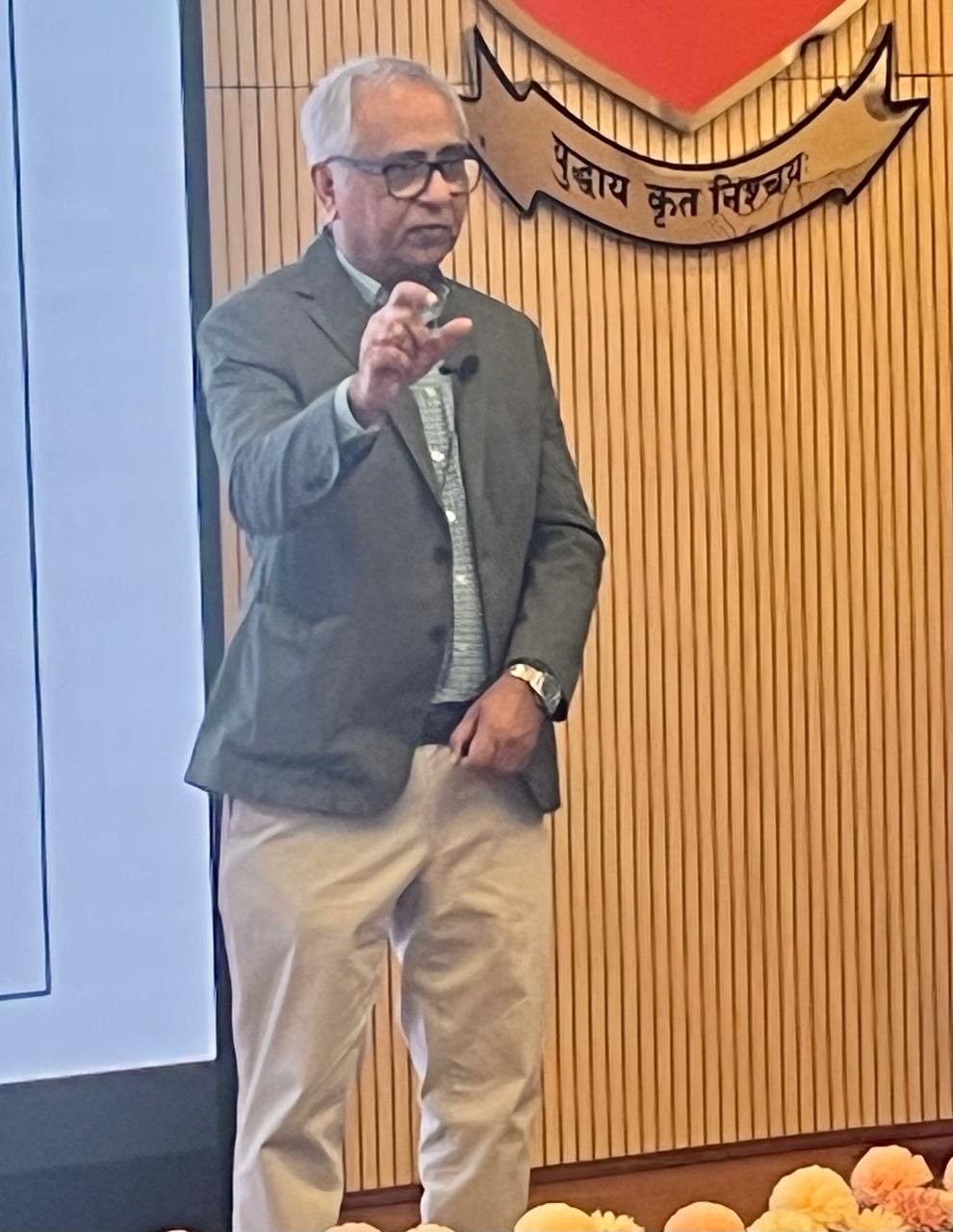

In an era when digital infrastructure has become the new frontline of international conflict, the invitation extended to Lt Gen (Dr) Rajesh Pant to deliver a keynote at the RSA Conference (RSAC) 2026 in San Francisco marks a significant milestone, not only for India’s cybersecurity ecosystem but for the global discourse on digital sovereignty. The world’s largest and most influential cybersecurity gathering, running from March 23 to 26 at the Moscone Center, will hear Pant address “The Impact of Geopolitical Turbulence on Global Cyberspace”, a theme that could scarcely be more prescient as nation-state actors, hybrid warfare, and emerging technologies converge to reshape the threat landscape.
Pant, a retired Indian Army Signals Corps officer with 41 years of distinguished service, former National Cybersecurity Coordinator in the Prime Minister’s Office, and a PhD holder in Information Security metrics, brings a rare blend of battlefield-honed operational insight, academic rigour (M.Tech from IIT Kharagpur, M.Phil from Madras University), and high-level policy execution. During his tenure as National Cybersecurity Coordinator, India’s ranking in the UN Global Cybersecurity Index surged from 47th to the global top 10, a testament to coordinated national strategy, public-private partnerships, and capacity building that few emerging powers have matched at such speed. He also led the Army’s dedicated cyber training establishment and has since taken on advisory and leadership roles, including Senior Advisor (India) at Resecurity and Chairman of the Cyber Security Association of India. Three Presidential honours underscore a career defined by excellence in both kinetic and digital domains.

Why This Keynote Matters Now
RSAC 2026 convenes thousands of CISOs, government leaders, researchers, and vendors at a moment when cybersecurity has ceased to be a technical silo and become a core vector of geopolitical competition. The World Economic Forum’s Global Cybersecurity Outlook 2026 explicitly states that “geopolitics is a defining feature of cybersecurity,” with 64% of organisations now factoring in state-sponsored disruption of critical infrastructure or espionage when shaping risk strategies. Among the largest enterprises, 91% have altered their cybersecurity posture due to geopolitical volatility, while overall confidence in national preparedness for major incidents has eroded, 31% of respondents express low confidence, up from 26% the previous year.
Pant’s chosen topic directly confronts this reality. Recent years have witnessed an acceleration of “weaponisation of everything,” as he told Defence Chronicle. State-linked actors have pre-positioned inside critical systems for months or years; hybrid campaigns blur the lines between espionage, sabotage, and criminal enterprise; and supply-chain compromises now carry strategic weight. The 2025 Norwegian hydropower incident and major state-linked crypto-exchange breach causing over $1.5 billion in losses illustrate how local geopolitical friction produces global digital shockwaves.
Compounding these pressures are two transformative technologies Pant explicitly flags: artificial intelligence and quantum computing. AI has become a dual-use accelerant, 87% of WEF respondents identified AI-related vulnerabilities as the fastest-growing cyber risk in 2025, while 94% see AI/ML as the single most significant driver of change in the coming year. Adversaries deploy generative tools for hyper-personalised phishing, autonomous exploit chaining, and deepfake-driven influence operations at machine speed. Defenders, meanwhile, leverage AI for anomaly detection and automated response, yet the asymmetry favours attackers who face fewer regulatory or ethical constraints.
Quantum computing adds an existential horizon. The “harvest now, decrypt later” tactic, already employed by sophisticated actors, means encrypted sensitive data intercepted today becomes decryptable tomorrow once cryptographically relevant quantum machines mature. Organisations must therefore treat today’s data as tomorrow’s liability, accelerating migration to post-quantum cryptography (PQC) standards formalised by NIST and echoed globally. Pant’s emphasis on these convergences positions his address as both diagnostic and prescriptive: how do mature and emerging powers alike forge resilience when the attack surface, the tools, and the motivations are all evolving simultaneously?

An Indian Lens on Global Resilience
Pant’s perspective carries unique weight precisely because India occupies a distinctive vantage point. As the world’s most populous digital nation, with over 900 million internet users, a burgeoning fintech and digital-public-goods stack (UPI, Aadhaar, ONDC), and ambitious 5G/6G and semiconductor initiatives, India has experienced both the opportunities and vulnerabilities of rapid digitisation. Under Pant’s coordination, the country strengthened CERT-In capabilities, enacted data localisation and critical sector guidelines, fostered international partnerships (Quad, Indo-US, EU), and emphasised “cybersecurity as everybody’s responsibility”, a mantra that resonates far beyond national borders.
His keynote arrives amid deepening Indo-US cyber collaboration. The Indo-US Cyber Conclave 2026, running alongside RSAC, further amplifies this dialogue. An Indian voice of Pant’s stature at the epicentre of Western cybersecurity thinking signals maturing multipolarity: the Global South is no longer merely a consumer or victim of cyber norms but a co-architect of solutions. This matters because fragmented governance, different regions applying divergent standards on AI safety, data sovereignty, and attribution, risks creating exploitable seams that adversaries eagerly widen.
Analytical Depth: From Attribution Challenges to Collective Defence
Pant has long highlighted attribution as a structural weakness for democracies. In earlier remarks, he noted the difficulty of conclusively linking sophisticated campaigns to state sponsors without compromising sources, a gap that emboldens deniable operations. At RSAC he is expected to explore how geopolitical turbulence exacerbates this: alliances of convenience between state actors and criminal proxies (e.g., ransomware groups aligned with geopolitical goals) further muddy the waters. Research from the Information Security Forum and others projects suggests that geopolitics will overtake pure cybercrime as the dominant risk driver in 2026, with critical infrastructure, telecommunications, and energy grids bearing the brunt.
Yet Pant is no pessimist. In conversations he expresses genuine excitement about “cutting-edge innovations” from enterprises and startups, likely referencing autonomous defence platforms, zero-trust architectures scaled by AI, quantum-resistant protocols, and ecosystem-wide threat intelligence sharing. His anticipation of engaging with these developments aligns with RSAC’s own emphasis on moving “beyond defence to disruption and active defence,” as seen in keynotes from Google Threat Intelligence and others. The message is clear: resilience demands not only better technology but better collaboration across governments, industry, and academia, plus a cultural shift where cybersecurity is viewed as strategic national power rather than an IT cost centre.

Implications for Boards, Policymakers, and the Ecosystem
For global executives attending RSAC, Pant’s address offers actionable takeaways. Boards must integrate geopolitical scenario planning into cyber risk registers, treating nation-state threats as strategic rather than purely technical. Governments should invest in talent pipelines and PQC roadmaps with urgency. Smaller nations and enterprises, often the weakest links in supply chains, require uplift through shared intelligence and capacity-building initiatives, precisely the model India scaled under Pant’s watch.
The broader analytical takeaway is that cyberspace has become the domain where great-power competition, technological acceleration, and economic interdependence collide most visibly. In such an environment, isolated national strategies are insufficient. Pant’s career arc, from Signals officer to national coordinator to global advisor, embodies the hybrid leadership required: one foot in military doctrine, one in policy execution, and both eyes on technological foresight.
As the Moscone Center fills with delegates next week, Lt Gen (Dr) Rajesh Pant’s keynote will serve as a bridge, between East and West, between legacy defence mindsets and future digital realities, and between alarm over turbulence and optimism rooted in innovation. In his own words, he looks forward to developments that “will define the future of global cyber resilience.” The international community would do well to listen, and to act on the insights of one of the field’s most battle-tested and forward-looking voices.
In an interconnected world facing polycrisis, voices like Pant’s remind us that cybersecurity is ultimately about securing humanity’s shared digital future. RSAC 2026 may just provide the platform where that future begins to be collectively charted.
contact: drrajeshjauhri@gmail.com
Dr Rajesh Jauhri is a Journalist with an experience of over 25 years in Indian and foreign media, a Social Scientist, an Ac-complished Author, a Political & Strategic Analyst, a Marksman (Rifle & Pistol), an Orator, a Thinker and an Educationist. He holds a Ph.D. degree on “Impact of colonial heritage on Indian police”. He runs an NGO dedicated to the social and eco-nomic uplift of tribal communities in MP and two decades back, he established a school in a village of Indore district, providing education and moral values to children belonging to underprivileged and minority families. Has received multiple awards in various fields.
Proud of Brajesh Pant’s competence in addressing such an international conference.
My best wishes
Thanks Col Gopi for your comment. Pant Sir is really a Gem
Pant is super.
Thanks for your comment
Congratulations to Gen Rajesh Pant
Thanks for your comment
We from the fraternity of IETE must be very proud that Pant Sab is one of our fellow members and was a member of Governing Council. As IETE we must find an opportunity to honour our own towering personality.
Requesting Lt Gen Rajesh Pant Sir to extend his mentorship again to IETE.
Thanks for your comments. Please let me know when you organise any such program to honour Gen Pant. Otherwise also, you are free to share your news at “drrajeshjauhri@gmail.com”