

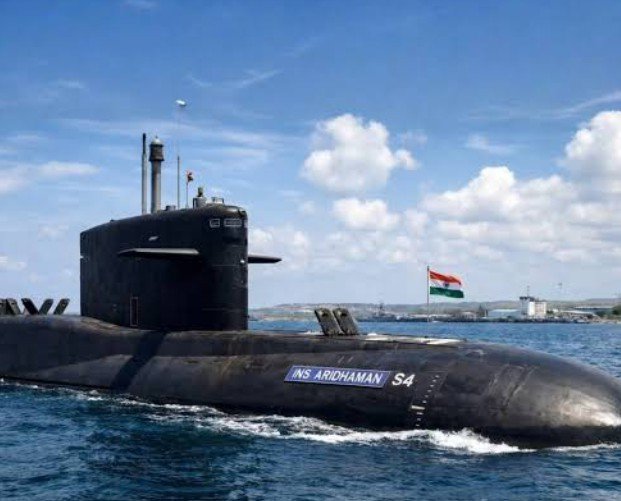
New Delhi: In a significant milestone for India’s strategic deterrence, the Indian Navy has commissioned INS Aridaman (S4), its third indigenously built nuclear-powered ballistic missile submarine (SSBN), on April 3, 2026. Defence Minister Rajnath Singh presided over a low-key ceremony in Visakhapatnam, underscoring the quiet professionalism that has characterised India’s Advanced Technology Vessel (ATV) programme.
The induction of INS Aridaman marks a key step in operationalising a credible sea-based leg of India’s nuclear triad. With this addition, India now operates three SSBNs, following INS Arihant (commissioned in 2016) and INS Arighaat (commissioned in August 2024), enabling, for the first time, sustained rotation for continuous deterrence patrols.
A Bigger, Quieter, and More Potent Platform INS Aridaman, weighing approximately 7,000 tonnes, is larger than its two predecessors (around 6,000 tonnes each) and incorporates substantial upgrades in stealth, endurance, and firepower. It is powered by an 83 MW compact light-water reactor, offering improved acoustic quieting that makes detection by adversary forces significantly harder. The submarine can remain submerged for extended periods, relying on nuclear propulsion rather than surfacing or snorkelling frequently.
It’s most notable enhancement lies in missile capacity. Unlike the four vertical launch system (VLS) tubes on earlier Arihant-class boats, INS Aridaman features eight tubes. This allows it to carry up to 24 K-15 Sagarika short-range submarine-launched ballistic missiles (range ~750 km) or eight K-4 missiles (range ~3,500 km), both capable of being armed with nuclear warheads. The platform is also designed to eventually integrate the longer-range K-5 missile (under development, with a projected range exceeding 5,000–6,000 km).
Defence Minister Singh captured the strategic essence in a succinct social media post: “Shabd nahin, Shakti hai; Aridhaman” (“Not words, but power: Aridhaman”). The name itself, meaning “Vanquisher of Foes,” reflects the submarine’s role in ensuring survivable second-strike capability, the ability to deliver a devastating retaliatory nuclear response even after absorbing a first strike.
Enhancing the Nuclear Triad India’s nuclear doctrine emphasises a credible minimum deterrent with a no-first-use policy. The land and air legs of the triad (mobile missile launchers and aircraft-delivered systems) have long been operational. The sea-based component, however, provides the most survivable platform: nuclear submarines can patrol vast ocean areas undetected, making them extremely difficult for adversaries to neutralise preemptively.
With three operational SSBNs, the Indian Navy can now maintain a more reliable patrol cycle, mitigating the challenges of maintenance, crew rotation, and refits that limited coverage with only two hulls. This development strengthens deterrence stability in the Indian Ocean region, where India faces evolving maritime challenges from both Pakistan and China.
The Aridaman- class boats are built at the Ship Building Centre in Visakhapatnam under the highly classified ATV project, demonstrating India’s growing self-reliance in critical defence technologies. A fourth SSBN in the series (S4*) is already under construction and expected to join the fleet in the coming years, while larger S-5 class submarines are planned for the next decade.
Strategic Context The timing of the commissioning comes amid heightened regional naval activity, including reports of Chinese-built submarines entering service with the Pakistan Navy. INS Aridhaman’s enhanced stealth and strike range, capable of reaching targets deep inland from positions in the Bay of Bengal, adds a robust layer to India’s underwater posture. Naval analysts note that while missile ranges and warhead yields remain classified, the progression from K-15 to K-4 and potentially K-5 reflects a maturing capability that aligns with India’s need for flexible, survivable deterrence across varying threat scenarios. The Indian Navy’s underwater fleet continues to expand with conventional submarines as well, but the SSBN programme remains the cornerstone of strategic stability. INS Aridaman’s entry into service reinforces the message that India possesses the means to protect its sovereignty and respond decisively if deterrence fails.
As one senior official reportedly remarked, this is not merely about adding another vessel to the fleet, it is about ensuring that India’s nuclear deterrent is resilient, credible, and fully operational across air, land, and sea domains. In the words echoed across defence circles: it is not words, but power. This article draws on official statements, defence ministry indications, and reporting from multiple Indian and international sources.

contact: drrajeshjauhri@gmail.com
Dr Rajesh Jauhri is a Journalist with an experience of over 25 years in Indian and foreign media, a Social Scientist, an Ac-complished Author, a Political & Strategic Analyst, a Marksman (Rifle & Pistol), an Orator, a Thinker and an Educationist. He holds a Ph.D. degree on “Impact of colonial heritage on Indian police”. He runs an NGO dedicated to the social and eco-nomic uplift of tribal communities in MP and two decades back, he established a school in a village of Indore district, providing education and moral values to children belonging to underprivileged and minority families. Has received multiple awards in various fields.