

Source: Ministry of Defence, Government of India
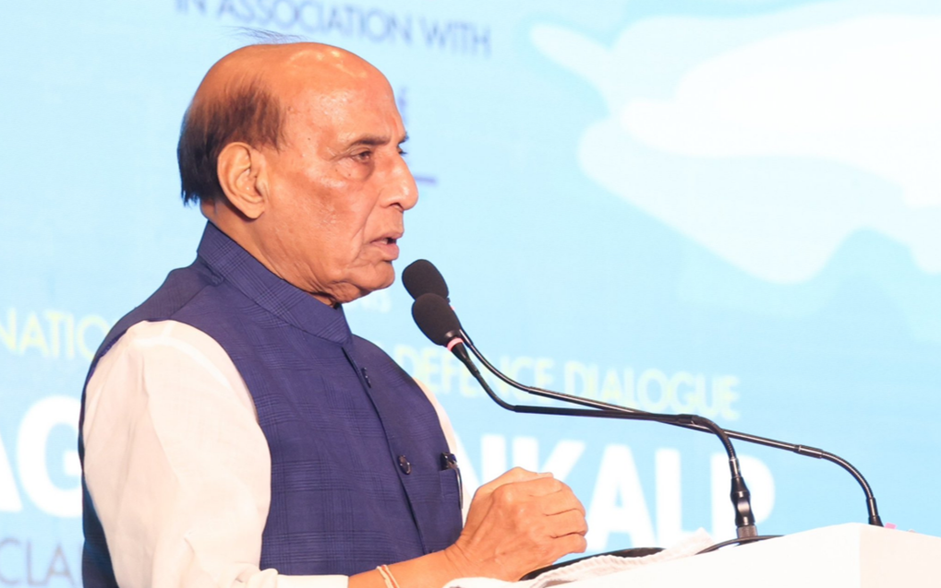
“The global scenario is an abnormal situation. What is more worrying is the fact that this abnormality is becoming the new normal”
As the global geopolitical architecture fractures into a poly-crisis of unprecedented instability[i], the traditional paradigms of deterrence are being fundamentally rewritten. From our strategic vantage point in New Delhi, there is a resounding consensus: the abnormal state of perpetual grey-zone friction and kinetic conflict is the undeniable new normal. Yet, as we dissect the Asian security dynamic, it becomes starkly apparent that the immediate strategic imperatives of the two regional giants diverge sharply. While the People’s Republic of China (PRC) is aggressively consolidating a mature, high-tech arsenal designed to project hegemonic power and counter Western influence,[ii] India is engaged in a profound structural renaissance aimed at foundational self-reliance and interoperability. To truly grasp Beijing’s current trajectory, one must look beyond its rhetoric and analyze its deliberate, sustained financial injections, which signify a shift from capability-building to capability-sustainment. The objective is no longer merely catching up; it is the mass scaling, deployment, and long-term maintenance of next-generation, multi-domain assets designed specifically for anti-access/area-denial (A2/AD). Consider their 2026 defence budget a targeted 7% increase amounting to roughly 1.9 trillion yuan, or $275 billion, marking an eleventh consecutive year of single-digit growth.[iii]
While Chinese state apparatuses defend this spending as moderate relative to their GDP, Indian strategists are acutely aware that these official figures routinely obscure massive, opaque civil-military fusion investments. This vast capital is ruthlessly targeted toward funding the exorbitant lifecycle costs of advanced hardware, insulating the People’s Liberation Army (PLA) from domestic economic headwinds by boosting personnel benefits, and bankrolling the aggressive, high-tempo operational logistics required to enforce expansive territorial claims across the Indo-Pacific.[iv] This sustained capital deployment has yielded undeniable and deeply concerning dividends in force projection, fundamentally altering the threat matrix on our borders and in our waters. Recent military parades, such as the massive V-Day showcase, have revealed a frightening maturation of multi-domain assets, from swarming air-superiority UAVs and next-generation main battle tanks to hypersonic anti-ship glide vehicles, high-energy weapons, hypersonic missiles and a rapidly modernised nuclear triad featuring land, air, and submarine-launched platforms.[v] The commissioning of the Fujian (Type 003) carrier, equipped with advanced electromagnetic aircraft launch systems (EMALS), signals China’s definitive entry into the three-carrier era.[vi] This technological leap allows the PLA Navy to launch heavier, fully loaded fighter jets and airborne early warning aircraft, directly challenging maritime stability and exacerbating India’s strategic anxieties in the Indian Ocean Region. Beijing officially attributes this sweeping militarisation to a deteriorating external environment, pointing to projected US defence budgets exceeding $1 trillion and perceived Japanese remilitarisation.[vii]
However, we know all too well that this supposedly defensive posture inevitably translates into offensive assertiveness along the Line of Actual Control (LAC) and an encroaching String of Pearls strategy in our maritime backyard.[viii] Pivoting our gaze inward to our own borders, if China is refining a mature, expeditionary spear, India is radically restructuring the very arm that wields it. Recognising the severe vulnerabilities exposed by weaponised global supply chains and acute chokepoint threats in the Persian Gulf and the Strait of Hormuz[ix], New Delhi has accepted a stark reality: in the modern era, strategic autonomy is entirely contingent on domestic industrial capability. This realization is elegantly codified in the recently promulgated “Defence Forces Vision 2047” A Roadmap for a Future-Ready Indian Military.[x] Drafted by the Headquarters Integrated Defence Staff, this document is not merely a procurement wish list; it is a civilizational blueprint.[xi] The absolute cornerstone of this vision is jointness and theaterisation. We are actively dismantling the historical, colonial-era siloes of our Army, Navy, and Air Force to create integrated theatre commands, ensuring synergistic operational planning and rapid deployment capabilities.
This mandates a whole-of-nation approach, fusing military kinetic power with India’s burgeoning diplomatic, cyber, and economic heft to secure our expanding strategic footprint. Nowhere is this technological dynamism and doctrinal shift more pronounced than in the maritime domain, where the Indian Navy is aggressively transitioning from a Buyer’s Navy to a Builder’s Navy.[xii] Driven by the imperative to remain the net security provider in the Indian Ocean, today, every single warship and submarine on order is being conceptually designed, engineered, and constructed entirely within Indian shipyards.
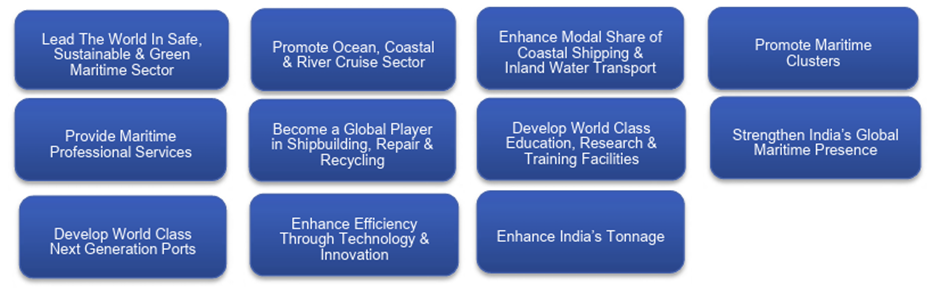
Source: Ministry of Ports, Shipping and Waterways (With 300+ initiatives mapped across 11 key themes, the Amrit Kaal Vision 2047 sets a definitive blueprint for our nation’s growth.)
Backed by a planned monumental investment of roughly Rs 3 lakh crore under the Maritime Amrit Kaal Vision 2047, these shipyards are actively transforming into modular, digitally driven technology hubs and By leveraging advanced digital design tools and modular construction techniques, the clear strategic objective is to position India among the top ten global shipbuilding nations by 2030, and definitively within the top five by our centenary of independence in 2047.[xiii] This sweeping, uncompromising drive for Aatmanirbharta (self-reliance) is generating tremendous economic momentum, turning the defence sector from a traditional capital sink into a vibrant engine of national growth.[xiv] With domestic defence production recently surpassing a record Rs 1.50 lakh crore in FY 2024-25, and exports hitting an all-time high of approximately Rs 24,000 crore, the state is deliberately engineering what it terms a Conglomerate Effect.[xv] The government projects that defence exports will reach Rs 29,000 crore by April 2026, targeting an ambitious Rs 50,000 crore by the end of the decade.
By opening up previously guarded DRDO laboratories[xvi], establishing dedicated Defence Industrial Corridors, and liberalising Foreign Direct Investment (FDI) norms[xvii], we are unleashing the agility of private sector MSMEs and tech start-ups. Currently handling about 25% of defence manufacturing, the private sector’s share is expected to double to 50% in the near future, driving innovation at a pace the traditional public sector simply cannot match. Ultimately, the strategic calculus dictates that while both Asian powers are bracing for a prolonged era of geopolitical friction, their immediate battlegrounds differ fundamentally. The PRC is leveraging its vast, centralized economic base to sustain a deterrence-heavy, expeditionary posture aimed at parity with and eventual displacement of Western forces in the Indo-Pacific. India’s focus, on the other hand, is intensely focused on curing historical legacy vulnerabilities. By prioritizing absolute sovereign control of our military-industrial supply chains and enforcing the deep, structural integration of our armed forces, we are ensuring that by 2047, India will possess the unshakeable strategic autonomy required to secure its rise as an independent, unassailable pole in a multipolar world.
Endnotes
[iii] https://www.chinadaily.com.cn/a/202603/05/WS69a8eacea310d6866eb3bd7f.html
[v] https://www.globaltimes.cn/page/202509/1342575.shtml
[vi] https://www.globaltimes.cn/page/202505/1334807.shtml
[vii] http://eng.chinamil.com.cn/2025xb/V_251452/16429362.html
[viii] https://www.idsa.in/system/files/book/india-china-rivalary-aksingh.pdf
[xi] https://www.pib.gov.in/PressReleasePage.aspx?PRID=2235847®=3&lang=1
[xii] https://www.pib.gov.in/PressNoteDetails.aspx?id=156668&NoteId=156668&ModuleId=3®=3&lang=2
[xv] https://www.pib.gov.in/PressReleasePage.aspx?PRID=2154551®=3&lang=2
[xvi] https://www.pib.gov.in/PressReleasePage.aspx?PRID=2210663®=3&lang=2
[xvii] https://www.pib.gov.in/PressReleasePage.aspx?PRID=2197654®=3&lang=1

Punit Shyam Gore (MA Defence and Strategic Studies) is an alumnus of the School of Internal Security, Defence & Strategic Studies of the Rashtriya Raksha University, Gandhinagar (an institution of national importance) under the Ministry of Home Affairs, Government of India.