
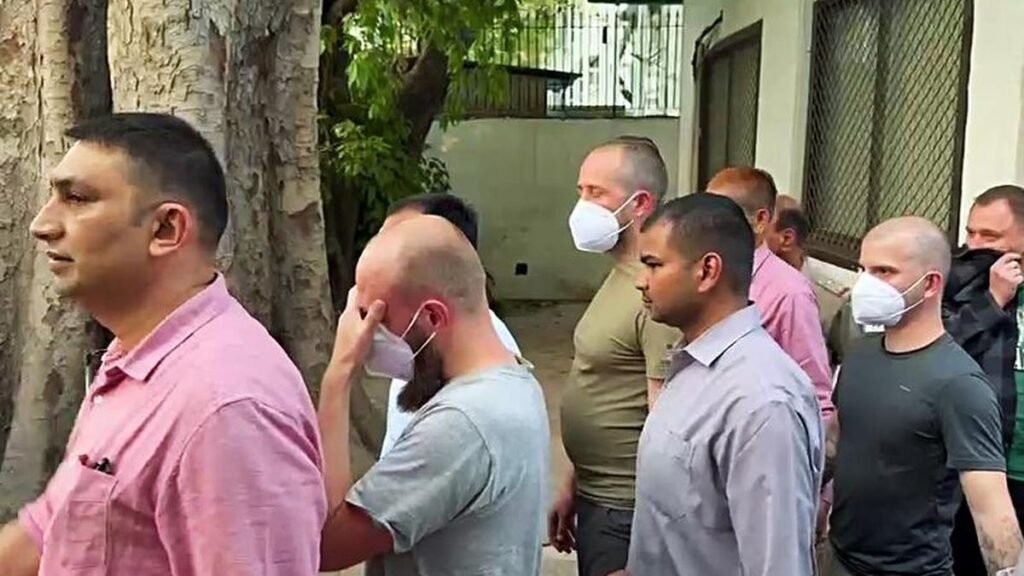
Mhow, India: The 11-day police remand of seven foreign nationals, one American and six Ukrainians, detained by India’s National Investigation Agency (NIA) for allegedly training Myanmar-based ethnic armed groups in drone warfare concluded today. The suspects were produced before the Special NIA Court in Delhi as investigators continue to unravel what officials describe as a sophisticated cross-border network involving illegal entry, technology smuggling, and potential threats to regional stability.
The case, which first came to light with arrests on March 13 at airports in Kolkata, Delhi, and Lucknow, has thrust the shadowy intersection of modern asymmetric warfare, porous borders, and great-power-adjacent conflict zones into the spotlight. According to NIA filings and court documents, the group, including American adventurer Matthew Aaron VanDyke and six Ukrainian nationals, entered India on tourist visas before travelling without required Restricted Area Permits to Mizoram, a sensitive north-eastern state bordering Myanmar. From there, they allegedly crossed into Myanmar’s Chin State to provide hands-on training in drone assembly, operation, electronic jamming countermeasures, and weapons handling to ethnic armed organisations (EAOs) fighting the post-2021 military junta.
Drones and related components were reportedly imported from Europe and routed through India, exploiting the country’s logistics networks before being diverted to conflict zones. The NIA has invoked the stringent Unlawful Activities (Prevention) Act (UAPA), charging the accused with conspiracy to commit terrorist acts, illegal border crossing, and supporting insurgent networks with potential repercussions for India’s own Northeast.
This is not mere speculation by Indian authorities. Multiple independent reports, including those citing NIA submissions to the court, corroborate the timeline: initial detentions at immigration points as the group attempted to depart the country, followed by swift transfer to Delhi for interrogation. The agency sought extended custody to recover digital evidence, financial trails, and links to a broader network, possibly involving up to 14 Ukrainian nationals who had entered India. Sources indicate the probe remains active, with no fresh arrests announced as of today but clear signals that accomplices and facilitators are still being pursued.
A Perfect Storm: Myanmar’s Civil War Meets Drone Proliferation
The arrests occur against the backdrop of Myanmar’s protracted civil war, which erupted after the February 2021 military coup. Chin State, where the training allegedly took place, has become a hotspot for resistance by groups such as the Chin National Army and allied People’s Defence Forces (PDFs). These EAOs control significant territory and have increasingly turned to commercially available drone technology, a trend accelerated by the Russia-Ukraine war, where Ukrainian forces honed low-cost, high-impact drone tactics against superior armour.
What makes this case particularly alarming for Indian security planners is the documented spill over. Several Myanmar EAOs have historical or tactical ties to insurgent factions in India’s Northeast, including groups operating in Manipur and Nagaland. As recently as 2024, Indian security forces reported weaponised drone attacks by Kuki insurgent elements in Manipur, underscoring how dual-use civilian technology can rapidly militarise local conflicts. The NIA’s concern, as articulated in remand applications, is that training provided to Myanmar militants could flow back across the 1,643-kilometre porous Indo-Myanmar border, a frontier where free movement regimes (now under review) have long facilitated both legitimate trade and illicit arms flows.
Another point of concern is the point, which is related to Afghanistan, where US forces left their weapons and armaments in Afghan territories before leaving the disturbed country on its worst plight. Reason for leaving the weapons there only was to make the whole Indian sub-continent more disturbed, which is evident even today. Same weapons, after crossing Pakistan reached Kashmir and put Indian forces under pressure for more than two decades. Actually CIA of US or their counterparts in Russia and China have long term vision when they plan anything and training the insurgents of Myanmar on dirty drone tactics is bound to cross border and pass to Kukis in very near future. Then, it will be a problem for us and same point has been realised by Indian agencies and leadership.
Analysts tracking the case note the irony and the risk. Ukrainian nationals, many with presumed military or technical backgrounds forged in Europe’s largest conflict since World War II, are now accused of exporting those same skills to Southeast Asia. VanDyke, a well-known figure in Western adventurist circles with prior involvement in Libya’s 2011 uprising and other conflict zones, adds a layer of international intrigue. His profile has drawn comparisons, albeit cautiously, to earlier cases of foreign mercenaries operating in South Asia.
Diplomatic Ripples and Technology Regulation Challenges
The case has already strained diplomatic channels. Ukraine’s Foreign Ministry has issued strong protests, demanding consular access and criticising the handling of its nationals while rejecting the allegations. US officials have acknowledged the detention of their citizen but offered no detailed public comment. Indian authorities, for their part, have emphasised due process under domestic law while highlighting national security imperatives.
Beyond immediate diplomacy lies a deeper policy challenge: the unregulated proliferation of dual-use drone technology. Commercial drones, once hobbyist tools, are now battlefield multipliers costing a fraction of traditional weaponry. India, which has rapidly expanded its own indigenous drone programme under the “Make in India” initiative, faces the flip side, vulnerability to misuse by non-state actors. The incident underscores gaps in monitoring foreign visitors in restricted border areas and the need for tighter export controls on components transiting through Indian hubs.
Security experts familiar with the Northeast have long warned of this convergence. The region’s insurgencies, though diminished from their 1980s-90s peak, persist in fragmented forms, sustained by cross-border sanctuaries and external patronage. Myanmar’s instability, compounded by refugee inflows into Mizoram and Manipur, has already tested India’s border management. New Delhi’s decision to fence much of the Indo-Myanmar border and suspend the Free Movement Regime reflects growing recognition of these threats.
Broader Implications for Regional Security Architecture
As the NIA’s investigation proceeds post-remand, with the accused likely transitioning toward judicial custody pending charge sheet, this case serves as a cautionary tale. It illustrates how distant conflicts (Ukraine, Myanmar) can localise rapidly through technology and mobile operatives. For India, it reinforces the strategic importance of the Northeast not merely as a peripheral frontier but as a critical node in its Act East Policy and Indo-Pacific ambitions.
The episode also raises uncomfortable questions about oversight of “tourist” movements in sensitive zones and the potential for hybrid warfare tactics to undermine stability without direct state involvement. With drones now democratised, the threshold for entry into insurgent operations has lowered dramatically. India’s response, blending aggressive law enforcement with diplomatic engagement and technological countermeasures, will be closely watched in ASEAN capitals and beyond.
The remand’s conclusion today marks the end of the initial intensive interrogation phase, but the wider probe is far from over. As officials sift through seized electronics, communication logs, and financial records, the full contours of this alleged network may yet emerge. In an era where conflict zones bleed into one another via silicon chips and satellite uplinks, these arrests in India could echo far beyond the hills of Mizoram and Chin State.
This analysis draws on official court records, NIA statements, and reporting from multiple Indian and international outlets tracking the case. Developments are ongoing.

contact: drrajeshjauhri@gmail.com
Dr Rajesh Jauhri is a Journalist with an experience of over 25 years in Indian and foreign media, a Social Scientist, an Ac-complished Author, a Political & Strategic Analyst, a Marksman (Rifle & Pistol), an Orator, a Thinker and an Educationist. He holds a Ph.D. degree on “Impact of colonial heritage on Indian police”. He runs an NGO dedicated to the social and eco-nomic uplift of tribal communities in MP and two decades back, he established a school in a village of Indore district, providing education and moral values to children belonging to underprivileged and minority families. Has received multiple awards in various fields.