

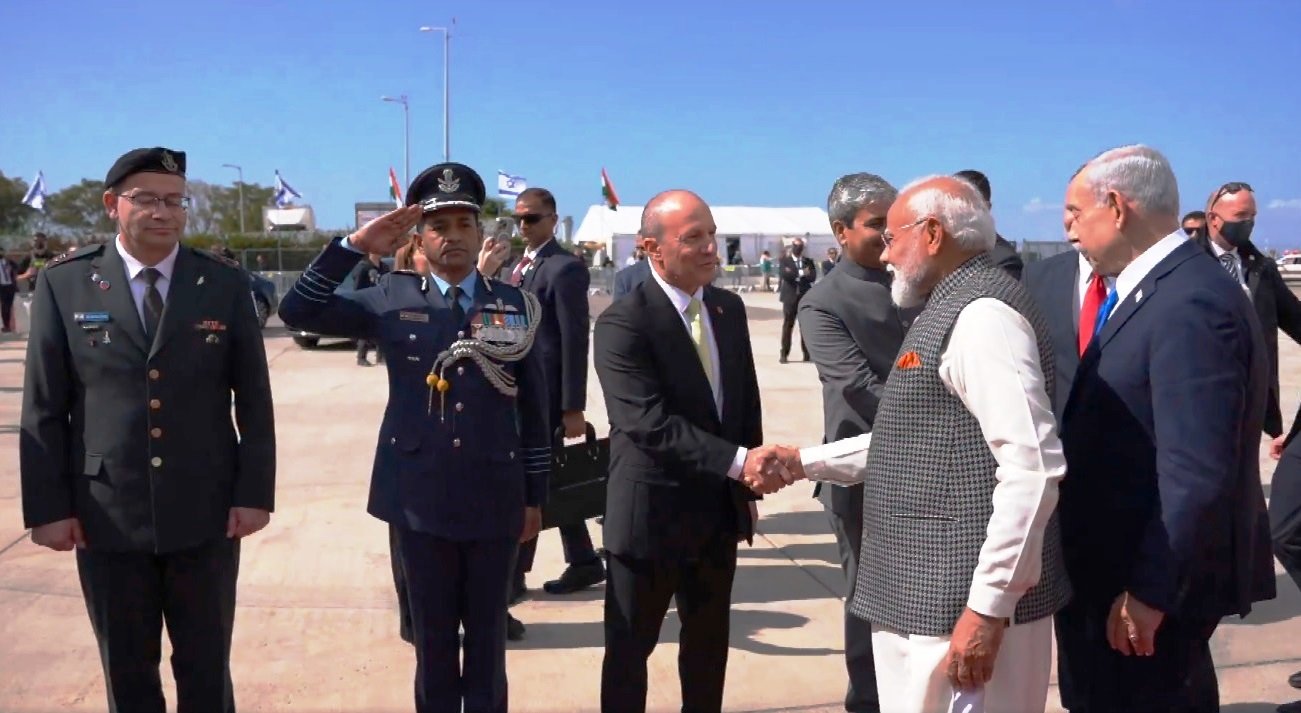
Mhow: In a display of enduring friendship and strategic alignment, Indian Prime Minister Narendra Modi was accorded a warm reception by Israeli Prime Minister Benjamin Netanyahu upon his arrival at Ben Gurion International Airport in Tel Aviv today. The two leaders shared a heartfelt handshake amid a ceremonial guard of honor, with Indian and Israeli flags fluttering in the background. This marks Modi’s second standalone visit to Israel, nearly a decade after his historic 2017 trip that redefined bilateral relations.
Modi, dressed in his signature kurta and jacket, descended from the Air India One aircraft to the strains of national anthems played by a military band. Netanyahu, accompanied by senior Israeli officials, greeted him with open arms, symbolizing the personal rapport that has characterized their interactions. In a post on X shortly after landing, Modi expressed his sentiments: “Deeply touched by the warm welcome extended by my friend, PM Netanyahu. May the India-Israel friendship continue to soar higher! 🇮🇳 🇮🇱”
The visit comes at a pivotal moment for both nations, amid evolving global security dynamics and India’s push to bolster its defense capabilities following recent regional conflicts. Over the next few days, Modi and Netanyahu are expected to hold wide-ranging discussions on defense, technology, agriculture, and cybersecurity, building on the foundation laid during Modi’s inaugural visit in July 2017.
Historical Context: From Covert Ties to Strategic Partnership
India and Israel established full diplomatic relations in 1992, but ties remained largely under the radar due to India’s historical support for the Palestinian cause and its non-aligned foreign policy. This changed dramatically under Modi’s leadership. His 2017 visit—the first by an Indian prime minister to Israel—elevated the relationship to a “strategic partnership” during Netanyahu’s reciprocal trip to New Delhi in 2018. The partnership shifted from shadowy defense deals to open collaboration, encompassing joint military exercises, technology transfers, and economic investments.
In the intervening years, relations have matured into what experts term an “era of strategic intimacy.” Key milestones include India’s swift condemnation of the October 7, 2023, Hamas attacks on Israel and the provision of Indian-made drones for intelligence gathering in Gaza. Bilateral trade has surged, with defense exports from Israel to India reaching $2.9 billion over the past decade, making India Israel’s largest defense market. In 2025 alone, joint deals worth $8.6 billion were signed for investment protection and defense production.
This 2026 visit underscores India’s multi-alignment strategy, positioning it as a key player in the Global South while deepening ties with Western-aligned nations like Israel. Unlike 2017, when Modi notably skipped a visit to Palestine to signal “de-hyphenation” of India-Israel relations from the Israeli-Palestinian conflict, this trip occurs against the backdrop of heightened Middle Eastern tensions and India’s recent border skirmishes.
Key Agendas: Defense Deals and Beyond
High on the agenda are multibillion-dollar arms agreements, estimated at up to $10 billion, focusing on advanced air defense systems to counter missiles and drones. These include upgrades to India’s existing arsenal with Israeli technologies like the Iron Dome and David’s Sling systems, tailored for short- and medium-range threats. Discussions will also cover joint production under India’s “Make in India” initiative, cybersecurity cooperation, and innovation in agriculture and water management—areas where Israel has provided expertise to address India’s challenges in arid regions.
The leaders are expected to sign memorandums of understanding (MoUs) expanding collaboration in space technology, biotechnology, and renewable energy. Netanyahu has already hailed India as an “enormously powerful” partner with 1.4 billion people, emphasizing the mutual benefits of this alliance.
India’s Security Scenario: Lessons from the 2025 Mini-War
Modi’s visit is particularly timely for India’s security landscape, which has been reshaped by the brief but intense conflict with Pakistan in May 2025—dubbed the “mini-war” or “Four Days in May.” The crisis erupted after a terrorist attack in Pahalgam, Jammu and Kashmir, on April 22, 2025, killing 26 civilians. India blamed Pakistan-based groups like Lashkar-e-Taiba and launched Operation Sindoor on May 7, striking alleged terrorist camps in Pakistan-administered Kashmir and Punjab province with missiles and drones.
The four-day escalation saw both sides exchange artillery, airstrikes, and drone attacks, resulting in dozens of casualties. Pakistan claimed to have downed several Indian aircraft, while India asserted it neutralized Pakistan’s air defenses and struck deep into enemy territory. A ceasefire was brokered on May 10 via U.S. mediation, but the episode exposed vulnerabilities in India’s border security, particularly against drone swarms and missile barrages—tactics reminiscent of those used in the Middle East.
In the aftermath, India adopted a more aggressive military doctrine, emphasizing preemptive strikes against cross-border terrorism and enhancing nuclear deterrence. The conflict highlighted India’s reliance on advanced surveillance and anti-drone systems, areas where Israel proved invaluable. During the mini-war, Israel provided unequivocal support, including material aid and planning assistance—standing alone among nations in backing India. In reciprocation, India remained neutral during the subsequent 12-day Iran-Israel conflict in June 2025, effectively favoring Israel despite close ties with Iran.
This visit aims to fortify India’s defenses against perennial threats from Pakistan and an assertive China, with whom India faced the Doklam standoff in 2017 and ongoing border tensions. Israeli technologies will help modernize India’s armed forces, improving interoperability in joint exercises like Blue Flag and boosting capabilities in asymmetric warfare.
Global Security and Political Ramifications
On the global stage, Modi’s visit signals India’s confident navigation of a combustible region, reassuring Israel of a reliable ally amid its diplomatic isolation and surges in antisemitism. The strengthened India-Israel axis counters Iranian influence, bolstering the resilience of the Abraham Accords and weakening Tehran’s proxies in the Middle East.
Politically, it underscores India’s shift from non-alignment to pragmatic multi-alignment, allowing it to balance relations with Gulf states, the U.S., and Russia while deepening ties with Israel. The U.S. mediation in the 2025 mini-war, which re-hyphenated India-Pakistan relations and proposed Kashmir mediation, frustrated New Delhi, pushing it closer to independent partners like Israel. This could reshape Indo-U.S. dynamics, with India leveraging Israeli tech to reduce dependence on American arms.
In a multipolar world, the partnership promotes stability in Asia and the Mediterranean, with Israel pivoting eastward for economic opportunities. Experts warn, however, of potential backlash from Muslim-majority nations and India’s domestic Muslim community, though Modi’s government views the alliance as essential for national security.
As Modi and Netanyahu chart the future, this visit not only cements personal bonds but also positions India-Israel ties as a cornerstone of global security architecture, promising mutual growth in an era of uncertainty.

contact: drrajeshjauhri@gmail.com
Dr Rajesh Jauhri is a Journalist with an experience of over 25 years in Indian and foreign media, a Social Scientist, an Ac-complished Author, a Political & Strategic Analyst, a Marksman (Rifle & Pistol), an Orator, a Thinker and an Educationist. He holds a Ph.D. degree on “Impact of colonial heritage on Indian police”. He runs an NGO dedicated to the social and eco-nomic uplift of tribal communities in MP and two decades back, he established a school in a village of Indore district, providing education and moral values to children belonging to underprivileged and minority families. Has received multiple awards in various fields.