



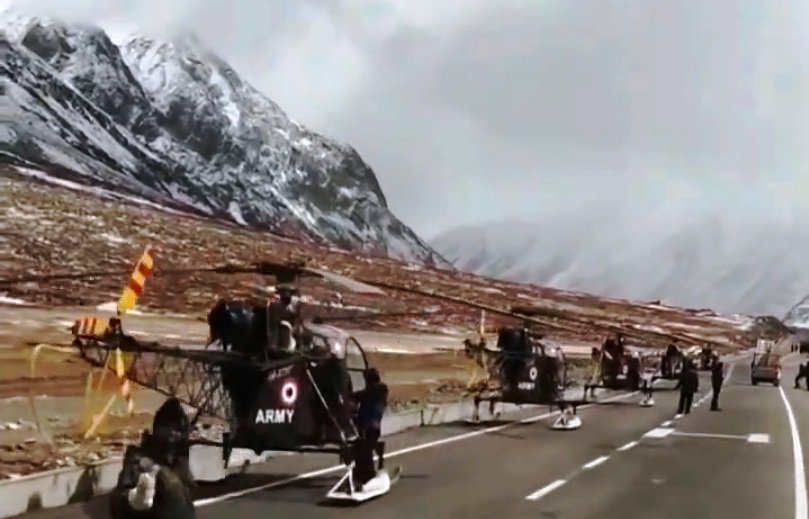
In a striking display of operational flexibility, Indian Army Aviation Cheetah helicopters were recently photographed landed on a paved highway stretch amid the stark, snow-capped peaks of the Himalayan region. The images, shared by defence observer IADN, capture multiple light utility helicopters positioned along the road with ground crew in attendance, underscoring the force’s ability to conduct precision operations far from conventional airfields or prepared helipads.
Keywords: Indian Army Cheetah helicopter, highway landing drill, Himalayan operational readiness, high-altitude aviation, Army Aviation Corps, contingency landing zones
The activity forms part of routine training and contingency drills designed to validate the Army’s capacity to generate and sustain aviation support in austere high-altitude environments. When fixed-wing airstrips or dedicated helipads are unavailable, degraded, or denied, national highways and other suitable road surfaces become viable temporary landing zones. Such proficiency is especially critical along India’s northern borders, where rugged topography, extreme weather and limited infrastructure demand constant adaptation.
The HAL Cheetah, a licence-built derivative of the Aérospatiale SA 315B Lama, remains the backbone of high-altitude aviation for the Indian Army. Renowned for its exceptional power-to-weight ratio, the single-engine helicopter routinely operates at altitudes exceeding 20,000 feet, supporting logistics, troop induction, casualty evacuation and reconnaissance in sectors such as Ladakh and the Siachen Glacier. Its ability to land on confined or unprepared surfaces, including roads, extends the reach of forward units and ensures continuity of supply and medical support even under contested or disrupted conditions.
Highway landing drills also enhance coordination between aircrew and ground elements, refine approach and departure procedures under constrained visual and environmental cues, and build confidence in rapid deployment concepts. Similar exercises conducted elsewhere, including on National Highway stretches near the western borders, have demonstrated the same principle across varied terrain. Together, these efforts contribute to the broader objective of multi-domain readiness and the ability to project aviation power with minimal fixed infrastructure.
As the Army continues to modernise its light utility helicopter fleet, the enduring utility of platforms like the Cheetah in extreme environments remains clear. The recent Himalayan highway operations reaffirm that operational ingenuity and rigorous training enable the force to maintain effective aerial mobility wherever it is required.

contact: drrajeshjauhri@gmail.com
Dr Rajesh Jauhri is a Journalist with an experience of over 25 years in Indian and foreign media, a Social Scientist, an Ac-complished Author, a Political & Strategic Analyst, a Marksman (Rifle & Pistol), an Orator, a Thinker and an Educationist. He holds a Ph.D. degree on “Impact of colonial heritage on Indian police”. He runs an NGO dedicated to the social and eco-nomic uplift of tribal communities in MP and two decades back, he established a school in a village of Indore district, providing education and moral values to children belonging to underprivileged and minority families. Has received multiple awards in various fields.