


Indian and Australian troops have demonstrated enhanced joint operational capabilities in coastal humanitarian assistance and disaster relief (HADR) during the fifth edition of ‘Exercise AUSTRAHIND 2026’, currently under way at the Foreign Training Node in Thiruvananthapuram, Kerala.
Keywords: Exercise AUSTRAHIND 2026, India-Australia joint military exercise, HADR coastal drills, ship-to-shore troop insertion, Garhwal Rifles 13 Brigade, Indo-Pacific defence cooperation, INS Sharda Sea King.
The bilateral army exercise, which started on October 19 and concluded on November 1, brings together approximately 120 personnel from each side. The Indian contingent is drawn primarily from the Garhwal Rifles along with supporting arms and services, while the Australian contingent comprises troops from the 13 Brigade. For the first time, an observer delegation from New Zealand is also participating.
Focused on joint sub-conventional operations in island and coastal environments under Chapter VII of the UN Mandate, the training emphasises coordinated land, sea and air operations, surveillance and reconnaissance, protection of vital installations, and rapid response to HADR contingencies.
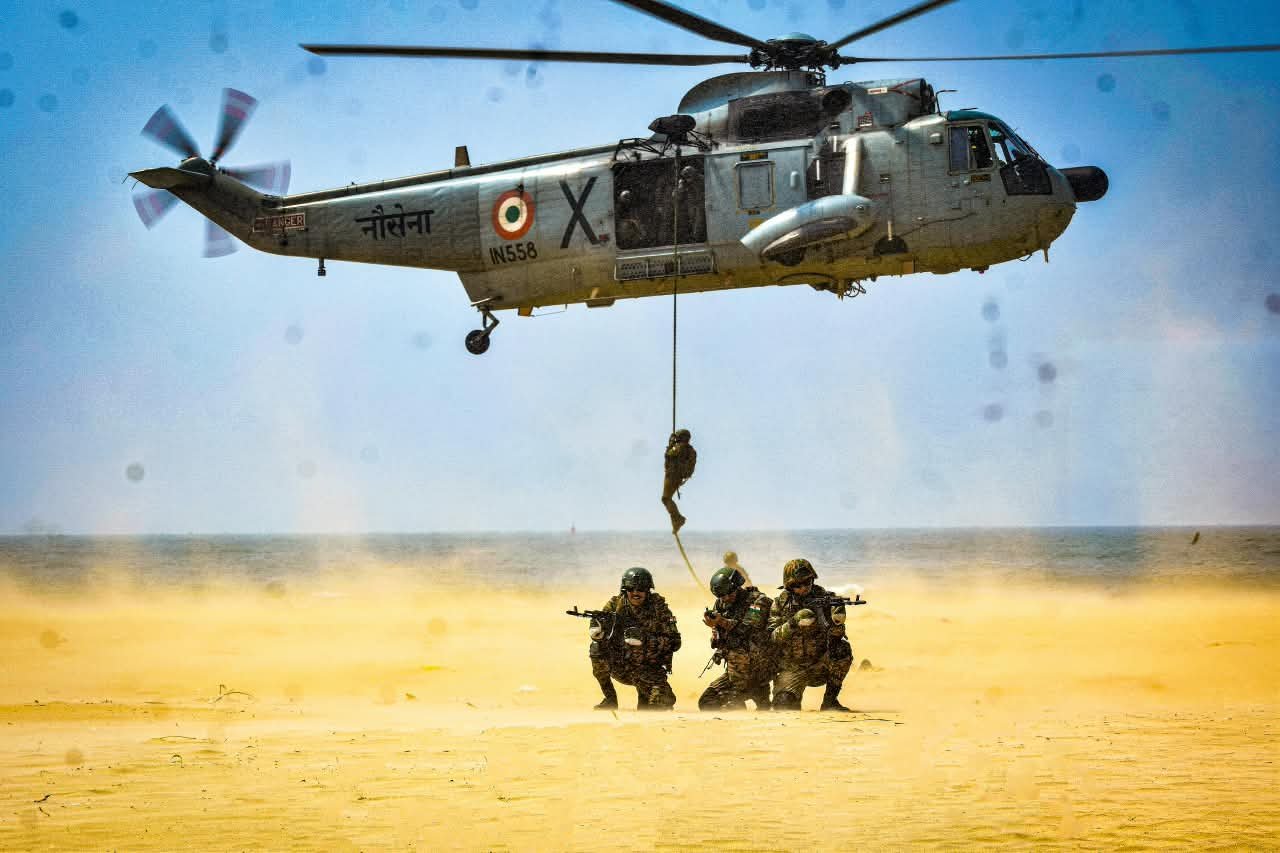
In a notable demonstration of tri-service integration, the Indian Navy’s INS Sharda and a Sea King helicopter, working in close coordination with Indian Army and Australian Army troops, executed a swift ship-to-shore troop insertion as part of joint coastal HADR drills. The evolution highlighted seamless land-sea-air coordination and the ability to rapidly insert forces in a simulated disaster scenario along Kerala’s coastline.
Australian High Commissioner to India Philip Green, who visited the exercise, underscored the value of such engagements. He noted that bilateral exercises like AUSTRAHIND strengthen mutual understanding and interoperability, build trust, and deepen the defence partnership between the two countries.
Defence officials said the drills are designed to develop shared tactics, techniques and procedures for operations in littoral and island terrain while enhancing overall combat readiness and jointmanship. The exercise also includes combat swimming, drone manoeuvres, ambush drills and inter-agency coordination with local disaster response agencies.
AUSTRAHIND 2026 forms part of the steadily expanding India-Australia defence relationship and contributes to broader efforts aimed at promoting stability and security in the Indo-Pacific. By practising rapid, coordinated responses to coastal disasters, both armies are building practical capabilities that can be applied in real-world humanitarian crises.

contact: drrajeshjauhri@gmail.com
Dr Rajesh Jauhri is a Journalist with an experience of over 25 years in Indian and foreign media, a Social Scientist, an Ac-complished Author, a Political & Strategic Analyst, a Marksman (Rifle & Pistol), an Orator, a Thinker and an Educationist. He holds a Ph.D. degree on “Impact of colonial heritage on Indian police”. He runs an NGO dedicated to the social and eco-nomic uplift of tribal communities in MP and two decades back, he established a school in a village of Indore district, providing education and moral values to children belonging to underprivileged and minority families. Has received multiple awards in various fields.