

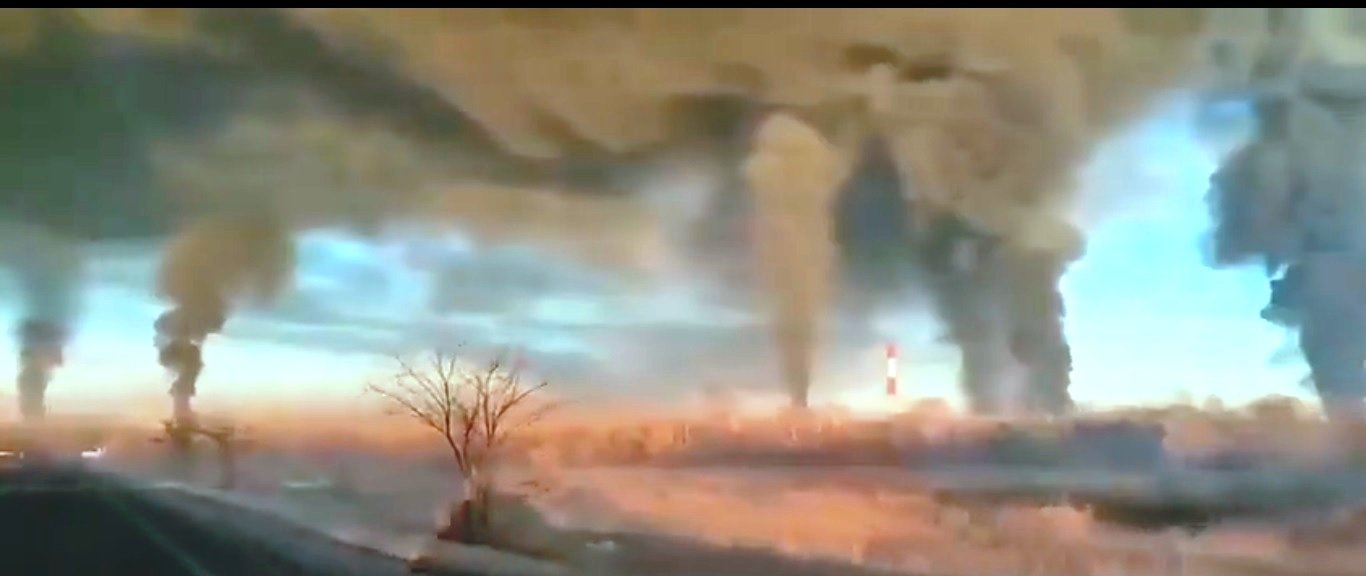
In one of the most extensive drone operations of the Russia-Ukraine war, Ukrainian forces launched a massive overnight attack on 29-30 October, targeting critical energy infrastructure deep inside Russia. Ukrainian long-range drones, including FP-1 models produced by domestic manufacturer Fire Point, struck the Rosneft-operated Novokuibyshevsk oil refinery in the Samara region. Monitoring channels and local reports confirmed multiple impacts, with at least 11 fires breaking out across processing units, including a diesel hydrotreating facility. Thick plumes of black smoke were visible over the industrial site for hours.
Keywords: Ukraine, drone strike, Novokuibyshevsk, oil refinery, Russia-Ukraine war, FP-1 drones, drone swarm, warfare
Russia’s Defence Ministry stated that air defences intercepted 1,043 Ukrainian drones across 19 regions during the night, describing it as one of the largest single-wave attacks of the conflict. Samara regional authorities reported emergency teams responding to fires at industrial sites, with at least two personnel killed while dealing with the aftermath. Russian Deputy Prime Minister Alexander Novak acknowledged strikes on three oil refineries and one gas-chemical complex, claiming only minor damage at one facility. The Novokuibyshevsk plant, with an annual capacity of approximately 8.8 million tonnes, produces gasoline, diesel, and jet fuel used by the Russian Aerospace Forces. It has been targeted repeatedly in previous Ukrainian campaigns.
The assault ended a roughly two-week lull in strikes on Russian refineries. Ukrainian drone maker Fire Point publicly confirmed its systems scored multiple hits on the site. The operation underscores the evolving nature of modern warfare, where relatively inexpensive, mass-produced drones and coordinated swarms have repeatedly demonstrated the ability to overwhelm traditional air defences and destroy high-value assets. From disabling armoured vehicles such as T-90 tanks in short engagements to threatening major surface ships and fixed industrial targets, unmanned systems have shifted the cost-exchange calculus dramatically, lessons reinforced both in Ukraine and in other recent conflicts involving low-cost aerial threats.
Military analysts note that the proliferation of long-range one-way attack drones has forced rapid adaptation in air defence doctrine, electronic warfare, and force protection. While Russia continues to claim high interception rates, the cumulative pressure on energy infrastructure highlights the strategic value of sustained, attrition drone campaigns. As both sides refine tactics and production scales, the dominance of small, expendable unmanned platforms over legacy platforms appears set to define the character of future conflicts.

contact: drrajeshjauhri@gmail.com
Dr Rajesh Jauhri is a Journalist with an experience of over 25 years in Indian and foreign media, a Social Scientist, an Ac-complished Author, a Political & Strategic Analyst, a Marksman (Rifle & Pistol), an Orator, a Thinker and an Educationist. He holds a Ph.D. degree on “Impact of colonial heritage on Indian police”. He runs an NGO dedicated to the social and eco-nomic uplift of tribal communities in MP and two decades back, he established a school in a village of Indore district, providing education and moral values to children belonging to underprivileged and minority families. Has received multiple awards in various fields.