


New Delhi
The Indian Air Force has achieved a major milestone in its quest for self-reliance with the granting of Final Operational Clearance (FOC) to the indigenous Netra Mk-1 Airborne Early Warning and Control (AEW&C) system. The clearance was formally handed over by DRDO’s Centre for Airborne Systems (CABS) to the IAF yesterday, at a ceremony in Bengaluru presided over by senior officials including the Deputy Chief of the Air Staff.
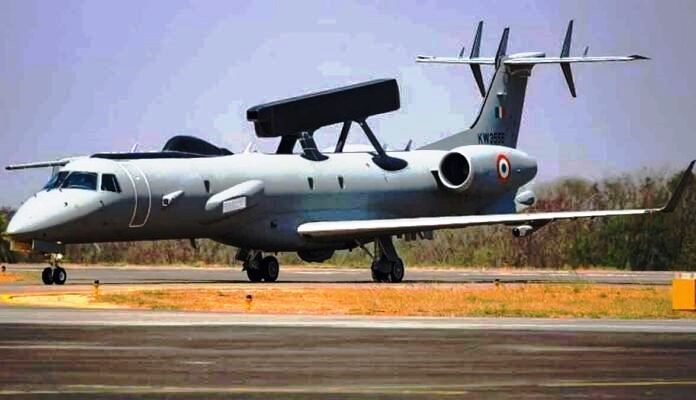
Mounted on the reliable Embraer ERJ-145 platform, the Netra Mk-1 functions as a sophisticated flying command centre. Its indigenous Active Electronically Scanned Array (AESA) radar provides 240-degree coverage, enabling detection and tracking of aerial threats, including aircraft and missiles, at ranges exceeding 250 kilometres. The system integrates advanced sensors for electronic intelligence, communications, and battle management, allowing real-time coordination of air operations from high altitudes.
Development of the Netra programme, a collaborative effort between DRDO, the IAF, and Indian industry partners, dates back to the early 2000s. The system received Initial Operational Clearance in 2017 and has since proven its mettle in real-world scenarios. It played a crucial supporting role during the 2019 Balakot airstrike, enhancing situational awareness and contributing to the success of the mission. Three Netra Mk-1 aircraft are currently in service.
The FOC certification validates that the platform fully meets the Air Staff Qualitative Requirements, paving the way for its unrestricted deployment in high-intensity conflicts. Defence analysts hail it as a significant boost to ‘Aatmanirbhar Bharat’, reducing dependence on foreign AEW&C platforms and strengthening network-centric warfare capabilities.
Looking ahead, the milestone clears the path for accelerated production and upgrades. The IAF plans to induct six enhanced Netra Mk-1A variants with extended range and improved sensors, while the more ambitious Netra Mk-2 programme, based on the Airbus A321 platform, aims for near-360-degree coverage and greater endurance. These developments are expected to address the IAF’s longstanding shortfall in airborne surveillance assets amid evolving threats from adversaries.
While some experts note the lengthy timeline from development to full clearance, the achievement underscores India’s growing prowess in complex aerospace technologies. “Netra Mk-1’s FOC is not just a certification, it is a declaration of India’s ability to develop, test, and field critical strategic systems indigenously,” a senior DRDO official remarked during the handover.
As regional security dynamics intensify, the operational maturity of Netra strengthens the IAF’s ability to maintain air superiority and early warning dominance. This success reinforces India’s position as an emerging defence technology powerhouse on the global stage.

contact: drrajeshjauhri@gmail.com
Dr Rajesh Jauhri is a Journalist with an experience of over 25 years in Indian and foreign media, a Social Scientist, an Ac-complished Author, a Political & Strategic Analyst, a Marksman (Rifle & Pistol), an Orator, a Thinker and an Educationist. He holds a Ph.D. degree on “Impact of colonial heritage on Indian police”. He runs an NGO dedicated to the social and eco-nomic uplift of tribal communities in MP and two decades back, he established a school in a village of Indore district, providing education and moral values to children belonging to underprivileged and minority families. Has received multiple awards in various fields.