

Sri Vijaya Puram, Andaman & Nicobar Islands
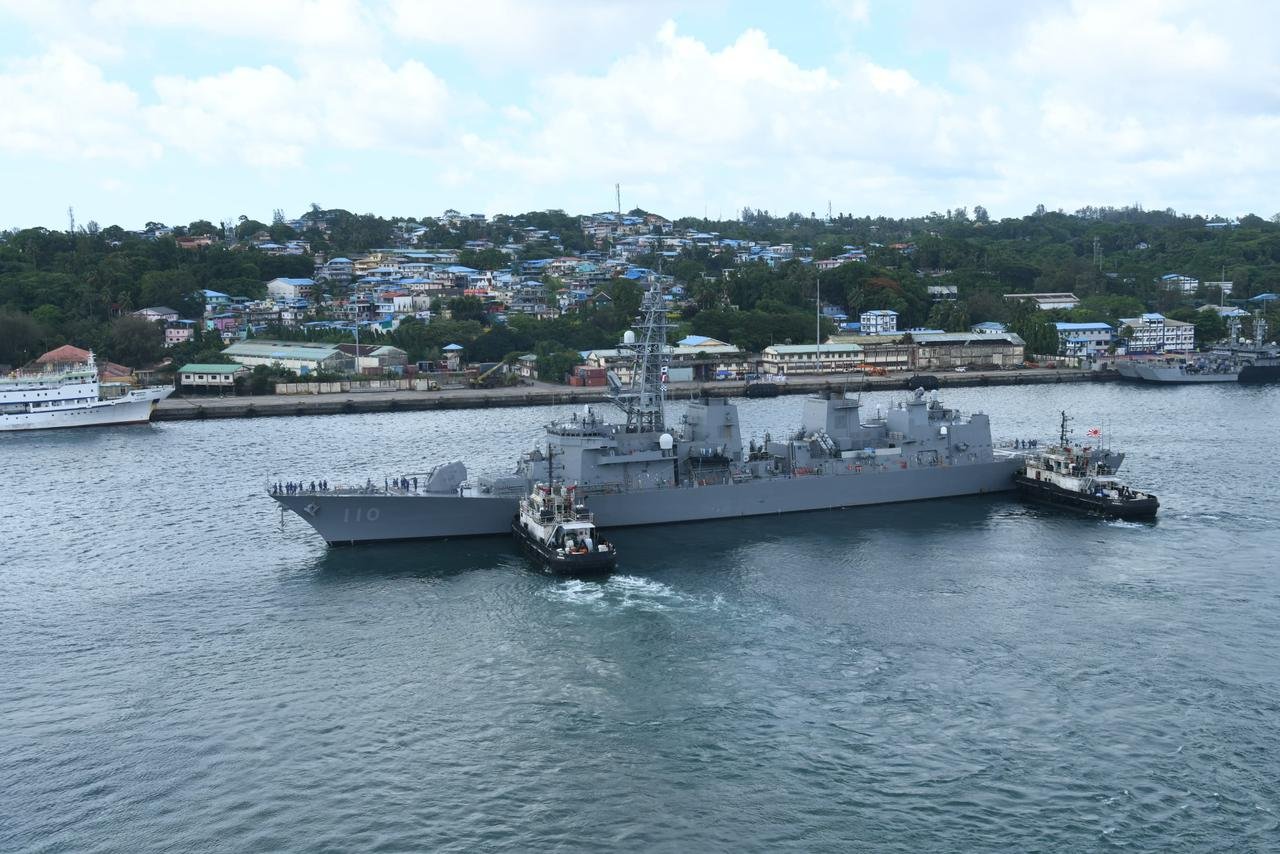
The Japanese Navy destroyer JS Takanami’s port call at Sri Vijaya Puram, highlighted the deepening strategic ties between India and Japan. The ship’s Commanding Officer, accompanied by Japanese Defence Attaché Captain Nakanishi Ryota, called on the Naval Component Commander of the Andaman & Nicobar Command, Commodore Nitesh Garg. In a warm ceremony, the two sides exchanged commemorative crests, symbolising the robust bilateral partnership.
The ship’s Commanding Officer, accompanied by Japanese Defence Attaché Captain Nakanishi Ryota, paid a formal call on the Naval Component Commander of the ANC. In a ceremony symbolising mutual respect and enduring partnership, the two sides exchanged commemorative crests. The Japanese crew further paid respects at the historic Japanese Temple in Gandhi Park, a site that evokes the complex shared history of the islands during World War II.
This visit is more than a routine goodwill mission. It reaffirms the critical role of the Andaman & Nicobar Islands, India’s easternmost outpost, in safeguarding maritime security across the Indo-Pacific. Straddling key sea lanes of communication (SLOCs), including the Six Degree and Ten Degree Channels near the Strait of Malacca, the archipelago oversees one of the world’s busiest shipping routes, through which nearly 40% of global freight and significant energy supplies transit.
Historical and Strategic Context
During World War II, Japanese forces occupied the islands from 1942 to 1945, making them the only part of British India under non-European Axis control. The Japanese Temple and remnants of bunkers in Gandhi Park stand as quiet reminders of that era. Today, these historical ties have evolved into a forward-looking strategic collaboration between two democratic powers.
Established in 2001 as India’s only tri-service command, the ANC has steadily and continuously enhanced its capabilities in surveillance, rapid deployment and joint operations between all three forces. It serves as a cornerstone of India’s Act East Policy and its engagement within the Quad framework.
Infrastructure Push and Future Plans
India is accelerating development in the region to bolster both economic and defence posture. The flagship Great Nicobar Island Development Project, valued at approximately ₹81,000 crore (around $9-10 billion), envisions a major international container trans-shipment terminal at Galathea Bay, a dual-use Greenfield airport, a gas-solar power plant, and township infrastructure. Implemented in phases over 30 years, the project aims to transform the southern island into a strategic logistics hub while balancing environmental and tribal concerns.
Japan has shown keen interest in supporting smart islands initiatives, including renewable energy, digital connectivity, and sustainable infrastructure, leveraging its expertise in island development.
As geopolitical competition intensifies in the Indo-Pacific, visits like that of JS Takanami send a clear message: India and Japan are committed to a free, open, and rules-based maritime order. With enhanced interoperability, joint exercises, and infrastructure synergy, the partnership is poised to contribute meaningfully to regional stability and maritime domain awareness.
Analysts view such engagements as essential in countering coercive strategies and ensuring secure SLOCs vital to global trade. The Takanami visit, though modest in scale, carries significant symbolic and operational weight in this evolving strategic landscape.

contact: drrajeshjauhri@gmail.com
Dr Rajesh Jauhri is a Journalist with an experience of over 25 years in Indian and foreign media, a Social Scientist, an Ac-complished Author, a Political & Strategic Analyst, a Marksman (Rifle & Pistol), an Orator, a Thinker and an Educationist. He holds a Ph.D. degree on “Impact of colonial heritage on Indian police”. He runs an NGO dedicated to the social and eco-nomic uplift of tribal communities in MP and two decades back, he established a school in a village of Indore district, providing education and moral values to children belonging to underprivileged and minority families. Has received multiple awards in various fields.