

New Delhi Correspondent
Indian Defence Minister Rajnath Singh concluded a productive round of high-level engagements in South Korea on May 20, 2026, reinforcing bilateral defence and strategic cooperation between the two nations amid evolving Indo-Pacific security dynamics.
Following bilateral talks with his South Korean counterpart, Defence Minister Ahn Gyu-back, the two sides signed key agreements covering defence cyber cooperation, university collaborations, UN peacekeeping operations, and enhanced cybersecurity information sharing. These pacts are expected to deepen trust and interoperability in emerging domains while building on established industrial ties.
The agreements expand upon recent initiatives such as the Korea-India Defence Accelerator (KIND-X), which focuses on co-development in air defence and autonomous systems. They also support the ongoing joint production of K9 Vajra self-propelled howitzers, a flagship programme under Make in India that has seen significant technology absorption and localisation by Indian industry.
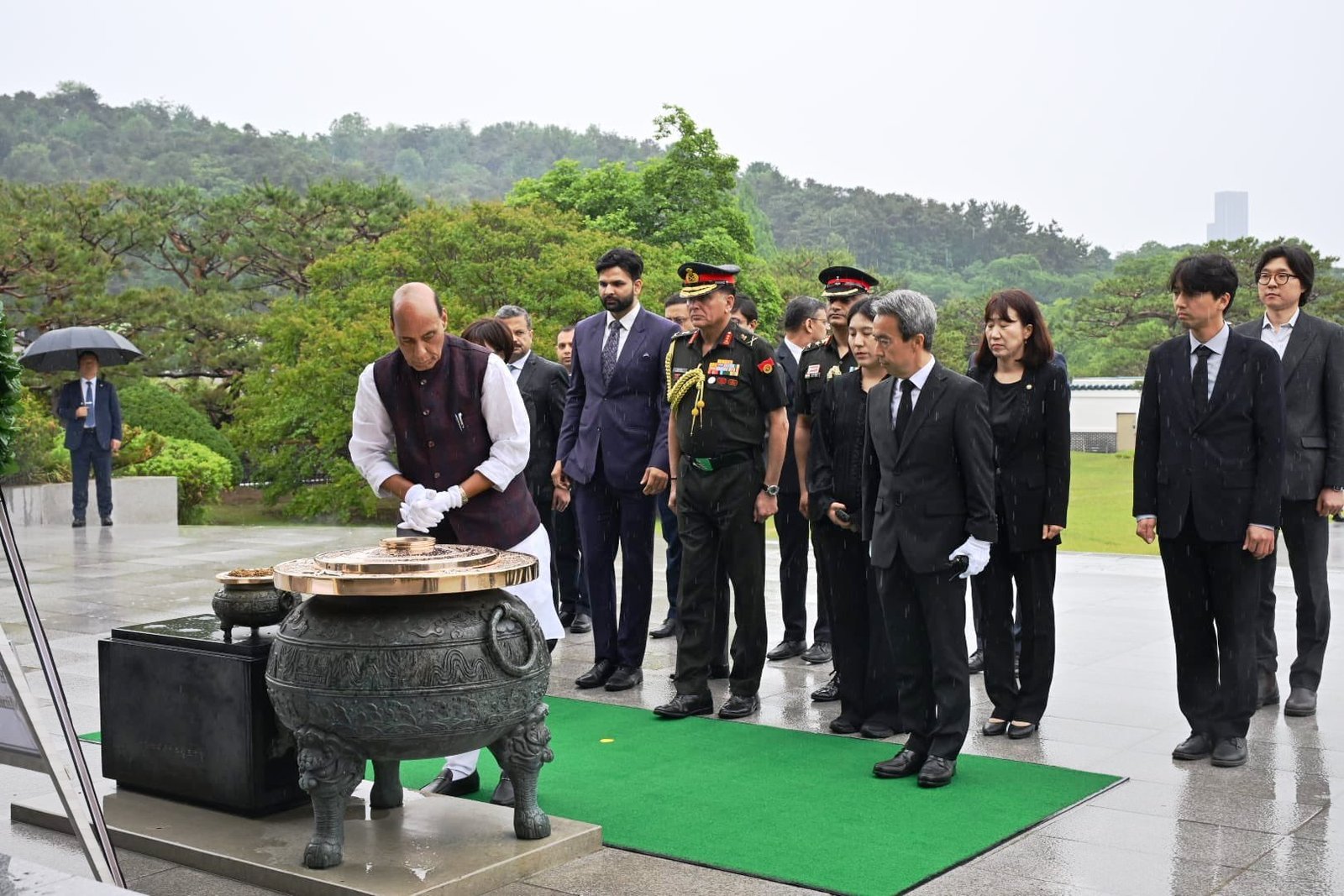
During his visit, Rajnath Singh laid a wreath at the National Cemetery of Korea, paying solemn homage to the Korean soldiers who made the ultimate sacrifice. In a statement on X, he noted: “Their courage, dedication and spirit of patriotism remain an enduring source of inspiration. India stands in solidarity with the Republic of Korea in honouring the legacy of its heroes.”
The gesture carries deep historical resonance, recalling India’s medical support to South Korea during the 1950-53 Korean War, when the Indian Army’s 60th Parachute Field Ambulance unit provided critical care and India played a neutral role in prisoner repatriation.
Describing the discussions as ‘highly productive,’ Singh emphasised the shared commitment to regional stability. Defence analysts view the visit, coming weeks after the South Korean President’s trip to India, as a strategic push to elevate the partnership beyond buyer-seller dynamics toward co-development and co-production in advanced technologies.
With both nations navigating complex maritime and technological challenges in the Indo-Pacific, the strengthened defence framework is poised to enhance deterrence capabilities, supply chain resilience, and joint contributions to global peacekeeping. Industry stakeholders anticipate accelerated progress on next-phase K9 Vajra orders and new collaborative projects in missiles and unmanned systems.
The developments underscore India’s calibrated approach to diversifying defence partnerships while advancing self-reliance. ‘Defence Chronicle’ will continue monitoring the implementation of these agreements and their operational impact on both armed forces.

contact: drrajeshjauhri@gmail.com
Dr Rajesh Jauhri is a Journalist with an experience of over 25 years in Indian and foreign media, a Social Scientist, an Ac-complished Author, a Political & Strategic Analyst, a Marksman (Rifle & Pistol), an Orator, a Thinker and an Educationist. He holds a Ph.D. degree on “Impact of colonial heritage on Indian police”. He runs an NGO dedicated to the social and eco-nomic uplift of tribal communities in MP and two decades back, he established a school in a village of Indore district, providing education and moral values to children belonging to underprivileged and minority families. Has received multiple awards in various fields.