



In an era defined by the pervasive threat of low-cost, first-person view (FPV) drones, armed forces worldwide are rapidly developing countermeasures that blend ingenuity with necessity. From the battlefields of Ukraine to flashpoints in West Asia, cheap unmanned aerial systems have inflicted disproportionate damage, prompting even resource-constrained militaries to innovate at the tactical edge.
Vietnam has recently showcased one such solution: an improvised anti-drone gun mount integrating six rifles on a single platform, equipped with integrated binocular sighting for visual tracking. Broadcast by Vietnam’s National Defense Television, the system mounts six Type 56 rifles, Cold War-era AK-47 copies, on a rugged metal frame with a centralized trigger mechanism. Designed for close-range engagement against fast, agile FPV drones, the setup emphasizes low cost, simplicity, and durability in austere environments. It repurposes older small arms being phased out in favour of more modern rifles like the Galil ACE, offering a practical, hard-kill option where sophisticated electronic warfare or missile systems may prove too expensive or logistically demanding.
The design reflects lessons from ongoing conflicts. In Ukraine, similar multi-rifle improvisations, including six AK-74 mounts, have appeared as stopgap measures against swarming FPV threats. Russia and Ukraine have both suffered significant equipment and personnel losses to drones, with reports indicating thousands of systems expended monthly and drones accounting for a substantial portion of battlefield casualties. In West Asia, Iranian-supplied Shahed-type drones have challenged even advanced air defences, underscoring the vulnerability of high-value assets to massed, inexpensive UAV attacks.
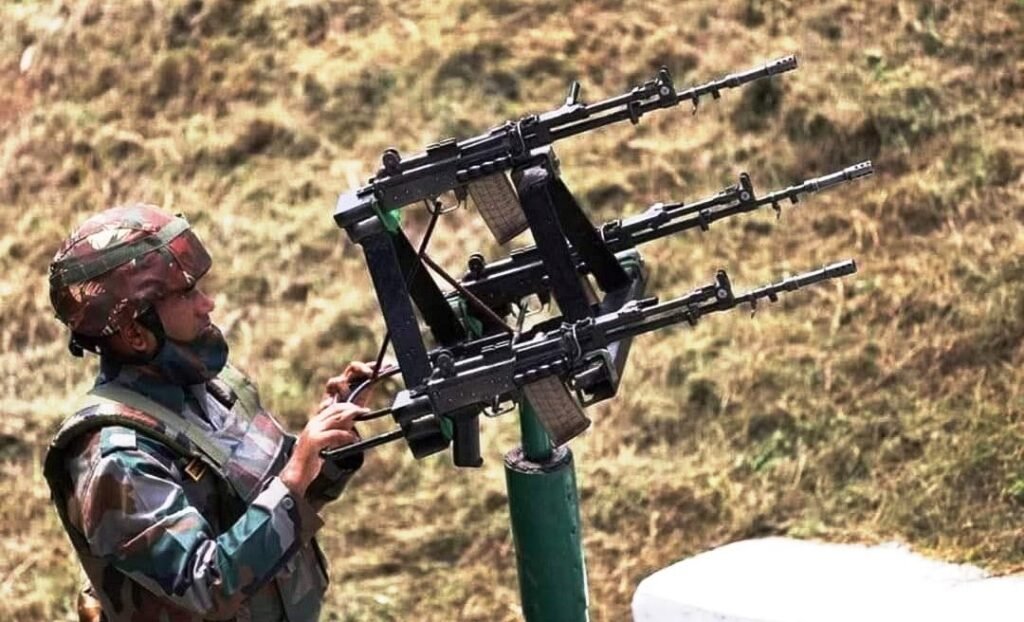
India, too, has explored comparable ‘Desi Jugaad’ solutions. The Indian Army has tested anti-drone configurations featuring multiple INSAS 5.56mm rifles mounted on anti-aircraft platforms. These efforts, alongside quad-mount Negev light machine guns and other hybrid systems, demonstrate a focus on volume of fire to counter low-altitude threats along sensitive borders. Such innovations highlight a broader trend: when facing asymmetric aerial threats, creativity and field-level adaptation often prove as valuable as cutting-edge technology.
While these multi-gun mounts are not precision solutions and face challenges in sustained fire, ammunition management, and accuracy against evasive targets, they provide an immediate, affordable layer of defence. Military analysts note that they complement rather than replace layered systems, including jammers, directed energy weapons, and dedicated counter-UAS platforms.
As drone warfare evolves, the ingenuity displayed by Vietnamese and Indian forces serves as a reminder that effective defence need not always rely on billion-dollar budgets. In the FPV era, the ability to improvise quickly may prove decisive on tomorrow’s battlefields.

contact: drrajeshjauhri@gmail.com
Dr Rajesh Jauhri is a Journalist with an experience of over 25 years in Indian and foreign media, a Social Scientist, an Ac-complished Author, a Political & Strategic Analyst, a Marksman (Rifle & Pistol), an Orator, a Thinker and an Educationist. He holds a Ph.D. degree on “Impact of colonial heritage on Indian police”. He runs an NGO dedicated to the social and eco-nomic uplift of tribal communities in MP and two decades back, he established a school in a village of Indore district, providing education and moral values to children belonging to underprivileged and minority families. Has received multiple awards in various fields.