

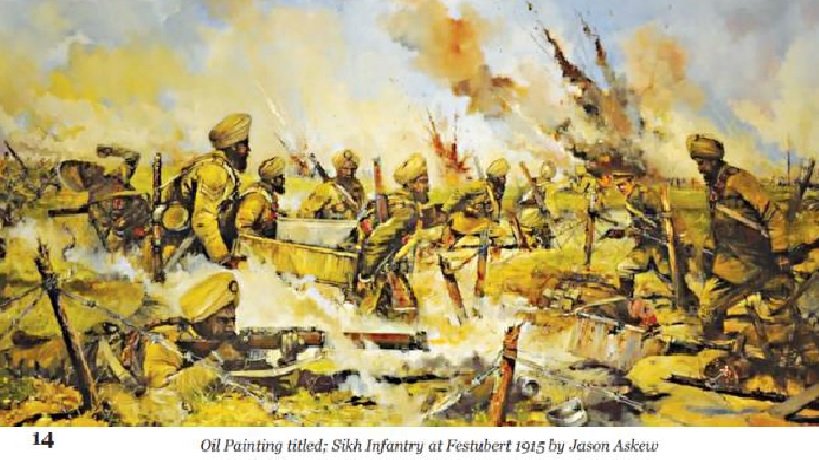
In the annals of military history, few actions capture the raw courage, regimental pride, and unyielding devotion to duty as vividly as the desperate resupply mission undertaken by a handful of Sikh and Punjabi soldiers on 17 May 1915. Amid the horrors of the Western Front during the Battle of Festubert, ten men from the 15th Sikhs and attached units braved a storm of fire to sustain their comrades, writing one of the most gallant chapters of the First World War.
The 15th Sikhs (now the 2nd Battalion, The Sikh Regiment), part of the 3rd (Lahore) Division’s 9th (Sirhind) Brigade, had seized a section of a German trench near Richebourg l’Avoué as part of the northern pincer of the British offensive. The situation was dire. The trench was barricaded with the bodies of the fallen, the air thick with an unbearable stench. Ammunition was critically low. Attempts by British units to bring up supplies from reserve trenches just 250 yards away had failed twice, with officers killed and parties decimated.
Only a high-risk operation could prevent the position from being overrun. Lieutenant John Smyth of the 15th Sikhs was tasked with leading a bombing party. What followed was an act of extraordinary bravery that would earn Smyth the Victoria Cross and etch the names of his men into the regiment’s immortal legacy.
Through Mud and Fire
Volunteers surged forward. Smyth eventually selected ten men, choosing largely by size and strength for the arduous task of manhandling heavy boxes of bombs across no-man’s-land. The party comprised:
– Lance-Naik Mangal Singh, Sepoys Lal Singh, Sucha Singh, and Sampuran Singh of the 15th Sikhs
– Sarain Singh, Sundur Singh, Ganda Singh, and Harnam Singh of the 19th Punjabis
– Fateh Singh and Ujagar Singh of the 45th Sikhs
With the Sikh battle cry “Jo Bole So Nihal, Sat Sri Akal” ringing out, the men dropped over the parapet, dragging two boxes containing 96 bombs (Grenades). Using their Pagris (turbans) tied to the boxes, they crawled, pulled, and pushed through the churned mud and over the corpses of the fallen, all while exposed to intense rifle, machine-gun, and shrapnel fire.
The toll was immediate and relentless. Fateh Singh fell severely wounded within the first few yards. Further on, Sucha Singh, Ujagar Singh, and Sundur Singh were cut down. As the survivors neared the British lines, Sarain Singh and Sampuran Singh were killed, while Ganda Singh, Harnam Singh, and Mangal Singh were wounded. One box had to be abandoned. Lieutenant Smyth and Sepoy Lal Singh pressed on, wriggling yard by yard under a hail of bullets that perforated their clothing yet miraculously left them unscathed at that moment.
Upon reaching the cheering defenders, their relief was short-lived. Lal Singh was struck and killed instantly shortly afterwards. In the end, every member of the party became a casualty. Once again, as at Saragarhi in 1897, an entire Sikh detail had perished executing what many considered an impossible task.
A contemporary report in Melbourne’s *Leader* newspaper captured the scene vividly: “Attaching their puggarees to the fronts of the boxes, the men pulled them over or through the dead bodies, all of the party lying flat on the ground. At any moment the bombs in the boxes might have exploded, for the whole of the ground was hissing with the deluge of rifle and machine gun fire, while the air was white with the puffs from bursting shrapnel.”
Recognition and Legacy
Lieutenant John Smyth received the Victoria Cross for his leadership. Lance-Naik Mangal Singh was awarded the Second-Class Indian Order of Merit, while the Indian Distinguished Service Medal was conferred collectively on the sepoys of the bombing party — only the second such collective award after Saragarhi. Many observers at the time and since have argued that the Indian soldiers deserved even higher recognition, yet for these men, duty and the *izzat* (honour) of the regiment transcended personal glory.
The 15th Sikhs carried a formidable battle record into the First World War, forged through campaigns in China (1860–62), Afghanistan, Sudan, Chitral, and Tirah. In 1914–18, they fought with distinction on the Western Front, in Egypt, and Mesopotamia. Today, their direct successor, 2nd Battalion The Sikh Regiment, upholds this legacy within the Indian Army — an institution renowned globally for its battle-hardened heritage, rigorous training, and unwavering motivation.
As Major General Harvijay Singh (Retd), SM, poignantly reminded in his account, these stories must continue to be told: “Lest we forget.” In an era when the world reflects on the sacrifices of the Great War, the actions at Festubert stand as a powerful testament to the universal values of courage, comradeship, and selfless service — qualities that continue to define the modern Indian Armed Forces and the Sikh Regiment’s storied history.
The men who crawled through the mud at Festubert did not seek fame. They answered the call of duty in the spirit of Guru Gobind Singh’s timeless words: those who wish to play the game of love, come with your head in your palm. A century later, their gallantry remains undimmed.
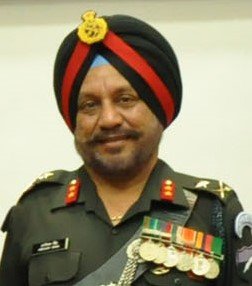
Major General Harvijay Singh is a third-generation officer, his two sons are also army officers.
He holds degree of B.Tech. and Master’s Degree in Management Sciences. He is a Certified Ethical Hacker and Cyber Forensic Investigator.
He is Member and Historian of the Punjab Military Literature Society, Chandigarh.
He has written books on Indo Pak Wars: 1948, 1965, 1971 – ‘Battles That Made History’, ‘Indo Pak War 1947-48’ (for Part D) and ‘Gallant Soldiers: Short Stories of Big Deeds’. He has also written Monographs on Grey Zone Warfare and Lessons Learnt from the Ukraine War. He is a regular contributor to Magazines on Military Strategy and Technology and a speaker on current Global Military events.
He is the winner of ARTRAC Scholar Warrior Badge for writing on Contemporary Military Thinking and Strategy.